All the Dramas

Between Burghley, Fair Hill, and Pau, I feel like it’s been a particularly dramatic fall season for eventing. The sport is in the spotlight in a way it really hasn’t been before, and everything is on public display. Hopefully that will be for the overall good… time will tell. I am a fan of upper level sport, so I sure hope so. In the mean time, it’s led to a whole lot of chatter.
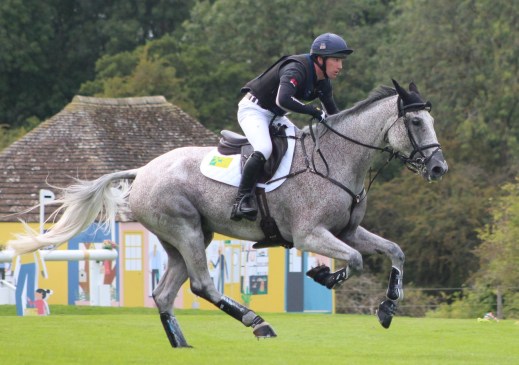
OllieBurghley
Miss you Ollie, errrr I mean… Burghley. Miss you BURGHLEY. Ahem.

Anyway, we already talked about Burghley a little bit so I won’t go into all that again, but I’m interested in some discussion about Fair Hill and Pau.

The big thing at Fair Hill, of course, was the flag penalties. A new FEI rule for this year, riders can be assessed 15 penalties when:

“A Horse is considered to have missed a flag if the
Horse jumps the dimension of the obstacle and the majority of the Horse’s body
(as defined above) passes through the flags. This means that some part of the
body is not inside the flags (e.g. one shoulder, or one shoulder and part of one
hip).”

As may be a surprise to precisely no one, this rule has been super confusing in it’s actual application all year. There’s even a very lengthy explanation with pictures and a flow chart here. The first time we saw it used in the US was at Kentucky with Will Coleman and Tight Lines, which led to mass confusion and a lot of disagreement. A few days later the FEI released a clarification which included the following:

The Eventing Committee has agreed that the following considerations must be taken into account when judging the run-out /flag situation on Cross Country:

1.    The Fence Judge is responsible for taking a decision as to a penalty to be awarded to the combination

2.    Knocking down a flag will not entail an automatic penalty

3.    The Ground Jury will only review any specific requests for clarification made by a Fence Judge or an Athlete after the penalty has been awarded

4.    Video reviews should be done immediately by the TD and/or GJ if there is a doubt, not left until after the XC so scores can be published and updated during competition

5.    When reviewing a video, it must be easy to decide if the horse is inside the flags, if it is necessary to review several times, the decision should be made in favour of the rider.

6.    As always if there is a doubt give the benefit of the doubt to the competitor.

7.    15 penalties on Cross Country will maintain the MER on Cross Country

Image result for fei logo

At Fair Hill 4 of these penalties were assessed, two of which went to horses that would otherwise have been first and second after cross country. Kind of a big deal.

I know that at least one of these was not put up in the scoring system until hours later, because I was watching the scores and saw it myself. I was surprised by this, considering the above FEI clarifications regarding the timing of the penalties. The real controversy though, came over whether or not the penalties were warranted, or if the guidelines were correctly followed. Doug posted footage on his facebook page that spurred a lot of discussion, as did Will Coleman. Neither of those are considered official video evidence, therefore can’t be taken into consideration, but… they do a good job of casting doubt on the 15 penalties.

To me they’re tough calls. Did the horses’ hips and shoulders pass between the flags? Were the penalties given in a timely manner? Was the benefit of the doubt given to the rider? I’ll be honest, I’ve seen a few instances where people have been much more deserving of 15 penalties at internationals this year and they were not assessed. So – is the rule being applied consistently and fairly across the board? The spirit of the rule is really meant to be addressing the intent of the horse – did they INTEND to jump the jump with their entire body, or did they try to evade and only get partway over – in which case are the penalties really being applied following the spirit of the rule?

Moving on to Pau…

how tf did we not have any 15pp controversy at Pau? There were so many skinnies and corners. 

I’ll be honest, I’m a bit incredulous over the fact that the biggest drama to come out of Pau is surrounding Jack Pinkney and his broken rein/eventual fall/reaction to said fall. For those that missed it, Jack’s rein broke (further back in the rubber part) around fence 10, and he managed to jump most of the course that way before having the rein pulled out of his hand at fence 27, resulting in his horse careening into, and trying to jump, a giant decorative wall. The horse bounced off it, Jack came off, and then he proceeded to throw his whip and air vest on the ground and appear to have a bit of a temper tantrum before his horse was caught and brought back to him.

Was it scary? You bet. Maybe, in retrospect, trying to jump a 5* course with a broken rein wasn’t the best idea. To be fair to Jack, as soon as the horse was brought back to him he immediately set to checking him out and offered no signs of anger toward the horse. He also immediately took himself to the stewards to own up to his mistake and issued a public apology admitting he was wrong. While he didn’t handle the situation well at the time, he was all class in the aftermath. I have to give him credit for that. Otherwise, I really only have 2 thoughts on this one:

  1. Honestly, this is kind of what happens when we glorify things like people riding an entire course with broken equipment, be that a missing stirrup or a flapping breastplate or a broken bridle or whatever. It’s happened before, plenty of times, often becoming the stuff of legend. When it ends well, we talk about how amazing someone is and what a great job they did to get the job done despite the adversity. When it doesn’t end well, we vilify the person for making a dangerous, unsafe choice. Maybe we (the collective “we”) should pick a stance on this.
  2. I’m relatively convinced that his horse read that wall as a brush fence or a bullfinch, with how he tried to jump it. He clears the bottom section of the wall but almost looks as if he’s expecting to brush through the top. Would make sense if he’s been out hunting. Either way, how honest is that guy, what a trier. Glad he’s ok.

Jack drama aside, to me the real issue at Pau (that I haven’t really seen anyone talking about) is what happened in the last water.

Three horses fell at this combination, completely unrelated to either fence. I saw at least two other horses stumble in the same spot where the other three fell, which was past the log but before the skinny, near the entrance to the water. Was there something going on with the footing here? Was it a lighting thing where horses weren’t reading the water? Was there something about those 3 rides in particular that led to the horses having trouble? I don’t know, but 3 falls and at least two other stumbles in the same location, one of which led to a broken shoulder that was ultimately that horse’s demise, raises red flags for me.

We can’t control broken tack, or how people react when things go wrong. But we can control courses, and footing, and design. Why are we not talking more about THIS part? What happened there? Was it just a freak thing that at least 5 horses had trouble in the exact same spot, or was there an identifiable reason? If so, what was it?

Let’s discuss!
The Tooth Fairy

I feel like there have been a lot more horse teeth in my life lately than one would typically want. The first one was kinda cute, Presto shed his first front incisor (apparently he’s reading the book, since that’s supposed to start around 2 1/2 and he’s bang on time), which presented as a hilarious snaggletooth for a few days before he finally lost it somewhere. Considerably less cute was Henry’s broken molar.

img_9478
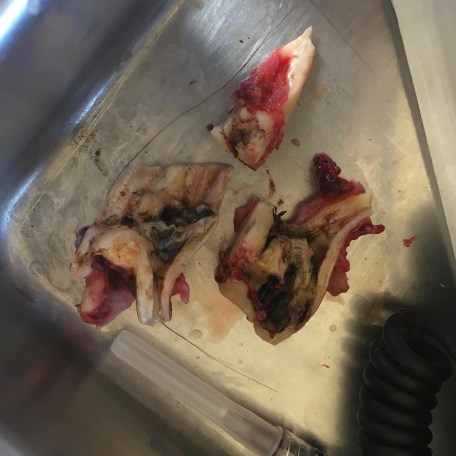
It’s not good when even I can see it

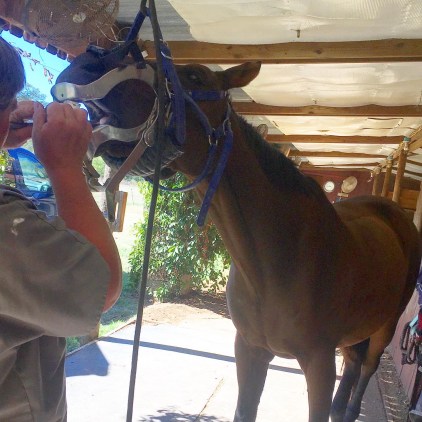
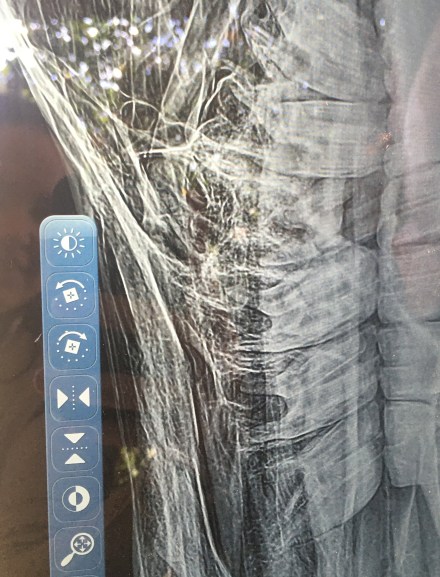
I had been seriously dreading this. The vet noticed the broken tooth when we touched up Henry’s teeth this summer (his jaw is slightly mis-aligned, so he needs dental every 6 months). It wasn’t emergency level broken, but it was “this needs to come out soon” broken. Ugggggghhhh I hate tooth stuff, it’s too close to the (admittedly teeny tiny) brain. I didn’t want to do it when it was still 110 degrees, since Henry has a higher risk for hyperthermia type side effects with lots of sedation, and I wanted to wait until he was settled at the new place before we added more stress. So last weekend we took the x-rays, to make sure my vet felt pretty confident he could get it out without too much trouble. If it was shattered, or particularly fragile, or the roots had broken away,  he would have referred me to the very fancy dental specialist guy and it would have been a much bigger deal that required a lot more digging and time and specialized equipment. Luckily we saw two distinct pieces, possibly three, and he felt pretty sure that he could get it all pretty easily.

The extraction appointment was this past Saturday, and y’all… it was gross. As soon as the vet started poking at that tooth and wiggling it (it was already loose) that disgusting rotten tooth smell floated from his mouth. Gag. That is one of the worst horse smells possible. I had to hold his tongue for a while and my hands smelled like it. I’d rather be elbow deep in horse placenta for hours than get a single whiff of rotten tooth.

Henry did not go down without a fight so we had to sedate him twice before he acquiesced to having a bone yanked out of his head. Once he stopped fighting it went relatively quickly, and the first broken chunk popped out. The tooth was split almost down the middle, and you could see where food material had gotten down into the crack and was basically composting. Yes, the tooth was literally stuffed with rotten food, which is where the smell was coming from. Hope no one is reading this while eating their breakfast.

Once the first half was out, the second half came pretty quickly. As it was removed it broke, but luckily it was already far enough out at that point so nothing was left behind. Luckily there was no sign of underlying infection, and there seems to be no communication with the sinus.

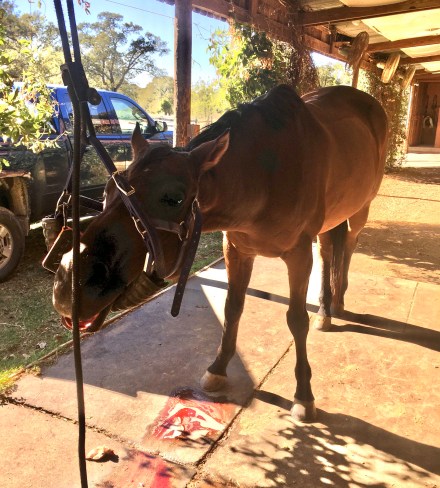
Henry, even in his drunk state, immediately started shoving his tongue in the hole. We tried to plug it but that lasted all of about 10 seconds before he worked it out. Tried again, same thing. Given how busy he is with his tongue all the time, I wasn’t very surprised. He came out of the sedation well, and it stopped bleeding pretty quickly, although he did get it started again a couple times because he just wouldn’t quit messing with it.

img_9654
He’s an angry drunk

We got him cleaned up and I watched him for a bit to make sure he was ok. Aside from continuously sticking his tongue into the hole, he seemed fine. He got to eat his dinner a few hours later, and on Sunday he was back to normal.

Of course, if there are going to be complications, many of them won’t show up for a little while. Since he wouldn’t leave the plug in, we’re flushing his mouth out twice a day (which Henry calls “waterboarding”) to try to keep too much debris from ending up the hole. Otherwise we just have to wait and see and hope it heals without issue. I’m mega paranoid. I’m probably gonna be mega paranoid for months.

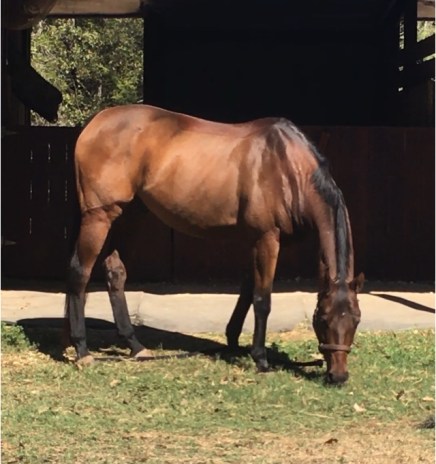
still a very effective lawnmower

The vet will be back out on Friday to recheck, so hopefully all still looks good by then. I’ll definitely be riding him in his sidepull for a while, until I’m sure that his mouth has fully healed. Hopefully he’ll be more comfortable without that gross broken thing in there, once his mouth is healed up.

Presto is scheduled to have his wolf teeth removed over the winter, which will cause a whole new round of worrying and paranoia on my part. Horses. Teeth. Gah.

It’s In the Blood: Fair Hill 2019

The final Fair Hill 4* is officially in the books – the end of an era, but also the beginning of a new one. Next year I’ll have yet another group of 5* horses to rifle through and overanalyze… my favorite things!

Image result for fair hill international

This field proved to be a good one, and particularly exciting if you are a thoroughbred fan. We had 14 full thoroughbreds, and another 7 horses who had at least one full thoroughbred parent. Plus, a TB won. I think that means we should start with them!

If we confine our digging to the first few generations, there are a couple TB stallions that show up more than once. Silver Deputy is the sire’s sire of one horse and the damsire of another. AP Indy, who we saw a lot of in the YEH field, is the sire’s sire of another horse here. Same for National Anthem – he was the sire of two YEH horses and is the sire of another in the 4*. The European based TB stallions Imperious and Heraldik both show up twice. Mr Prospector shows up 4 times and Buckpasser 3 times. But if you go back a little farther, the real standout here is (and not for the first time) Northern Dancer. He’s in an incredible 11 horses, through a variety of different offspring. Direct ND sons Sadler’s Wells, Danzig, Vice Regent and Nijinsky II make multiple appearances. Our winner, Paddy the Caddy, himself carries a triple dose of Northern Dancer.

Image result for northern dancer
Northern Dancer

Other sires with multiple representations within the first few generations are Contender, Courage II, Cruising, Puissance, Animo, Clover Hill, and Voltaire. All jumping blood, and none of those names should be unfamiliar by now if you’ve been reading these posts. Puissance is by the stallion Imperious xx, who is also the sire of the legendary Master Imp xx. Holsteiner stallion Capitol shows up in the sire’s sire position three different times, through sons Cassini II, Capitalist, and Courage II. We’ll circle back to that.

Personal favorite – Mighty Magic – had one offspring in the field, and although I’m not officially covering the 3* horses, he had two more there (both finished in the top 10).

Despite being a field overwhelming dominated by thoroughbred and jumping lines, dressage stallion Sandro Hit does have some representation as the damsire of QC Diamontaire (by Diarado). Of course, Sandro Hit himself does have strong jumping blood via Sandro, Gepard, and Ramiro. So… ya know. Maybe not a surprise that they can jump, especially when he’s crossed with more jumping blood.

Image result for sandro hit stallion
I will never forget when we saw Sandro Hit in Germany and the farm worker described him as “the lights aren’t always on upstairs”.

One of the most exciting figures from this group, for me anyway, is that 48% of the horses were bred in North America. That does include most, but not all, of the thoroughbreds.

If you average the entire field (including all the full TB) the blood percentage is 68%. If you take out the full TB’s, the average blood percentage is 51%.

Looking at the results side of things, the top 5 horses after dressage only included one full thoroughbred (Business Ben, one of my favorite up and coming horses at the moment). There were only four double clear XC rounds: Palm Crescent xx, Fernhill Fortitude, BGS Firecracker, and Lancaster. Their blood percentages range from 33% to 100%. Double clear showjumping rounds were easier to come by, with 12 horses managing to add nothing to their score in the final phase. Two of those were full TB’s, and the average blood percentage of the other 9 was 46.2%.

Image result for capitol i stallion
The unofficial winner of Fair Hill? Capitol.

Only two horses finished on their dressage score – BGS Firecracker and Fernhill Fortitude. Interestingly, the sire’s sire of both horses is Capitol, via Courage II for Fernhill Fortitude and via Capitalist for BGS Firecracker. Even MORE interestingly, BGS Firecracker’s damsire is also Courage II (which yes, makes him double Capitol). If you remember back to Burghley last month, Courage II had two offspring finish in the top 15 there. You will never convince me that bloodlines don’t matter!

Did anyone else have any favorite horses from Fair Hill? Who do you think will be back next year to contend the 5*?

The Fluffy Experiment

As you may recall, I went on a quest a few months ago to find a saddle pad solution that would work for Captain Sensitive. Er, Henry. I’ve had problems on and off over the years with different pads rubbing him in different places, but this summer in particular everything I had seemed to irritate him somehow. I decided, somewhat desperately and very hesitantly, to try the sheep route. Natural fibers and plenty of protection for sensitive skin – maybe that would be the key?

img_8967

This was not my first foray into the world of fluff. Way back in my hunter days (a separate lifetime, really) I had some Fleeceworks stuff. I thought it was kind of a PITA to take care of, but that could be because I’m kind of a garbage human in general and non-living things that require a lot of special or particular care will probably not fare well with me. Granted, I’ve gotten a little better about that with age. BUT, if Henry would be happier in a fluff-covered world, I was willing to give it a go again.

The real problem was trying to decide how to choose what to get. Back in the day there weren’t really a TON of options or brands. These days – you dream it, you can find it, or you can have it custom made. The first order of business: did I want sheepskin or did I want wool?

Image result for sheepskin difference wool

With sheepskin, the wool is still attached to the skin of the sheep, and that’s sewn onto the pad. With wool, it’s been sheared from the sheep and woven onto a fabric backing. Not really sure which I would prefer, I scoured the internet to see what other people had to say about the two. The general consensus was that sheepskin tends to be more dense, which makes some people think it offers better shock absorption, but that it was harder to clean. Since the skin of the sheep is still attached, you kind of have to think of it as a leather item, which requires special care when washing. With wool, since it’s attached to a fabric backing, it’s easier to wash and care for. Some people also prefer the fact that a sheep didn’t have to die to make the wool. And it’s cheaper. Both sheepskin and wool are touted for their excellent wicking abilities, superior airflow, and comfort. So basically – did I want it still attached to the skin, or not?

There are other factors to consider, too, of course. Do you want the spine of the pad to have wool or not? Some claim that having wool over the spine can make the pad bind on the horse’s back, where others claim that NOT having wool on the spine leaves seams that could rub or create pressure points. This is the point in your research where your head starts to spin and you wonder if the wisdom of the internet is a blessing or a curse. As with all things horse, there are many ways to do the same thing and everyone thinks their way is best.

I also had to decide if I wanted to have the ability to add shims to the pad, to adjust the fit of the saddle if needed. Henry is older and maintains a steady shape, and his saddles fit him well (important to note: they were fitted to him specifically to allow for a half pad underneath). But Presto is a bit narrower and may require some shimming to make my saddles work for him.

img_9329
shim pockets

And THEN, after you figure all that stuff out, you get to decide whether you want said fluff on a half pad or on a full pad. And if you want rolls or no rolls on top. And how far down you want the fluff to go. And how much you want to pay for it. And what colors you want. And who you want to buy it from. So many options.

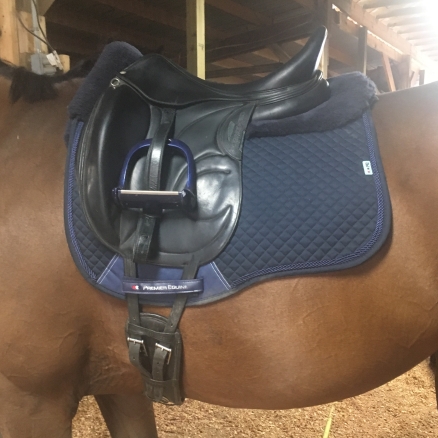
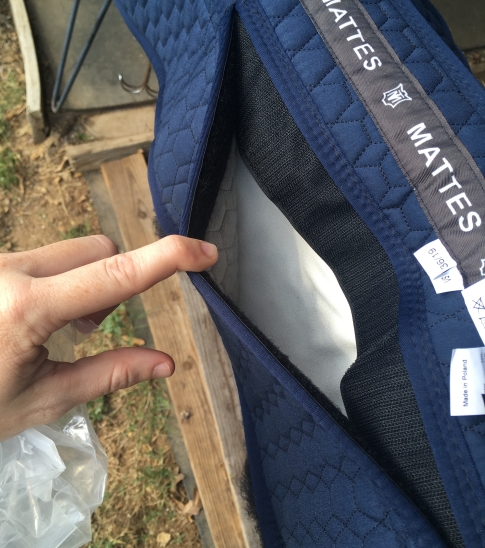
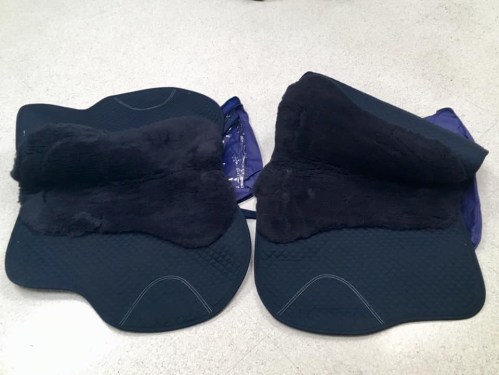
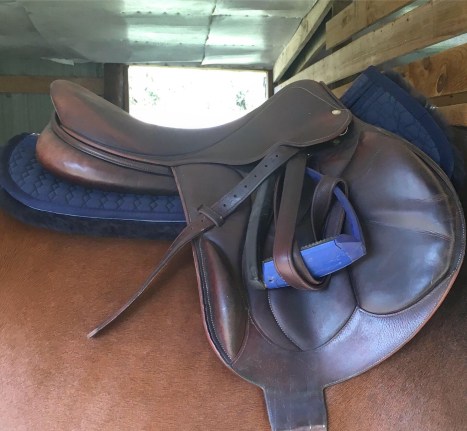
In the end I just couldn’t really make up my mind, because it’s tough to know what your horse will prefer until you try different things. Plus I have two horses to consider, and knowing my luck they’ll probably like different things. I also have two saddles, a jump saddle and a dressage saddle. So I bought a couple of Premier Equine merino wool full pads (wool, covered spine, no shim options) – one dressage and one jump – and a Mattes half pad (sheepskin, clear spine, with shim pockets). I got that one in an XL jump shape so that I could still use my dressage saddle with it and everything would sit ok underneath. All bases covered. Or… no actual hard decisions made, since I got a little bit of everything.

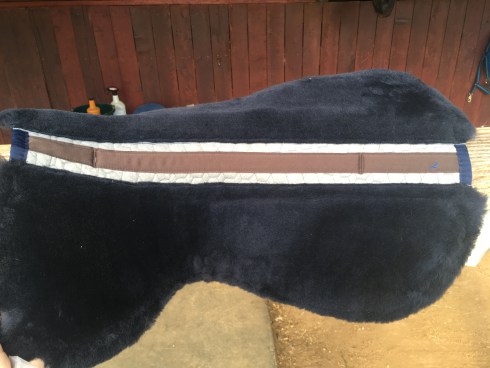
underside of the Premier Equine pads

Well ok I did make ONE decision – navy. Everything navy. Color is the easiest part.

I’ve been using all of them, trying to get a feel for how they compare and what I think of the different designs and wool vs skeepskin. I remain convinced that it’s an entirely personal choice. The Premier Equine pads, with their merino wool, are definitely a lot easier to take care of than I thought they would be. My memories of taking care of my sheepskin pad back in the day were not very fond, but these have been pretty easy. They don’t get gross very fast, because the horse’s back stays so much cooler under them. I’ve only washed them once so far, and that was this week.

If we put them in a head to head comparison, I think they both have their pros and cons. For ease of care and wash, the nod would go to the merino wool. I tossed them in the wash with nothing special and they came out looking new again. Granted, neither the sheepskin or the merino wool gets gross very fast, because the horse’s back stays so much cooler and drier under them. I would also give a very slight nod to the merino when it comes to breathability, I have noticed that Henry’s back is ever so slightly drier under the merino than the sheepskin. As to the shock absorption factor, I definitely feel that both of them do absorb some impact, but I don’t notice a difference between the two.

If you’re looking for luxury, sheepskin wins. The material just FEELS expensive, and really soft. They’re both soft, but sitting right next to each other the skeepskin is clearly more luxurious. The merino wool is more coarse to my own hand, although I haven’t noticed any difference in how Captain Sensitive feels about one vs the other. I also haven’t noticed a difference in how he feels about the wool covered spine or the clear spine – he seems to have no preference. I like the idea of the wool covered spine more, just because any “disruptions” to the surface of things that are touching him have generally been a problem, but in this case I can’t say that I’ve seen anything to actually back up my theory. Without a doubt though, Henry has had ZERO rubs or skin irritation since I swapped to the fluffy pads, both seem to have done the trick.

Both pads also have good wither clearance, which is very important. If you have an exceptionally high withered horse I might be inclined to go with the clear spine, so the pad sits a bit further up off the wither. For longevity, I can see the sheepskin lasting a bit longer too (uh… assuming I don’t accidentally destroy it in the wash…). The merino wool, being attached to a fabric backing, does shed a little bit whenever it’s brushed or washed.

The care hasn’t been as hard as I had imagined. Like I said, they don’t get gross very quickly. I just hang them upside down in the tack room so they can dry between rides, and once a week or so I brush out the fluff with a slicker brush. The sheepskin/wool is actually a lot easier to keep clean than the cotton parts!

There was, of course, a massive price difference between the two. I paid $108 for BOTH of the Premier Equine pads (on sale, with a coupon code), making them $54 each. The sheepskin Mattes half pad was $140 on it’s own, and that was from Australian company Hufglocken, who definitely has the best prices on Mattes (and always has coupon codes too). The same pad from an American shop would have been closer to $300. The construction of the Mattes is clearly superior, as you would expect from the price difference, and they can make just about anything you can possibly dream up. The options on the Premier Equine pads are many fewer (and sadly I don’t like most of their color combinations), and none are shimmable, and they don’t have any customization. The Mattes took longer to get, of course, being a custom order and then having to go from Europe to Australia to the US. It was a couple months all total. The Premier Equine pads made it from the UK to my door in just a few days. Of course, these aren’t the only two brands on the market either… there are LOTS, with all kinds of different options.

To me there’s not a really super clear winner between the two. I think it depends on you and your horse, and what you want from the pad. I actually really love having both, because between the two designs I feel like pretty much all of my possible needs are covered. Each has it’s perks, and their own pros and cons. Overall though, I’m pleasantly surprised by how much I’m liking my fluffy pads in general. I was scared to take the leap, because of the care, but they’ve been much easier than I thought and Henry really seems to like them. I will be buying more, since I want show pads too.

I’ll do a separate review of just the Mattes pad by itself soon, with more details about it and all of the possible options. Until then, hopefully this helps anyone who’s thinking about going the fluffy route themselves. I don’t regret it!

It’s OK to just… Not

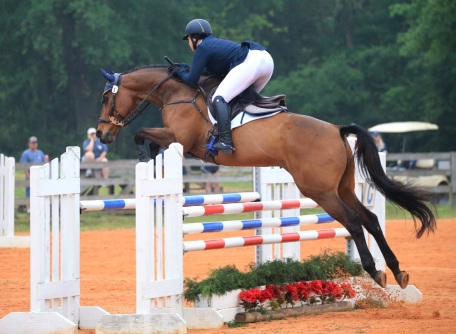
I only did 2 recognized horse trials this year. In the grand scheme of things, that’s… certainly not a lot. Especially considering that a lot of people do that many shows per month. I kind of expected to reflect back on that figure and feel a bit “disappointed”, but truth be told, I’m not.

PHrecPrelim2

Sometimes I have major FOMO when I see other people showing all the time, all season long. Sometimes I stalk the online scores, look for any pictures and videos I can find from the show, and check all the course walk sites to try to get an idea of the courses. And then other times, I just kind of look at everyone’s posts from the show and think “good for them” and keep right on scrolling. That’s it, no FOMO, and I don’t particularly feel driven to follow that closely. Because, to be honest, sometimes it just feels nice to take a step back from it all and take a deep breath.

I feel like we don’t often really see that side of other people though. Nobody gets on Facebook or Instagram to talk about their long breaks, how few shows they’re doing, how they’re taking some time to fill the holes at home, or that they just plain want to slow everything down and reconnect with their horses again. All we really see, and what we seem to be conditioned to crave, are the show pictures and show results… the glossy glamorous exciting stuff. We’re impressed by that, and we want pretty show pictures and results of our own.

img_9575.jpg

It almost leaves you feeling guilty or like you’re doing it wrong if you aren’t following suit. If you aren’t showing 10 or 12 or 20 or however many times a year it takes to make you “serious”. If you’re not always looking onward to the next show. If your life isn’t constantly consumed by the next jump lesson, the next XC schooling, or trying to perfect that one elusive dressage movement that you just can’t seem to score above a 6. People start asking you where you are, and when your next show will be. If they don’t see you on the entry list, they tend to ask you what’s wrong. Because surely something must be wrong if you aren’t out there at all the shows, right? As if life’s rhythm is dictated by the show season.

A lot of the time, I’m totally ok with that. I love showing, I enjoy it, and it’s fun. Most of the time I do live that lifestyle, consumed by progress and what’s next. But also… it’s not the be all, end all for me. For some people it is, 100% of the time, and that’s fine, but for other people it isn’t. When I start feeling a little burned out or like I want to step back and re-center myself, I often find myself looking at other people and wondering why they never seem to feel like that. How they can go from show to show to show and never want a break, and why I seem to be wired “wrong” compared to so many of my peers. I try to light the competitive fire under myself, or look for shows to sign up for. Sometimes I even do it without really considering if I actually WANT to. There’s this expectation in our sport’s culture that we’ll just keep trudging on, from one show to the next, and so that’s what we do.

I mean, after all, that’s so often how we decide our worth as a rider isn’t it? What level have you gotten to, how many runs have you had, how does your record look? The better it is, the more respected you are, right? The more your opinion matters. So to prove ourselves to the world, and to keep getting those glossy photos and show reports that we so crave, we keep going, always seeking more, because that’s just how it’s done.

But the truth is, it’s okay to just… not. I don’t know who needs to hear this today, but it’s okay to take a step back, for any reason you want, or for no actual freaking reason at all. Don’t feel like it? Then don’t. You don’t owe anyone an explanation, and you certainly shouldn’t feel guilty about it. Sometimes you’re totally gung-ho to just traintraintrain showshowshow and other times it does a world of good to take a few months to ride bareback, or hack out for hours, or just take the pressure off and reconnect with your horses. Whatever. You do you. When you’re ready, IF you’re ready, come back to it – I promise the sport will still be here. Whatever you decide to do has no bearing on your worth as a rider or your validity in the sport. Sometimes we just need to spend some time taking ridiculous pictures of our horses making weird faces, or sew pompoms on our helmets, or do bareback dressage in the field. And we have to stop thinking of that time and those things as a “waste” or something to feel bad about.

We all get different things out of this, and have different journeys. They don’t all have to look the same, and it doesn’t mean you’re any “less than”. Have fun, love your horses, and enjoy the time you get to spend with them. If you’re doing those things, you’re doing it right, no matter how many shows end up on your record.