Remember when I was talking about the Labor Day sales and how well I restrained myself at Riding Warehouse? Yeah, well.
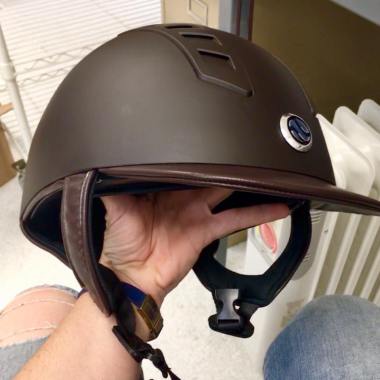
In that post I mentioned how I had a lot of regrets about not buying the brown TraumaVoid helmet and some Horze Grand Prix breeches while they were on sale. I wasn’t kidding. I had so many regrets. I didn’t even make it 8 hours past publishing that post before I caved and bought the helmet. It went on sale after Labor Day – $199 plus it came with a $25 gift card, and free shipping of course. That was an even better deal than during the Labor Day sale. And when I innocently added it to my cart there was only one left in my size. That’s a sign if I’ve ever seen one. Let’s be honest, I never stood a chance anyway. Resistance is futile.
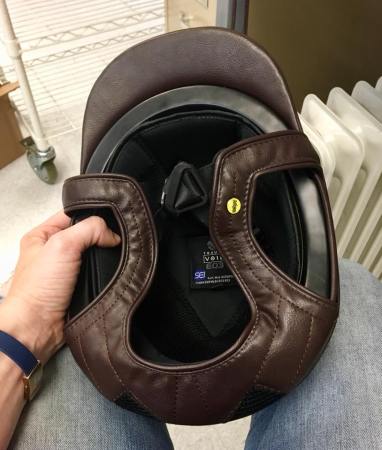
AND IT’S BEAUTIFULThe color is perfection
Did I neeeeed the pretty brown helmet? I mean… not totally, I have other helmets. But it did prompt me to toss my old GPA Speed Air (my previous daily schooling helmet) in the trash, where it definitely belonged. I’ve been wearing the brown TraumaVoid every day since, and I love it, and it perfectly matches my brown Ego7 boots, and now I regret nothing. It’s my new favorite helmet.
But it didn’t stop there.
Of course it didn’t.
As soon as that helmet arrived, and I registered it online at TraumaVoid, and packed it away back in it’s bag to take to the barn, I pulled out the $25 gift card and was contemplating where to put it so I wouldn’t lose it or forget I had it. Then, lightbulb moment.
Why not put it toward the breeches I wanted? Riding Warehouse gives discounts if you buy multiples of certain things. With those breeches, if you bought 2 or more pairs, they were marked down from $109 each to $89 each. Already a $20 per pair savings. BUT WAIT! I also had a 20% off coupon code (I almost always have coupon codes, FYI). That knocked them down to $72 each. $37 off per pair! BUUUUT WAAAAAIIITTT!!! Toss in the $25 gift card I got from buying the helmet. BAM! Now they’re $59 per pair. $50 off the regular price per pair.
At that point it would be a crime NOT to buy them, right? So that’s how, within one week of posting about how I had resisted all this stuff, I found myself now owning ALL OF IT. Brown TraumaVoid, white Horze breeches, and black Horze breeches. Yes, that gift carded lasted all of one hour in my possession before I used it.
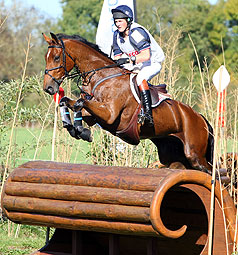
Now that I’ve finished watching the eventing XC and showjumping in it’s entirety (ok, mostly, because round after round of stadium makes my eyes bleed), I have a few thoughts about WEG so far.
First, that endurance debacle was just WOW. Watching that unfold on Ahmed al Hammadi’s page was more dramatic than any soap opera you could imagine. It was just a shitshow from start to finish in every single possible way. However, I am a big fan of the meme that’s going around of the Frenchman flipping the officials the bird. It makes me chuckle.
After that whole thing, my hopes were not very high for the eventing. Especially with a hurricane on the way. I am not the biggest Tryon/Bellissimo fan anyway, so I didn’t have a lot of faith. I have to admit though, I think they pulled it off as well as they possibly could have. The footing ended up being excellent – even on Monday after all that rain, the stadium ring looked fantastic. The XC looked better than I thought it would, and I liked that the mistakes generally resulted in runouts and refusals rather than falls. That’s ideal. I still don’t like CMP’s tendency to make everything look like a freaking miniature golf course (bees, squirrels, turtles, waterfalls, fountains mushrooms, cantering under/through construction equipment… kinda makes me gag) but the result was a good one and I can’t begrudge him that.
I was shocked at how many problems the little waterfalls caused. Some really steady horses and veteran riders fell victim to trouble there. Wanna take bets on how many people spent the plane ride home trying to figure out how to finagle their own waterfall bank at home?
The horse that ended up jumping down into the ditch in front of the Weldons Wall – THAT IS MY NIGHTMARE.
And last but not least for the XC stuff: I was really wowed by Ingrid, Astier, and Sam Watson’s rides in particular. They’re all so smooth, so bold, so balanced, and as a result… so fast. They all did an impeccable job of just staying in the middle, keeping their leg on, and not getting in the horse’s way. No yanking, no big changes to the rhythm. It made everything look effortless and easy. I must have watched the full replay of Ingrid’s ride at least 5 times by now. It’s poetry in motion. I have always been a bit of a fangirl when it comes to Ingrid, and she did not disappoint.
Having the last rail in showjumping was a heartbreaker for Ingrid, but I like Ros Canter a lot too, so I’m not sad that she won. Her horse was jumping fantastically on Monday and Ros had ice in her veins.
I’m bummed for the US team, but not super surprised. But CAN WE TALK ABOUT JAPAN?!?!? WOW!
Watching a top level rider epically miss a distance will never stop making me feel a tiny bit better about myself, even if that makes me a bad person.
Also bummed that the dressage freestyle got cancelled, but how could you not be impressed with Isabell Werth and Bella Rose? A chestnut mare, with a French AngloArab for a damsire. How about THAT? The average blood percentage for the dressage horses is somewhere around 35%, but Bella Rose has 49%. And no Donnerhall or Rubenstein. That’s pretty rare these days!
Not to mention their all female podium – two of which were on mares. Suck on that, boys. We were darn close to an all female podium in eventing too, until Sarah Ennis’ rail. Heh. Heheheheheh.
As soon as the Games are totally done I’ll do another post about the breeding of the horses in each of the main 3 sports, along with blood percentages and all that fun stuff. For now… on to the jumping!
So, I’m not sure if y’all know this, but Henry is a delicate flower. Shocking, I know. If you so much as look at him wrong he’ll end up with a bald spot or a swollen bump. Summer (or should I qualify that as “Texas Summer”, which is like mid April to mid October) is an especially hard time of year for him. He has a harder time breathing in the heat and humidity, and various plants or things in the air seem to set him off fairly regularly. He never has any kind of extreme reactions, just a more mild persistence with the occasional extra flair. Skin funk, hair falling out, major itchiness, goopy eyes, some random bumps or raised skin, etc. I’ve always kind of been curious about what all could be bothering him, but none of his reactions have ever seemed severe enough to pursue the more invasive intradermal testing. When I saw Affordable Pet Testing, though… I was intrigued.
APT uses bioresonance testing on hair samples from your animal. They’ve been doing cats, dogs, and humans for a while but this year expanded to offer testing for horses as well. Basically you yank out a little chunk of hair, send it in, and they test it for intolerances to 63 different food items, 28 environmental items, 31 nutritional deficiencies, and 8 heavy metals. Full list here.
Notice that I said “intolerances” and not allergies. They’re pretty clear about this in all of their disclaimers, saying:
As a reminder, 5 Strands® Affordable Pet Testing only tests for non-IgE mediated reactions or “intolerances.” This type of reaction may have a delayed onset with symptoms appearing several hours or days after ingestion or exposure and lasting a longer period of time.
IgE (Immunoglobulin E) allergies, which are caused by the body’s immune system, are NOT measured by 5 Strands® Affordable Pet Testing. These reactions occur within minutes of ingestion or exposure and are diagnosed through a blood test or skin prick test by veterinarians.
wants to know if “dressage” and “mom’s bullshit” count as official intolerances
I’m not totally sold on the validity of this kind of thing, but figured “why the heck not” and sent Henry’s sample in. They emailed me when they received it, and then I had the results back in my inbox 4 days later. All told it was about a week from when I put in the mailbox to when I had the results.
The first attached document was the “How to Interpret the Results” page. It explained the three different levels that show up on the various results pages:
Level 3 (Stop) Level 3 intolerances are considered items that the body registered an imbalance to and may be very likely to cause noticeable symptoms. Reactions may show up as inflammation, digestive issues, skin problems, fatigue, etc. Level 3 items should be eliminated from the diet. Your main focus should be on level 3 items first. Level 2 (Slow down) Level 2 intolerances are items that the body has registered an imbalance to that may result in reactions such as itchy skin, runny nose, watery eyes, etc. Level 2 items should be avoided or reduced at least for a short period of time. Level 1 (Be aware) Level 1 intolerances are items that the body registered a low level imbalance. While there may be no noticeable symptoms, they may potentially cause issues with ingestion or exposure over time.
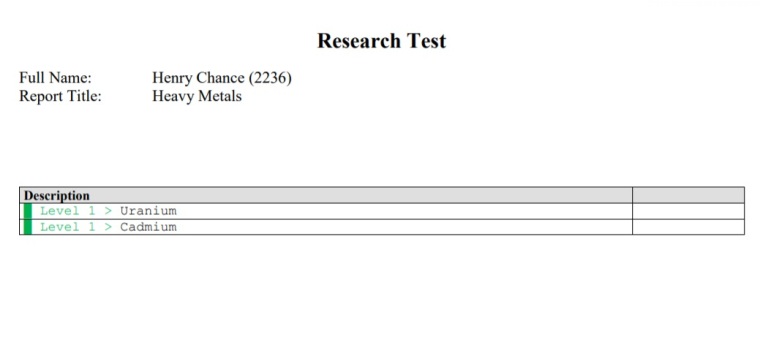
First up, the heavy metals test.
I’ll be honest, I’m not really sure what to make of this. Seems like everyone is intolerant of Uranium, right??? I kinda wish they explained this one in more detail, because I really don’t know what to do with this information.
After that was the deficiencies.
I’ve been pretty meticulous and intentional with Henry’s diet, although I can see his lysine being a bit low due to the type of forage we have here. The rest… I dunno. I’ll have to look at it more closely.
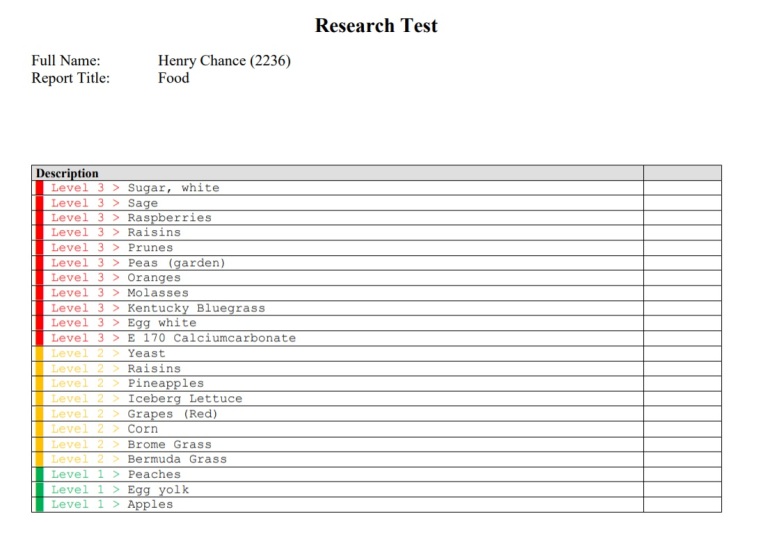
Next up was the food intolerances, which literally made me laugh out loud when I opened the document. Out of 63 food items, he had some level of intolerance to 22 of them. Honestly, that sounds about right.
Granted, most of this is stuff he would never eat anyway… not really sure how they decided on some of these things on the test, they seem a bit random. Except, ya know… SUGAR… and MOLASSES… and CORN… and BERMUDA GRASS. He’s on a low-sugar, no-corn feed, but pretty much all we have in Texas is coastal bermuda hay. That’s what his pasture is, too. Not much I can do about that. He does get alfalfa as well, but clearly I’m not going to feed him only alfalfa. He hates apples, so that one isn’t an issue at least.
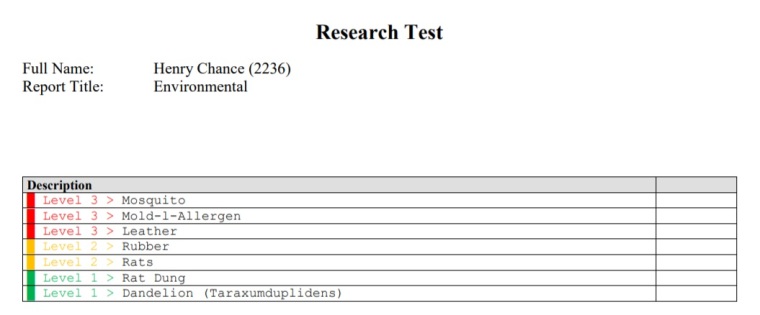
Last up was the environmental factors, which is the part I was most interested in. Out of 28 possibilities, he tested with an intolerance to 7 of them. Honestly I kind of expected more.
Mosquitoes and mold are easy to believe, I’ve seen those reactions in him before. But… leather? Rubber? Whaaaaa? Clearly the horse has leather on him daily, and I have to say I’ve never noticed any specific issues. Granted… I don’t know how I would necessarily tell, unless he had some kind of extreme reaction, which intolerances don’t generally create.
The test results are definitely interesting, although I’m still kind of left wondering what to do with this information. How valid is it? How much of an impact would any of it have on him? How would I really change any of this? I don’t know. I’m still thinking about it and talking to my vet about it. If I lived in an area where I had easy access to another type of hay, I’d be tempted to change him over for a couple months and see if I noticed any change. That’s pretty much impossible though, so… again… not totally sure what to do with all of this. I can’t really put the horse in a mold, bermuda, and mosquito free environment… welcome to Texas!
Horse, I just don’t know what to think of you sometimes.
But, while I’m sitting over here stewing over Henry’s results, Affordable Pet Testing has been kind enough to offer a free test to one of my readers – a $189 value! To enter here, leave a comment on this post (be sure that you leave a link or an email so I have some way to contact you if you win). I’ll also be running the giveaway on Instagram, so check out my post there for more ways to enter! Winner will be chosen on 9/24.
Guess who turned 18 months old yesterday, and thus is officially a “long yearling”?!?
this crazy little beast
Said kiddo is also in the middle of a growth spurt again (or should I just say “still”, because I don’t actually think he’s stopped growing since April). You should see how much hay he can put away in a day. It’s been raining a lot here, so they’ve been stalled at night, and I’ve been throwing him like half a bale of hay at dinner every night. There’s never even so much as a speck left by the next morning. It’s like a teenage boy, hoovering food in mass quantities yet still looking scrawny.
at least the grass is back!
The good news is that most of his gross sunbleaching from the summer has finally shed out and he’s a relatively normal color again. The bad news is that he’s rapidly getting hairy. I swear when I left on Saturday, both boys were just a little hairy on the top of their rumps. When I got there Sunday they both looked like they were well on their way to full winter coats. And they also both looked hot, since it’s still 90 degrees. Henry might find himself body clipped soon, but I’m just hoping that Presto doesn’t get much hairier in the next couple weeks before we go to championships. The only thing worse than a yearling is a hairy yearling.
I’m kind of excited about him being a long yearling though. It means he’s closer to being a 2yo than a 1yo. Closer to being a real horse. Closer to being able to do more. Lately we’ve been working on the concepts of ground tying and standing at the mounting block – two things that require immobility, which is probably the hardest thing for a distractable baby brain.
The mounting block stuff, he’s pretty good at. I guess it’s interesting (and brief) enough to engage his brain. The ground tying has had mixed success. He’s pretty good until something else catches his eye, and then it’s definitely an “ooo shiny!” moment in whatever direction has caught his attention. It’s getting better though. If there’s nothing else exciting going on, he stands pretty well. As long as I’m relatively close to him, anyway. Small victories.
Still though, for a yearling (especially still being a colt), he’s pretty darn good. The main barn worker even said the other day that he’s one of the best behaved horses in the barn. I’ll definitely take that compliment, considering that aside from my two, the barn consists only of a bunch of older trail and pleasure horses.
Oh and yes, I will continue celebrating Presto’s half birthdays at least until he’s 3. Time moves so slowly when you’re waiting for them to grow up, I’ve got to entertain myself somehow.
If you’ve read this blog more than like… once before, it’s probably no secret that I am a huge nerd about all things breeding related. I tend to watch every live stream with a pedigree database open in another window, looking up every horse. For WEG I decided to take it a few hundred steps farther and make an actual spreadsheet, so I could see all the horses together and pull some stats. It’s possible that I spent far too many hours doing this, but I regret nothing.
These stats are for just the eventing horses at WEG. I threw out the couple of horses that I could not find any reliable damline information on, lest they skew things incorrectly – they aren’t included in any stats. That left us with a field of 81.
Why it’s important to look at the pedigree and not the registry
Irish Sporthorse and Selle Francais are the most represented breed registries with 14 horses each. Of the 14 Irish horses, only 5 of these are of “traditional” Irish breeding – ie some mix of Irish Draught and Thoroughbred, with no European warmblood. One is WB x TB with no traditional Irish blood, leaving the remaining 8 to be some mixture of ID/ISH x TB x WB.
On the flip side, all 14 of the Selle Francais registered horses have Selle Francais blood, with only 3 of those not being completely of French descent.
Selle Francais Qorry Blue d’Argouges
Several of the same stallions show up repeatedly throughout the field
Heraldik xx shows up in the pedigree of four different horses, three times as the sire (the most of any in the field) and once as the damsire.
Contender shows up five times: four times as the sire’s sire and once as the sire’s grandsire. His son Contendro is the sire of 2 horses and the sire’s sire of one.
Quidam de Revel and Landgraf show up somewhere in the first four generations a remarkable 6 times each. Ramiro shows up 5 times in the same span.
Chipmunk FRH, the leader after day 1 of dressage, is by Contendro. He was also a Bundeschampionate winner.
Thoroughbred/Arab/AA blood is still important
The average “blood” percentage for the WEG field is 62% (highest – 100%, lowest – 27%).
72% of the field has at least 50% blood.
37% (30 horses) have at least one FULL thoroughbred parent.
Of those 30 horses, 17 are F1 crosses between a WB and a TB. 7 have the thoroughbred parent as the sire, and 10 have the thoroughbred parent as the dam.
Five horses are full thoroughbred.
The most represented American thoroughbred is Danzig, showing up in the first 4 generations in 5 different horses. Sir Gaylord and Nijinsky also make multiple appearances.
Henri Z, by Heraldik xx
The influence of the registries known to produce mostly showjumpers is evident
47% have Holsteiner blood in the first 4 generations of their pedigree.
41% have Selle Francais in the first 4 generations of their pedigree.
19% have both Holsteiner AND Selle Francais in the first 4 generations.
BWP-registered Imperial van de Holtakkers is by SF stallion Quidam de Revel out of a Holsteiner damline going back to Landgraf and Ramiro.
The FEI Young Horse classes have a pretty high success rate
51% of the field (42 horses) competed in FEI Young horse classes – ie 1* for 6yo’s and/or 2* for 7yo’s. Of those, 28 horses (so 34% of the entire field) competed at the World Young Event Horse Championships at Lion d’Angers.
Toledo de Kerser, 2nd in the 7yo World Championships at Lion d’Angers 2* in 2014
My general takeaways:
The average blood percentage is lower than I would have thought. I want to break down a “real” top level event like Burghley or Badminton… I have a feeling the average blood percentage would be higher for an event like that.
Having been a pedigree stalker for a long time, none of the stallions that show up over and over again are surprising to me. However, I was a little surprised at the strong showing from the Selle Francais in general. There are more than I thought.
The F1 cross of a warmblood stallion to a TB mare has kind of gotten a bad rap in this country for being a lower quality cross, but these stats show that it certainly can and does work when it comes to breeding event horses.
The fact that Holsteiner blood shows up in the first 4 generations of almost half the field yet only 6 of the horses are actually registered Holsteiner shows how important these bloodlines have been across a wide variety of warmblood registries.
Lastly, despite the fact that some of us may wince at the idea of a 6yo competing 1* or a 7yo competing 2*, clearly it works when it comes to producing upper level horses. Over half of these horses have come up through that path and continued up the levels to find success. And 1/3 of them having competed at Lion d’Angers – that’s a big chunk!
If anyone is actually still reading by this point… what are your takeaways from this? Anything surprising?









 breedrideevent.com