Course Design Clinic notes

One of the items on my crazed list of weekend activities was a course design clinic with Eric Hasbrouck. I fully admit that I was only in attendance for about half of it… by the time we closed up the shop and got some food, we got there a bit late, and then we cut out a little early to go watch the handy round of the derby. My notes are a little light, but it was still interesting.

None of what he said was a major revelation to me, I’ve heard it before, but it’s definitely been a while since I’ve dedicated any real brain power to SJ course design, so it was a good reminder. In the beginning he spoke a lot about how it’s important to design courses appropriate for the people that are showing… like a Grand Prix the first week of WEF is going to be softer than a Grand Prix near the end of circuit. Or never put a 2 stride into a speed class or jumpoff for an under 1.10m jumper class, because without fail someone will try to leave a stride out and end up crashing. Or how, since he was new to the Texas crowd, he designed the courses a little bit friendlier the first week, like putting a more difficult question going toward the ingate, so he could feel it out a bit before ramping up the challenge.

Looking at the course from the WEF week 1 GP. Quinn was not interested.

Then he talked a bit about the jumps themselves and how the horse’s see them.

  • White and yellow is hardest to jump clean
  • Horses are more bothered by severe contrast than by lots of color (he gave an example of a black and white domino jump that caused a lot of problems)
  • Always pay attention to the background that the jump is going toward… poles that are the same color as the background are harder for the horse to see clearly. For example, the curtains lining the arena were blue, so the blue rails were going to be more difficult for the horse to see.
  • For jumps with pillar standards, a pole that is set near the front of the pillar (as opposed to the middle of the pillar), is harder to jump clear. The pillar draws the horse’s eye in past the rail.
  • On the same note, jumps that have a planks near the bottom draw the horses eye down.
  • A liverpool that is set flush with or slightly behind the front rail will also draw the horse’s eye down past the rails, and is more difficult to jump clear than a liverpool that is set so that it’s edge is slightly in front of the rail.
Image result for liverpool showjumping
like so

There was also some discussion about a movement that some riders are championing, trying to get open water jumps taken out of the sport. Eric is very against this and thinks that the open water is a staple, and should stay (I agree with him there). He said that instead, we should be working on introducing these jumps a lot sooner in a horse’s career, in smaller and easier-to-jump versions, so that they don’t end up 7yo and thrown into a class with a full size open water and be caught unprepared. He said that in Europe horses start seeing them a lot sooner in their competitive career, so by the time they get to the real GP with a real open water, it’s not a new concept to them.

Image result for showjumping open water

He was also a big proponent of keeping variety in the courses, and bringing back some of the more old-fashioned fences. He said that this year he used a hedge oxer at WEF, something that used to be very common but isn’t seen much anymore, and included walls as much as possible. He expected riders to be a little up in arms about the hedge oxer but actually got a lot of people that loved it, and enjoyed seeing something different in the ring. He is not a fan of how most of the courses look so cookie-cutter these days, and thought it was really important to preserve the types of fences and courses that you see at places like Spruce Meadows and Aachen and Hickstead.

Fence 6: privet hedge oxer (4ft 11in high; 6ft 6in wide)
hedge oxer at Hickstead

He also talked about the fact that time is much tighter than it used to be, and courses are wheeled on a higher speed. This is mostly due to the fact that everything is so much more competitive now, and the footing is so good that you CAN set these higher speeds without it being dangerous. BTW, he thinks it’s also very important for riders to know and understand how to think in METERS, including meters per minute for speed and what 350mpm vs 375mpm vs 400mpm feels like. Not just an eventer skill!

I wish I could have stayed for the whole thing, Eric was interesting to listen to, and if nothing else he’s definitely re-ignited my brain as far as how closely I look at our showjumping courses to understand the questions the course designer is asking. You can bet that I’ll be looking at them with a bit more of an analytical eye! Yeah sure, a lot of it isn’t applicable to me (like… don’t have to worry about jumping open water) but even just as a spectator, knowing these things makes it a little more interesting.

I know that this clinic was live-streamed but so far I haven’t been able to find a replay of it anywhere. If I do, I’ll come back and add the link.

Holy. Weekend.

Over the course of 48 hours I managed to drive to Houston, work two full days at the Luxe EQ trailer, take two lessons on my horse, watch a hunter derby, catch snippets of the Carolina live feed on my phone, and attend a course design clinic. Now it’s 6:30am on Monday and I’d like a nap, please, instead of a regular work day.

Driveway corgi was pumped for his adventures

After work on Friday I stopped at home to load up the corgi (aka tack shop dog extraordinaire) then swung by the barn to get Henry. Originally I was not planning on bringing Henry with me for the weekend, but my at-home jump schools have been a jumbo sized shit sandwich, deep fried on a shit stick. I was starting to panic about Texas Rose this upcoming weekend. Megan, the owner of Luxe EQ, is married to Mark, who I used to ride with when they lived in the Austin area. He has this way of simplifying things that has always worked really well for me, so I thought if anyone could quickly fix my situation, it was probably him.

Henry unsure of this whole idea.

I dropped Henry at his barn, did a quick 10 minute hack, and then jetted into Katy to get to the show. I pretty much just made it in time to help close up for the day, then take advantage of the free catering out by the hunter derby ring. I will give h/j shows some credit in that regard… they have some great food. I wanted to sit in on a course design clinic with Eric Hasbrouck so we went up to the clubhouse for a while before coming back down to watch the handy round of the hunter derby.

This blur would be Jen Alfano and Miss Lucy

Then I passed out, because I’m an old lady and it was way past my bedtime.

On Saturday I was up early (well… late for me…) to go set up everything at the shop.

There are like 50 more varieties than this, it’s so dangerous if you’re a belt lover. The navy/gunmetal was super tempting… and the rose gold/black.
pretty new Samshield clothing line!
The crowning glory of shop setup: corgi, in place.

We stayed pretty busy all day, then had a wine and cheese party plus a raffle in the afternoon. There was some nice stuff in the raffle, and some good cheese. Winning combination. Word on the street is that it’s happening again this week, so if you’re at Pin Oak, don’t miss it.

Not part of the raffle, but excellent bartender.

I tried to catch snippets of the Carolina live feed throughout the day on my phone, but it had a hard time streaming. I don’t know if it was the wifi at the show grounds or a problem on their end, but it would play for a few minutes at a time and then freeze or drop and I’d have to reload and log in again. I gave up after a while, so I mostly just saw a few horses in the 2* and parts of a couple in the 3*. Not worth the $5 I paid for live stream access.

The course looked good though!

I ducked out of the wine and cheese party a little early to head out to Mark’s barn for a lesson. He pretty much nailed my problem right off the bat and gave me a simple solution, which worked 100% of the time when I actually executed it. Sometimes I reverted to Floundering Moron mode, but things definitely improved a whole lot overall. Less is more. Simpler is better. Stop trying to over-ride the horse, it doesn’t work.

seriously, lady, how do you not know this by now?

By the time I got back to the RV it was almost 9, and I took a shower and pretty much immediately passed out. I was gonna head up to the Grand Prix ring to catch the jumpoff, but I was pretty spent by that point. I fell asleep so hard that I don’t think I even moved a muscle until I woke up the next morning.

Can we talk about this adorable dog wearing a hat?

Sunday was pretty much a repeat – up early, open shop, set up, work, then cut out in the late afternoon for another lesson. This one was shorter, no point in drilling the horse, and we did some gymnasticy (that’s a word) courses to drive home the points from the day before and work on technique. Basically my instructions are leg-maintain-jump-breathe-repeat. Let’s see if I can actually execute that on my own. I feel a lot better now than I did last week though. I knew I was overcomplicating things, I just couldn’t figure out how to stop it.

I bought these, because it’s so true. Happy hour at Texas Rose!

After my lesson I loaded everything up and we were on the road back home. By the time I dropped Henry off and unpacked, I was driving home in the dark, so it turned into yet another shower-and-flop-into-bed type of evening. Today it’s back to the grind.

Luckily it’s a short work week, we leave for Texas Rose on Thursday. And THEN, on our way home, we get to stop and pick up Presto! I think both horses will be considerably less thrilled about this than I am.


First Foal of 2018!

Spring is in full swing in Texas, and you know what that means: foaling season at Willow Tree Warmbloods!

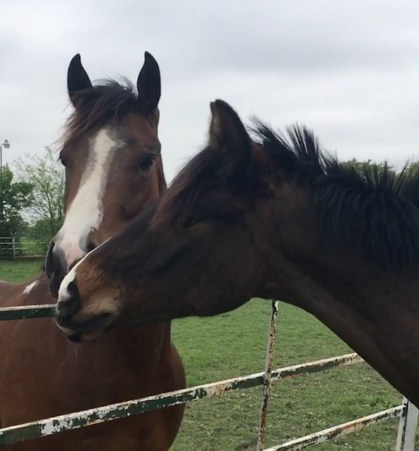
The first 2018 foal was born this past Monday, a big gorgeous bay filly named Mari. This is the first of two Diarado foals expected this season, this one out of Laken, who is by Torino out of a Pikadero mare. Mari had a bit of elbow lock during the delivery but mom and filly recovered well and are doing great. Mari is bred to JUMP (Diarado – 1.50m GP horse, Torino – 1.50m GP horse, Pikadero – 1.60m GP horse) and loves to canter.

Mari1
Laken does not approve of all this cantering.
Mari2
Mari don’t care. Mari got zoomies.
Mari6
SYNCRONIZED ZOOMIES
Mari3
And sass.
Mari3
Plenty of sass.
Mari4
Ooooo what dis??
Mari5
NOPENOPENOPE BAD IDEA
Mari2
highly offended cantering
Mari1
MOM ❤

Of course, this means that the Baby Bets contest is now officially in full swing. There are only 2 foals this year, so it might end up being a neck and neck race that goes all the way down to the wire. Remarkably enough, one person managed to guess the correct foaling date AND time AND gender of Mari! Dang Amelia… that’s some crystal ball you’ve got there.

Image result for crystal ball gif
I’m impressed

So far she’s got a 15 point lead on anyone else in the field. All of that could change dramatically with the next foal, though. Since we’re only halfway done, it’s still anybody’s game. Sadie is at 310 days today, “due” somewhere around 4/22 if you calculate to the average 340 day gestation. Her first two foals were born slightly before the 340 mark, so we’ll see what happens!

Image result for love eyes gif

HORSE BABIES!

What I’m Not

When I did the “New Year, New Giveaway” contest back in January, I asked everyone to leave a comment telling me a subject that they wanted me to write about this year. One of the most popular responses was people asking me to write about evaluating young horses, mostly by way of conformation or potential. I have a lot of opinions on that, and I’ve spent a long time honing my eye and reading books and studying pedigrees and going to clinics and looking at horses. I’ve made a hobby of it, and I absolutely LOVE to talk to people about it. Seriously, it’s my favorite subject.

ConfoSlide2

But at the same time, I don’t really feel comfortable writing about it. I think mostly because a lot of that stuff comes down to personal opinion. And mostly because I never ever want this blog to take on an “instructional” feel. I just really hate that. I’m a low level amateur rider that just so happens to have a major information in conformation, breeding, and young horses. Anyone could learn what I have, if they wanted to. I’m not a professional. I don’t feel comfortable acting like I am. I am not qualified to write about things like that.

A couple months ago the local Pony Club asked me to come do a lecture on sporthorse conformation, and I have to admit that my initial reaction was 100% total discomfort at the idea. Like I said, I just don’t feel qualified to do anything even remotely “instructional”. But I thought about it and a) I can’t say no to Pony Club, that seems like 1000 bad karma points, b) I kinda thought it might be fun to have a discussion like this with these smart, educated kids. I very hesitantly said yes, and spent some time really thinking about what I wanted to talk about and why.

ConfoSlide1
FYI this is a really fun conversation starter!

When it came down to it, I thought to myself – how do you make a bunch of teenagers interested in something as boring as conformation? So I took the “functional conformation” approach, very much along the lines of what Judy Wardope teaches, where we’d really focus on certain aspects of the conformation and how they directly translate to performance. I picked a couple areas of confo that are really important for eventing that a lot of general texts rarely touch on – specifically the LS gap, the pillar of support, and the length/angle of the humerus. I got a lot of glazed eyes, as expected, but I also got a few kids that were as excited about learning a new approach as I originally had been. Honestly… it was kind of fun to share my MegaNerd enthusiasm on the subject. We had some great discussions. I hope a couple kids walked away with a new tool in their toolbox, or at least a re-kindled interest.

I was kind of energized by that experience, and thought about sharing the notes and printouts here. But that situation was a lot different from me sitting here and writing some kind of “here is how it should look” instructional. Writing a blog post just doesn’t have the same effect as an in-person group discussion. I won’t do that with conformation and breeding, I won’t do that with training, I won’t do that with riding… hell, I even feel uncomfortable doing basic DIY’s, or sharing my conditioning/care routine. There are a lot of different ways to do things, and a lot of them are correct. Plus, like I said.. I AM NOT A PROFESSIONAL. I’m happy to tell you what I personally do or think, but I’ll be the first to admit that my way isn’t the only way, and maybe not even the right way.

heraldik
But if you ever want to talk about how amazing Heraldik was, I am 100% down

So really, it’s important to me that the tone of this blog remains conversational. If anyone ever wants to have private discussions about stuff, I’m totally on board with that. My blog’s facebook messenger is always open, as is the contact form here, for peer-to-peer conversations. I just don’t want to sit here on my silly internet platform and pretend like the fact that I have an audience means that I’m qualified to preach. Opinions on other, minor things, or current events? You’ll get those all day long. But a teaching situation on a grandiose subject… nah.

Since I’m not qualified to write about things like this, I’m more than happy to point you toward someone who is. To the people who asked me to discuss conformation or evaluating a young horse, I highly recommend investing in Judy Wardrope’s ebook, Equine Conformation for the Olympic Disciplines. It’s a little pricey, yes, but it’s 400+ pages of photos, diagrams, and new ways of looking at conformation that you probably haven’t seen before. To me, this is the sporthorse bible. In my experience, much of what she writes about holds true in practical application. If you’re at all interested in the subject, this is a must-own item.

If you’re not ready to invest in that, you can get an idea of her approach/concepts by reading through some of the free articles posted on this page.


Striphair vs SleekEZ: The Battle of the Shedding Tools

I have a weird confession to make: I really really really like grooming a hairy horse during shedding season. I don’t know why, but there’s something extra satisfying about losing yourself in the simplicity of it, and seeing that big billowing pile of hair on the floor when you’re done. It’s satisfying work, with easily-seen results. I love body clipping for the same reasons. Okay, maybe I’m just really into hair removal. Either way, Henry doesn’t get a full body clip – lower maintenance when it comes to blanketing – so right now his super fuzzy back half (or as I like to call it, The Mullet) is in serious shed mode. I already own a SleekEZ, and someone else at the barn has a StripHair, so I decided it was time for a Shedder Showdown.

cue dramatic, suspenseful music

Before we start, I should say that StripHair has recently come out with a newer model of their tool, one that is more ergonomic and a bit… fancier looking (if it’s possible for a chunk of rubber to look fancier). From what I’ve seen of it, the material is the same, so I’m betting the performance is similar, but just a heads-up on that – to be totally fair, I tested their older model.

Neither of these tools is particularly ground-breaking as far as materials or design. The SleekEz is like a dulled mini saw blade set into a carved wooden block. The StripHair looks like a chunk of 1″ stall mat, it’s literally just a rectangle of rubber. But hey, simple tools often get the job done well. I have the large SleekEZ, which retails at $18.50. The StripHair retails at $39.00. So, how do they work?

Side 1: the SleekEZ’s bounty, after 10 strokes

I’ve been using both of them together, for the sake of comparison, for two weeks now. For “control” purposes I’ve also used a currycomb, a grooming stone, a Shed Flower, and the most basic of tools – my hands. When it comes to just the sheer amount of hair that each tool is able to remove, the SleekEZ is the winner. I can definitely get more hair off with it than with anything else. I also like that it sort of has a combing action to the coat, which helps it lift some of the dirt and dander to the surface. There’s definitely some cleaning action to it. The little teeth of the shedding blade itself seem to be good at getting down into the coat and picking up the hair from down there, too, not just the top layer.

Side 2: the StripHair’s bounty, after 10 strokes.

The StripHair mostly just seems to gather that top-most layer of loose hair, which makes sense given the design. The rubber grips the loose hairs and pulls them away. If your horse has already fully blown it’s coat, then it’s great, but if it’s still in the process, the StripHair isn’t really going to get down in there and expedite things. I DO think that when it comes to legs or delicate areas, the Strip Hair is more useful. It bends and flexes around the contours pretty well, and obviously it’s a softer material.

pretty good on the legs

That said, I think that I can get just as much hair off the legs simply by using my hands as I do from using the StripHair. Maybe even more. Those big long double jointed fingers of mine are finally useful for something.

If you really want a complete shedding arsenal, both tools are useful in their own way. But when it comes to sheer performance, the SleekEZ is the winner, hands down. If you have an extremely delicate flower of a horse then maaaaybe the StripHair could edge it’s way to the forefront, but honestly Henry is one of the most delicate flowers I know and he has no objections to the SleekEZ. You can’t really beat the bang for your buck, either… at less than half the price it outperforms the basic shedding capabilities of the StripHair, for sure. My favorite combination is currycomb + SleekEz.

all in a days work

As for the other grooming tools, get outta here with those Shed Flowers and grooming stones. Garbage. Yeah I said it. GARBAGE. Well, ok, Sadie really loves the Shed Flower to scratch her perpetually itchy elephant stomach. Other than that, though…