If you’re on facebook at all, you’ve probably seen the video thats been going around this week of the gray sale horse freejumping and clearing the fence by about 3 miles. I think at least half of my friends have shared this freaking video (or pictures of it) by this point.
The general concensus from most people is “wow” and “I’d love to own that horse” and “so much talent”. I guess I am in the minority when I’m sitting over here with this face:
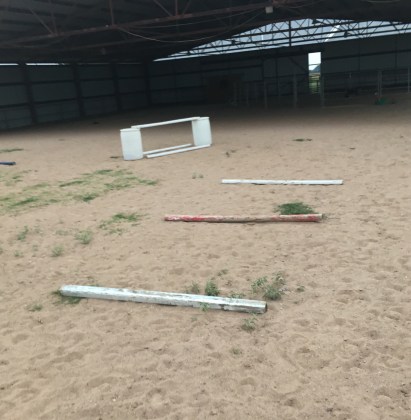
First of all, if that horse hasn’t been poled/hot wired/worn pinch boots/been prepped in any other myriad of ways, I will eat my helmet. Literally. Eat. It. The fact that a lot of other horses from this same place also have a tendency to majorly overjump makes me even more sure of that. Sure, horses sometimes get taken by surprise or are quite green about things and they’ll overjump, of course, but a) not THAT extreme b) not repeatedly. It’s very hard on their bodies to do that, so sometimes a very extreme effort can scare them a bit and make them not want to jump at all.
If the horse HAS been prepped, you’re going to have to un-train that, mentally. Sometimes the ones that get prepped too much end up overly careful, which can turn them sour or make them want to stop. If the horse HASN’T been prepped (which again, I’ll eat my damn helmet if it hasn’t) and jumps like that naturally, who the heck could ride it? Definitely not me. Probably not you. Maybe McLain could stick that.
Not to mention that I sure hope you have a really freakin good vet and equine (and human) chiropractor, because good luck keeping something like that sound.
So I guess, yeah sure, that jump is an impressive feat as far as sheer athleticism goes… but I just can’t get on board beyond that. I don’t like it. I don’t like how it’s produced and I don’t like the effect it has, mentally and physically, on the horse. Someone explain to me why the rest of the internet does.
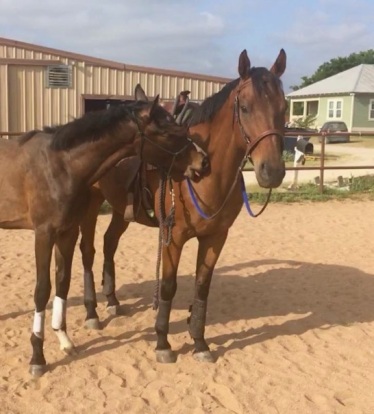
I need to think of a name for this Dynamic Duo. They’re like Tweedle Dee and Tweedle Dum. Starsky and Hutch. Butch Cassidy and the Sundance Kid. Batman and Robin. Abbott and Costello.
I NOM YOU
This past weekend I was pretty excited to be home and have no other plans. That’s a rare occasion these days. I planned a big, exciting (to me), day of fun (for me) with the boys. Henry worked hard all week so I figured he could have an easy riding day, and Presto desperately needed a bath. I planned to spend a nice long leisurely morning at the barn doing whatever the actual heck I wanted, and taking however long I wanted to do it. Those are the best days.
Days like this
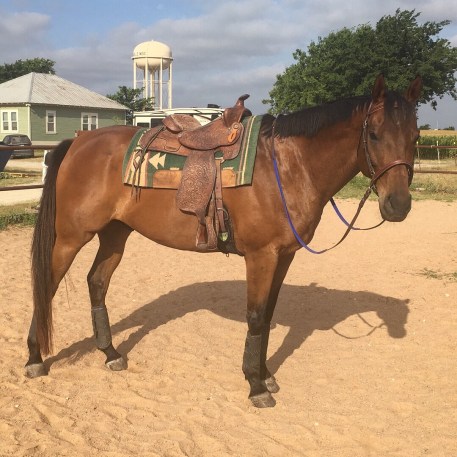
I showed up before 8 while they were getting fed, so I spent some time organizing and cleaning up my stuff while they ate. A friend let me borrow her western saddle to help make ponying a bit easier, so I cleaned it up a little and went off in search of a pad to borrow. Side note: why do so many western pads have neoprene bottoms, directly against the horse’s back? Is that a thing? I had to dig to find a felt-bottom one.
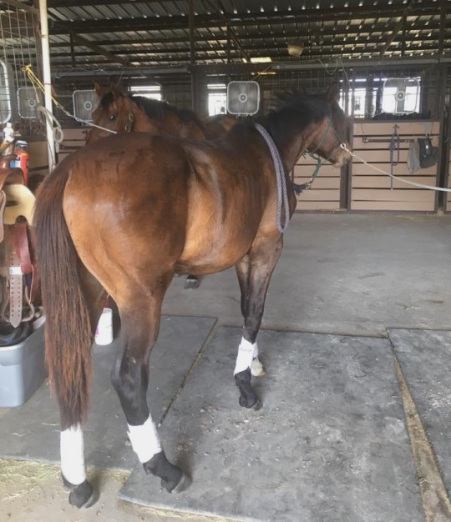
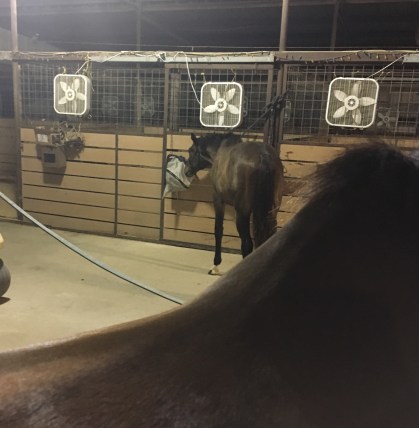
Then I brought both boys in, tied Presto in the aisle and put Henry in the crossties, just like I’d done the day before. This time Presto found plenty of ways to entertain himself while I tacked Henry up.
Jokes on you kid, I got your brother a relatively indestructible fly mask. RIP to the lid of that supplement box though, that’s going to require a drill and some screws to fix. Although in his defense it was already mostly broken off. Sorrryyyy. Add it to my bill.
It’s been many years since I put a western saddle on a horse, so I had to spend a few minutes remembering, but once it was on I could not stop giggling. Poor Henry gets mistaken for an Appendix ALL THE TIME (which is fair, he looks like one), and putting the western saddle on just took his natural QH-ness up a notch.
hehehehehe
Presto was fascinated by the weird new thing that Uncle Henny was wearing. It must have smelled different to him, he’s never seemed interested in my other saddles but he just kept resting his nose on the seat and taking deep whiffs.
Presto: DIS WEIRD! Henry: Mom, why?
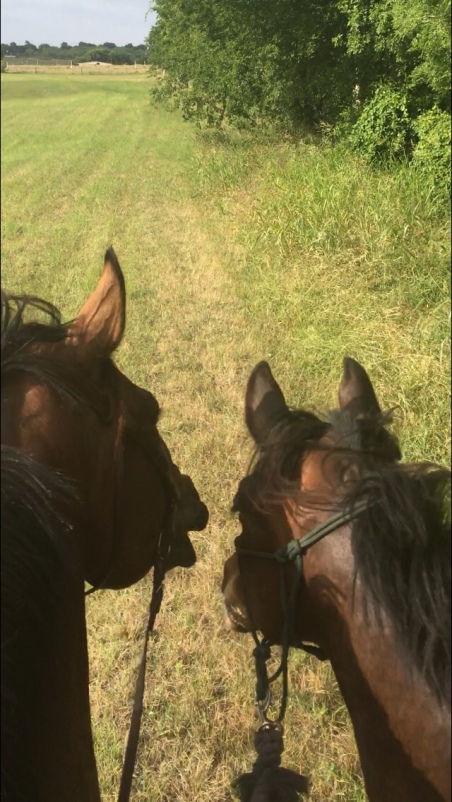
Then we went out for a pony session! I had intended to go for a nice long walk on the hills but someone was feeling mighty full of himself and kept trying to nip and play with Henry, so I decided to do a lap of the field at trot to take some of the friskies out. It was more like a Henry trot/Presto leap and canter lap. The good part is, Presto gets tired fast. After a trip up the big hill he decided maybe he should just trot, and after the full lap of the field he thought my original plan of a nice long walk was sounding better and better.
Henry when you act like you have manners
Every once in a while he thought maybe he was ready for another frolic, and Henry would without fail start pushing him over toward the tree line. At one point he pushed Presto right into a bush. Honestly, he had it coming. He was acting like a kid that belonged in a bush. I can’t fault Henry for putting him there.
Henry when you try to push past him and be rude
We spent about 45 minutes out there, and by the end they were both just chugging along like a well oiled machine. It was already HOT though, so they were a pretty sweaty well-oiled machine. This was part of my plan though, because confession: Presto has never had a real soap bath before. I wanted him to be kind of sweaty before we started, so that maybe it would feel nice instead of offensive.
Post-pony: sweaty Presto in crossties, sweaty Henry in the barn aisle
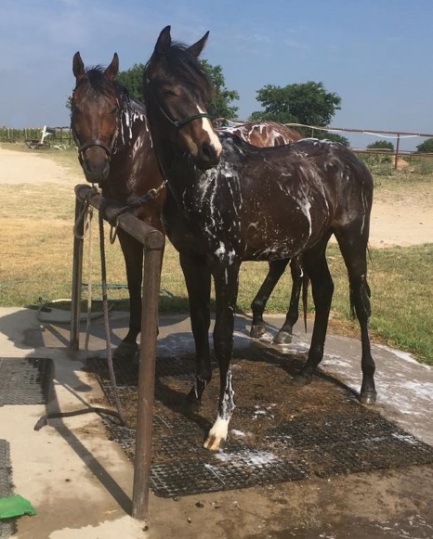
I brought Henry along, because role model, and stuck them both in the wash rack. Originally I had one of them on each side but they kept play-biting at each other and getting each other’s lead ropes over their heads, so eventually I gave up and put them on the same side. Sometimes I feel like the ringmaster of the circus with these two.
Henry wants a cookie. Presto wants to walk the runway.
The bath itself was actually pretty easy, aside from when I was rinsing the conditioner out of Presto’s tail and apparently shot some cold water up his buttcrack, judging by the way he curled himself up like a roly poly. Whoops. All things considered, though, it was a good first bath and I was able to scrape a lot of that crustiness off of him.
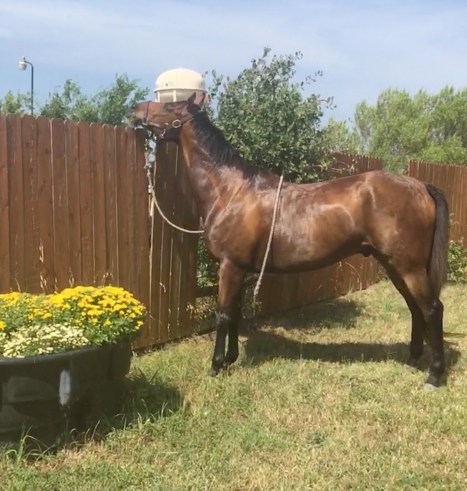
Then I took them both out in the back corner of the courtyard to graze while they dried. I’ve been slowly introducing Presto to the concept of a “drag rope”… letting him drag the lead rope around while he’s loose and learn to not freak out and panic when he steps on it. I prefer to do it supervised, just in case. Each time he stepped on it he figured it out a little bit more and started trying to drag it to the side (Henry has never thought to do that, it was interesting to see Presto’s smarts at work!), and by the end if he hit resistance you could see him trying to figure out which foot to pick up to free himself.
Of course, Henry tried to exit stage left during all of this and take off for the barn, until he realized that Presto was still just obliviously grazing next to where I was sitting. Henry stopped, looked at Presto, looked at me, and came walking back in a huff. So much for the grand escape. From babysitter to instigator and back again, all within 2 seconds flat. Never change, Henny, never change.
After that Henry was shopping for new friends, because apparently Presto betrayed him.
Ok maybe he’s QH/Saddlebred.
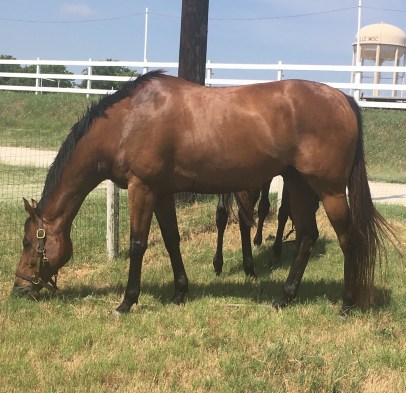
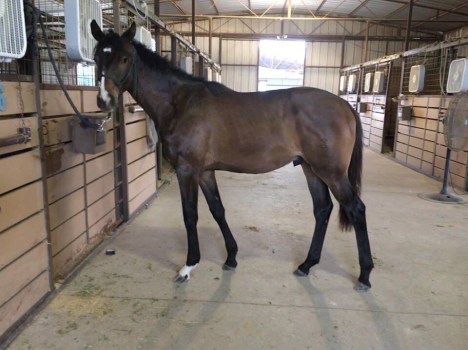
The boys went back to their stalls after that, since it was already getting really hot. Oh, and I did actually stick both of them. For some reason I had it in my head that Henry was 16.1h, and I don’t think I’ve measured him since the day I brought him home. I’ve been shorting him all this time – he’s actually 16.2h on the dot. As for Presto, he’s 15.0 1/2 right now, which means he’s grown 2″ in the past 4 months. That’s not hard to believe. He doesn’t show any signs of slowing down either, if the sudden re-appearance of his ribs is any indication. The growth spurts are constant. His dam seemed to do all of her growing at one specific time of year and not really grow at all in between, but Presto seems like more of a slow-but-steady type.
sometimes from certain angles you can catch a glimpse of the horse he’s gonna grow into
It’s getting to where he looks more and more like a horse and less and less like a foal. Ok, maybe not horse… maybe giraffe, or llama. But not a baby, either way.
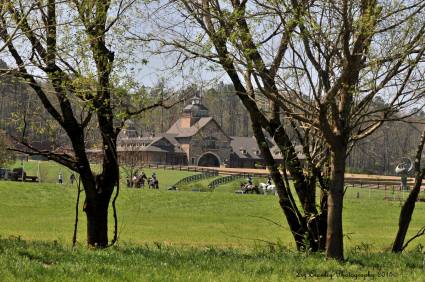
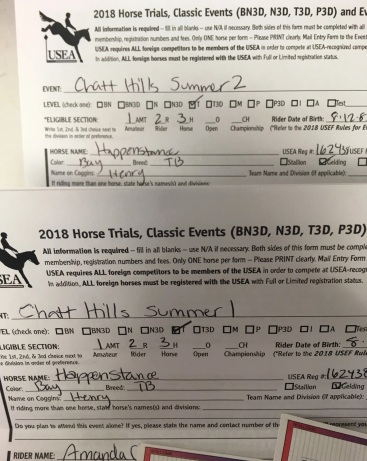
Well, you guys helped convince me! We’re going to Chatt Hills at the end of the month!
It’s not very often that an opportunity presents itself so impeccably, and I felt like I would be an idiot NOT to go. No one else had taken those days off at work, I can afford it (PLEASE DO NOT TAKE THIS STATEMENT AS A CHALLENGE, HORSE GODS) thanks to my endless stream of side gigs, and plenty of people are going, so hauling and places to stay should work out fine. Trainer is one of those organized people that is really good at pulling things together quickly, and that’s exactly what she did. Within a few days of me saying I would go, she had a whole plan worked out and 8 horses going.
I swear he actually works a lot and doesn’t eat that much
The cool thing about this trip, compared to the Great Coconino Adventure of 2016, is that I feel a lot less pressure about it. That trip was both Henry’s move up to Training (with Trainer) and our Novice Three Day. Both of those things were stressful, and with a lot of build-up and planning. This time we’re just going to have fun, jump around a new venue, and get some miles. I feel a lot less stressed about it, and since I’m hauling with other people, won’t have my own vehicle, and am not in charge of accommodations… for someone who is normally a total control freak, it’s a little freeing. I’m feeling very “go with the flow” about the whole thing. However the details unfold, I’m cool with it. I really did NOT think I’d have an opportunity like this this year, so we’re just gonna go have some fun.
I sent in my entries last week, because, well… closing date is already next week! Yeah, we’re only about 3 weeks away from leaving, really. Now I’m trying to get my brain in hardcore “Um, yeah, you should probably start getting your shit together because we’re about to go on a 2 week road trip/horse show spree”. Eep!
Gear wise I have about everything anyone could need, it’s just a matter of 1) remembering what all I need, 2) finding it, 3) making sure it’s all clean, 4) figuring out how the eff to pack all this crap into as little space as possible. I also need to schedule a vet appointment to get Henry a health certificate, maybe move up a farrier appointment, and order whatever extra stuff we might need for the trip (ie Gastrogard, paste electrolytes, etc). It’s like all the crap involved with going to a regular show except on steroids because it’s 2 weeks long, 4 states, and 14 hours away.
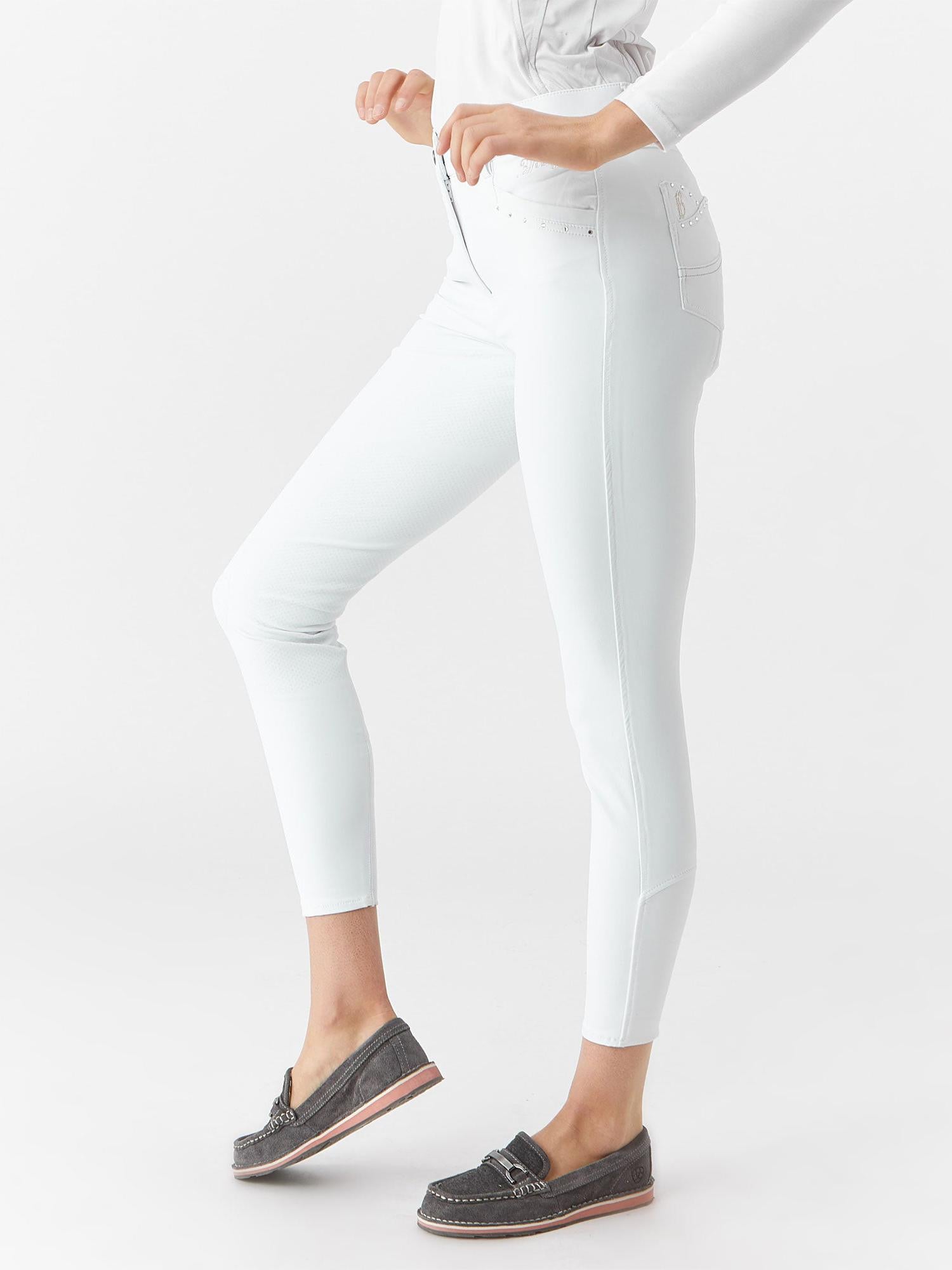
I strongly considered having a “Treat Yo’self” on a Motionlite coat, but thought I should probably quit with the not-actually-necessary-or-justifiable money hemorrhages while I was ahead. I did cave and finally order a package of Quick Knot though, so we’ll try that out and see if it saves me some time and fuss. The barn is doing an order of polo shirts, so I’ll probably pick up one of those too. I really wanted to get an extra pair of white breeches, too, but I managed to talk myself out of that. Which is a good thing because this morning I found a pair of whites in the closet that I haven’t even worn yet and completely forgot I had.
Whoops.
Otherwise the purchases will be limited to whatever is required to keep Henry comfortable and happy.
I’m actually stupid excited about this trip, at this point. Horse shows have been kept to such a minimum over the past year, and I’m longing for a little “showcation”. Plus totally brand spanking new-to-us XC!!! I’m hoping it’s as fun as I’m imagining.
can’t wait to jump the iconic Chatt Hills stone wall!
But for the next few weeks, if I seem a little… crazier than normal… no one be surprised. Anyone want to come organize and pack for me?
Being on my summer schedule, riding before work, means that my barn time is a little more limited. I have a meeting every day at 8, so I have to be in my chair and ready to work (ie hopefully not still wearing sweaty barn clothes) by then. Yet, it isn’t actually light enough to ride until about 6:15. Plus I have Presto to account for now, too, not just Henry. This has led to some experimentation with how to fit everything in and still get to work on time/manage to get adequate sleep.
grooming one and sneakily supervising the other
For the most part I don’t do a whole lot with Presto on a day to day basis. Most of the time I just bring him into the crossties, groom him, and put him back out. I try to pony him once a week, though, and I’m trying to give him a least a couple of longer tying sessions per week, plus a couple of short groundwork sessions per week. He went a wee bit feral while I was gone to Tennessee and on Tuesday, his first “session” in 8 days, he swore he’d never seen crossties or fly spray in his life. While it only took about 15 minutes to remind him, clearly benign neglect is not the best method for this horse. So, at least 5-6 days a week, he comes out and does something.
whut dis wind macheen?
All I’ve really had time for this week was a quick grooming, but this morning I decided to set up some pole exercises for Henry in the little arena (because the ground out in the field is already getting too hard for my liking) and figured it was a good opportunity to “school” both boys at once.
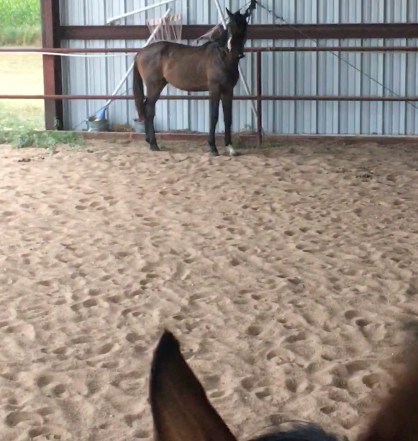
So I brought Henry into the crossties, then went and got Presto and tied him in the aisle while I groomed Henry and tacked up. It’s good for Presto to have to come in the barn and then be ignored. It ain’t always about him. Then I took both of them out to the arena. I tied Presto over to the side and left Henry with him while I set up my poles, then went and retrieved Henry, got on, and left Presto tied to his spot while we rode around him.
Muahahahahaha
Presto was not really thrilled about this.
There was some pacing, and there was some pawing, but for the most part I think his time on the Tree of Knowledge a couple weeks ago kind of took a lot of the wind out of his protest sails. He wasn’t happy about it, but he seemed to know that he was stuck there no matter what. Henry and I rode around, blissfully ignoring him, and steadily working our way closer and closer to him. Eventually we were cantering right past him. We jumped the little vertical a few times, the first time of which caused Presto to prop a leg on each corner and stare at Henry like he’d sprouted another head. After that it was old hat.
Our weird-ass poles to vertical exercise. Presto’s butt is just out of the frame on the left wall of the arena.
I only rode for about 30 minutes, then hopped off and left Henry standing in the middle while I went to retrieve Presto from the rail and do a little bit of in-hand work with moving his body and feet. I wanted to make sure his attention was back on me.
Henry in park while I work with Presto
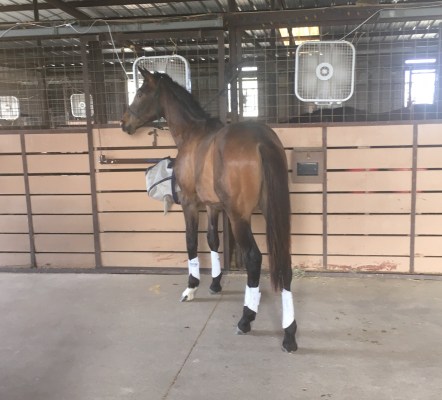
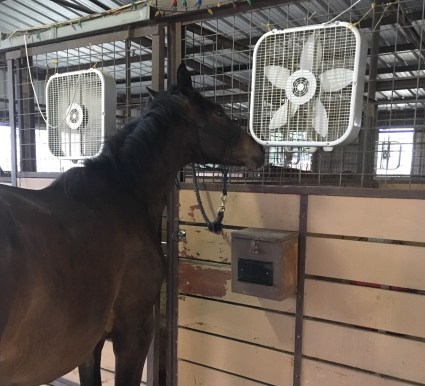
Then we went back into the barn and I again tied Presto in the aisle and ignored him while I untacked Henry and took him over for a bath. Once Henry was squared away in front of the fan, I went over and groomed Presto. He gets attention when I decide he gets attention, and for now he’s #2 on this hierarchy. Poor kid, having to learn that the world doesn’t revolve around him. Life is hard.
I liked how today went, and I felt like I was able to “work” both of them at the same time, really optimizing the little bit of time that I have in the mornings. I wasn’t rushing through either one of them to make sure I could get to the other, and I got everything done with each of them that I wanted to get done. This little arrangement might happen more often.
Henry using someone’s box as a foot rest, because sure?
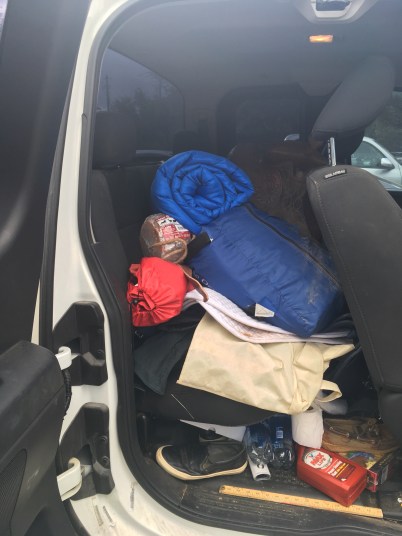
Of all the things that equestrians are kind of “renowned” for, the one I’ve always been most guilty of is the messy car. On any given day there may or may not be a passenger seat available (usually not), and you may as well forget about the backseat entirely. If anyone ever peers into my windows they would probably assume that I’m homeless (and/or a serial killer), given that it usually contains a tent, a sleeping bag, a full set of linens/blanket/2 pillows, chairs, toilet paper, a wide variety of clothing, and a really weird assortment of tarps, tapes, rope, knives, scissors, and tack.
Yes that is a western saddle in the background. Don’t ask questions. Also I don’t really know where the ruler came from…
I’ve always felt relatively unapologetic about this. Like… I know that I technically should be embarrassed by it, but I’m not. My vehicles are always a mess, much like me and my life. Kinda makes sense. Part of the package.
I will always use a Fresh Prince gif when one is available
Plus it seems like every time I clean my truck out, I can’t find a damn thing. Or the one thing I needed, I took out. Like last time I went to a show, thinking I had my BOT dressage pad, but then I remembered that I took it out and stored it in the guest bedroom because I’m “supposed to”. I ended up having to go buy a new white pad at the show. So, ya know, being a walking disaster/hoarder sometimes has it’s benefits. I surrendered to my messiness a long time ago.
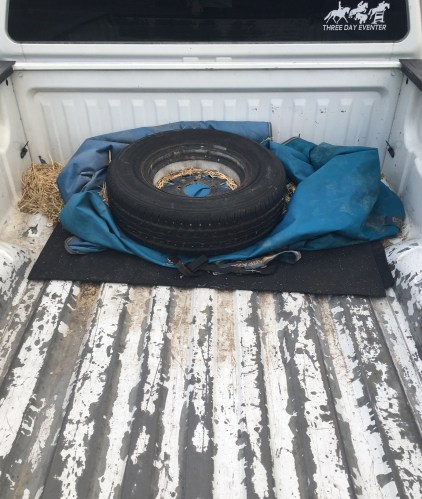
The only thing that’s changed about having a truck is that I now have another area to store crap… the kind of crap that I would never want to put inside of a car. The only problem is that the truck bed is kind of a black hole in my life, and I tend to completely forget it exists until I’m trying to set up my trunk tent. Then I’m like “geez, wtf is all this crap back here”? Because that’s typical.
Like those winter blankets that have been back there for a month. I should PROBABLY take those out and wash them. This post has actually prompted me to set a reminder on my phone for tonight so that I remember to go out and get them.
The rest of that crap is the spare tire for my trailer (which I usually keep IN the trailer when I’m not hauling, but forgot to put back in like 3 trips ago) and rubber mats. Don’t even ask. At least I took all of the broken jump standards and metal dressage letters out, finally, after like 6 months of toting them around. I’m telling you, I forget the bed of the truck is a thing that exists. Kinda like how I forget that the backseat isn’t technically supposed to be the backcloset.
I know I should be, but… I’m not sorry. And don’t even ask me to go through my purse right now. You think the truck is bad.