The Fluffy Experiment

As you may recall, I went on a quest a few months ago to find a saddle pad solution that would work for Captain Sensitive. Er, Henry. I’ve had problems on and off over the years with different pads rubbing him in different places, but this summer in particular everything I had seemed to irritate him somehow. I decided, somewhat desperately and very hesitantly, to try the sheep route. Natural fibers and plenty of protection for sensitive skin – maybe that would be the key?
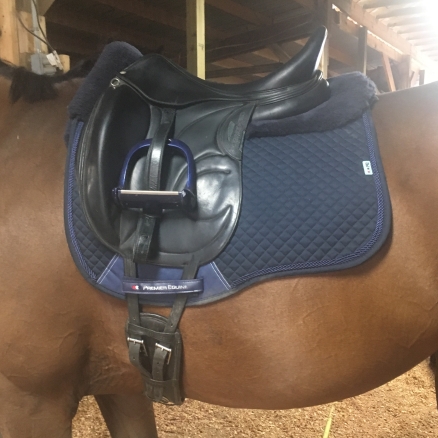
img_8967

This was not my first foray into the world of fluff. Way back in my hunter days (a separate lifetime, really) I had some Fleeceworks stuff. I thought it was kind of a PITA to take care of, but that could be because I’m kind of a garbage human in general and non-living things that require a lot of special or particular care will probably not fare well with me. Granted, I’ve gotten a little better about that with age. BUT, if Henry would be happier in a fluff-covered world, I was willing to give it a go again.

The real problem was trying to decide how to choose what to get. Back in the day there weren’t really a TON of options or brands. These days – you dream it, you can find it, or you can have it custom made. The first order of business: did I want sheepskin or did I want wool?
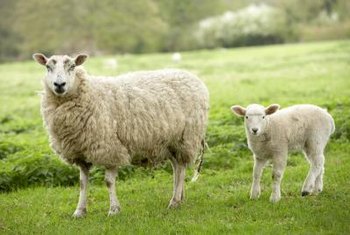
Image result for sheepskin difference wool

With sheepskin, the wool is still attached to the skin of the sheep, and that’s sewn onto the pad. With wool, it’s been sheared from the sheep and woven onto a fabric backing. Not really sure which I would prefer, I scoured the internet to see what other people had to say about the two. The general consensus was that sheepskin tends to be more dense, which makes some people think it offers better shock absorption, but that it was harder to clean. Since the skin of the sheep is still attached, you kind of have to think of it as a leather item, which requires special care when washing. With wool, since it’s attached to a fabric backing, it’s easier to wash and care for. Some people also prefer the fact that a sheep didn’t have to die to make the wool. And it’s cheaper. Both sheepskin and wool are touted for their excellent wicking abilities, superior airflow, and comfort. So basically – did I want it still attached to the skin, or not?

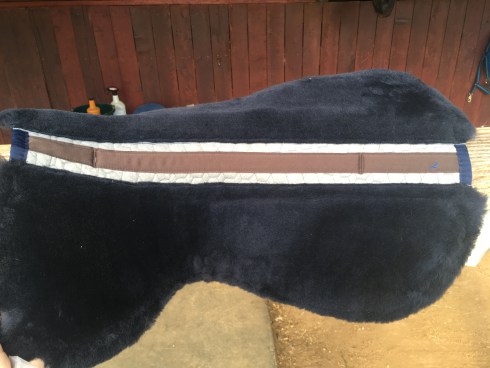
There are other factors to consider, too, of course. Do you want the spine of the pad to have wool or not? Some claim that having wool over the spine can make the pad bind on the horse’s back, where others claim that NOT having wool on the spine leaves seams that could rub or create pressure points. This is the point in your research where your head starts to spin and you wonder if the wisdom of the internet is a blessing or a curse. As with all things horse, there are many ways to do the same thing and everyone thinks their way is best.
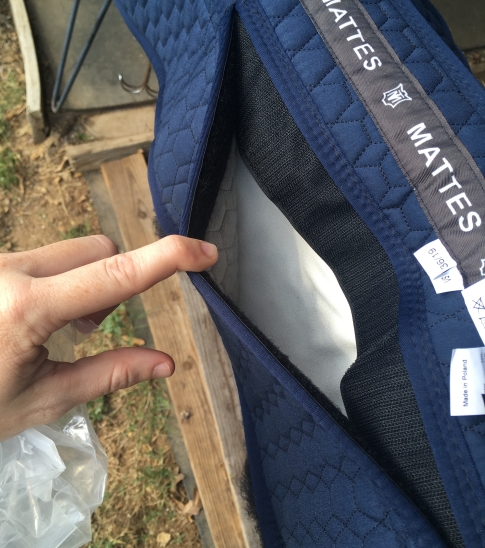
I also had to decide if I wanted to have the ability to add shims to the pad, to adjust the fit of the saddle if needed. Henry is older and maintains a steady shape, and his saddles fit him well (important to note: they were fitted to him specifically to allow for a half pad underneath). But Presto is a bit narrower and may require some shimming to make my saddles work for him.
img_9329
shim pockets

And THEN, after you figure all that stuff out, you get to decide whether you want said fluff on a half pad or on a full pad. And if you want rolls or no rolls on top. And how far down you want the fluff to go. And how much you want to pay for it. And what colors you want. And who you want to buy it from. So many options.

In the end I just couldn’t really make up my mind, because it’s tough to know what your horse will prefer until you try different things. Plus I have two horses to consider, and knowing my luck they’ll probably like different things. I also have two saddles, a jump saddle and a dressage saddle. So I bought a couple of Premier Equine merino wool full pads (wool, covered spine, no shim options) – one dressage and one jump – and a Mattes half pad (sheepskin, clear spine, with shim pockets). I got that one in an XL jump shape so that I could still use my dressage saddle with it and everything would sit ok underneath. All bases covered. Or… no actual hard decisions made, since I got a little bit of everything.
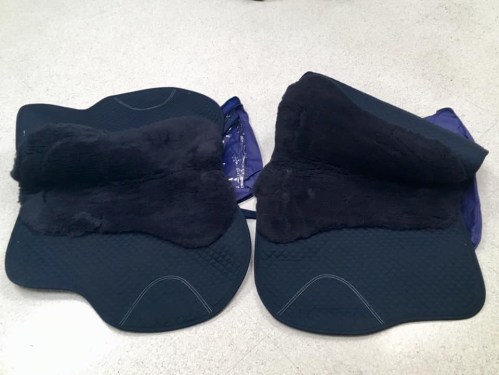
underside of the Premier Equine pads

Well ok I did make ONE decision – navy. Everything navy. Color is the easiest part.

I’ve been using all of them, trying to get a feel for how they compare and what I think of the different designs and wool vs skeepskin. I remain convinced that it’s an entirely personal choice. The Premier Equine pads, with their merino wool, are definitely a lot easier to take care of than I thought they would be. My memories of taking care of my sheepskin pad back in the day were not very fond, but these have been pretty easy. They don’t get gross very fast, because the horse’s back stays so much cooler under them. I’ve only washed them once so far, and that was this week.

If we put them in a head to head comparison, I think they both have their pros and cons. For ease of care and wash, the nod would go to the merino wool. I tossed them in the wash with nothing special and they came out looking new again. Granted, neither the sheepskin or the merino wool gets gross very fast, because the horse’s back stays so much cooler and drier under them. I would also give a very slight nod to the merino when it comes to breathability, I have noticed that Henry’s back is ever so slightly drier under the merino than the sheepskin. As to the shock absorption factor, I definitely feel that both of them do absorb some impact, but I don’t notice a difference between the two.

If you’re looking for luxury, sheepskin wins. The material just FEELS expensive, and really soft. They’re both soft, but sitting right next to each other the skeepskin is clearly more luxurious. The merino wool is more coarse to my own hand, although I haven’t noticed any difference in how Captain Sensitive feels about one vs the other. I also haven’t noticed a difference in how he feels about the wool covered spine or the clear spine – he seems to have no preference. I like the idea of the wool covered spine more, just because any “disruptions” to the surface of things that are touching him have generally been a problem, but in this case I can’t say that I’ve seen anything to actually back up my theory. Without a doubt though, Henry has had ZERO rubs or skin irritation since I swapped to the fluffy pads, both seem to have done the trick.

Both pads also have good wither clearance, which is very important. If you have an exceptionally high withered horse I might be inclined to go with the clear spine, so the pad sits a bit further up off the wither. For longevity, I can see the sheepskin lasting a bit longer too (uh… assuming I don’t accidentally destroy it in the wash…). The merino wool, being attached to a fabric backing, does shed a little bit whenever it’s brushed or washed.

The care hasn’t been as hard as I had imagined. Like I said, they don’t get gross very quickly. I just hang them upside down in the tack room so they can dry between rides, and once a week or so I brush out the fluff with a slicker brush. The sheepskin/wool is actually a lot easier to keep clean than the cotton parts!
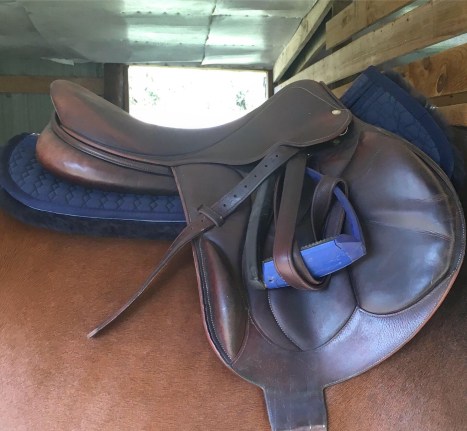
There was, of course, a massive price difference between the two. I paid $108 for BOTH of the Premier Equine pads (on sale, with a coupon code), making them $54 each. The sheepskin Mattes half pad was $140 on it’s own, and that was from Australian company Hufglocken, who definitely has the best prices on Mattes (and always has coupon codes too). The same pad from an American shop would have been closer to $300. The construction of the Mattes is clearly superior, as you would expect from the price difference, and they can make just about anything you can possibly dream up. The options on the Premier Equine pads are many fewer (and sadly I don’t like most of their color combinations), and none are shimmable, and they don’t have any customization. The Mattes took longer to get, of course, being a custom order and then having to go from Europe to Australia to the US. It was a couple months all total. The Premier Equine pads made it from the UK to my door in just a few days. Of course, these aren’t the only two brands on the market either… there are LOTS, with all kinds of different options.

To me there’s not a really super clear winner between the two. I think it depends on you and your horse, and what you want from the pad. I actually really love having both, because between the two designs I feel like pretty much all of my possible needs are covered. Each has it’s perks, and their own pros and cons. Overall though, I’m pleasantly surprised by how much I’m liking my fluffy pads in general. I was scared to take the leap, because of the care, but they’ve been much easier than I thought and Henry really seems to like them. I will be buying more, since I want show pads too.

I’ll do a separate review of just the Mattes pad by itself soon, with more details about it and all of the possible options. Until then, hopefully this helps anyone who’s thinking about going the fluffy route themselves. I don’t regret it!
It’s OK to just… Not

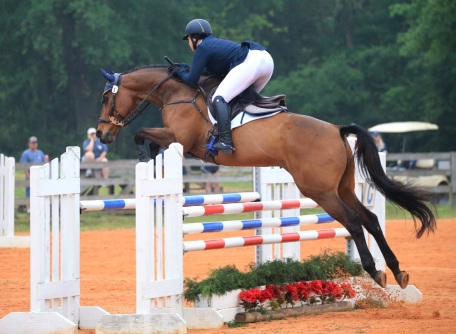
I only did 2 recognized horse trials this year. In the grand scheme of things, that’s… certainly not a lot. Especially considering that a lot of people do that many shows per month. I kind of expected to reflect back on that figure and feel a bit “disappointed”, but truth be told, I’m not.

PHrecPrelim2

Sometimes I have major FOMO when I see other people showing all the time, all season long. Sometimes I stalk the online scores, look for any pictures and videos I can find from the show, and check all the course walk sites to try to get an idea of the courses. And then other times, I just kind of look at everyone’s posts from the show and think “good for them” and keep right on scrolling. That’s it, no FOMO, and I don’t particularly feel driven to follow that closely. Because, to be honest, sometimes it just feels nice to take a step back from it all and take a deep breath.

I feel like we don’t often really see that side of other people though. Nobody gets on Facebook or Instagram to talk about their long breaks, how few shows they’re doing, how they’re taking some time to fill the holes at home, or that they just plain want to slow everything down and reconnect with their horses again. All we really see, and what we seem to be conditioned to crave, are the show pictures and show results… the glossy glamorous exciting stuff. We’re impressed by that, and we want pretty show pictures and results of our own.

img_9575.jpg

It almost leaves you feeling guilty or like you’re doing it wrong if you aren’t following suit. If you aren’t showing 10 or 12 or 20 or however many times a year it takes to make you “serious”. If you’re not always looking onward to the next show. If your life isn’t constantly consumed by the next jump lesson, the next XC schooling, or trying to perfect that one elusive dressage movement that you just can’t seem to score above a 6. People start asking you where you are, and when your next show will be. If they don’t see you on the entry list, they tend to ask you what’s wrong. Because surely something must be wrong if you aren’t out there at all the shows, right? As if life’s rhythm is dictated by the show season.

A lot of the time, I’m totally ok with that. I love showing, I enjoy it, and it’s fun. Most of the time I do live that lifestyle, consumed by progress and what’s next. But also… it’s not the be all, end all for me. For some people it is, 100% of the time, and that’s fine, but for other people it isn’t. When I start feeling a little burned out or like I want to step back and re-center myself, I often find myself looking at other people and wondering why they never seem to feel like that. How they can go from show to show to show and never want a break, and why I seem to be wired “wrong” compared to so many of my peers. I try to light the competitive fire under myself, or look for shows to sign up for. Sometimes I even do it without really considering if I actually WANT to. There’s this expectation in our sport’s culture that we’ll just keep trudging on, from one show to the next, and so that’s what we do.

I mean, after all, that’s so often how we decide our worth as a rider isn’t it? What level have you gotten to, how many runs have you had, how does your record look? The better it is, the more respected you are, right? The more your opinion matters. So to prove ourselves to the world, and to keep getting those glossy photos and show reports that we so crave, we keep going, always seeking more, because that’s just how it’s done.

But the truth is, it’s okay to just… not. I don’t know who needs to hear this today, but it’s okay to take a step back, for any reason you want, or for no actual freaking reason at all. Don’t feel like it? Then don’t. You don’t owe anyone an explanation, and you certainly shouldn’t feel guilty about it. Sometimes you’re totally gung-ho to just traintraintrain showshowshow and other times it does a world of good to take a few months to ride bareback, or hack out for hours, or just take the pressure off and reconnect with your horses. Whatever. You do you. When you’re ready, IF you’re ready, come back to it – I promise the sport will still be here. Whatever you decide to do has no bearing on your worth as a rider or your validity in the sport. Sometimes we just need to spend some time taking ridiculous pictures of our horses making weird faces, or sew pompoms on our helmets, or do bareback dressage in the field. And we have to stop thinking of that time and those things as a “waste” or something to feel bad about.

We all get different things out of this, and have different journeys. They don’t all have to look the same, and it doesn’t mean you’re any “less than”. Have fun, love your horses, and enjoy the time you get to spend with them. If you’re doing those things, you’re doing it right, no matter how many shows end up on your record.

Brontosaurus on a Leash

I’m not doing much with Presto at the moment. He’s officially 2.5 (ok to be precise he’s 2 years, 7 months, and 6 days, but WHO’S COUNTING?) and I’m pretty sure the closer he gets to 3, the slower time actually goes. In the grand scheme of things 3 is super young and babyish, sure, but when you consider that this horse has been “in planning” since 2014, it feels like a really long time to get to a point where they’re almost a real horse. We’re at that “so close, yet so far” stage right now.

Henry, for one, cannot wait.

Luckily he is super chill and retains everything well, so I don’t have to do much with him. His transition over to his new living arrangement went pretty seamlessly, and he seems very content. I bring him in one day a week to make sure he hasn’t gone feral, but otherwise he just hangs out and eats and plays with his friends. He has taken the perfectly middle position in his herd, below the iron rule of the older mare, but ahead of the yearling. None of them cares when another one leaves, so there are no herdbound issues, which is what I was most afraid of. It’s almost like having a younger horse in the dynamic has made Presto mature a little bit. Which, btw, the poor yearling somehow managed to get himself skunked last week. What are the odds that a skunk could be anywhere near Presto and he actually manage to NOT be part of it? I know, I’m also shocked.

Still though, despite missing the actual skunking, he was filthy and disgusting. And it was 90 degrees on Sunday. So I made an evil plan to roll a couple different things into our once-a-week activity day: ponying and a bath.

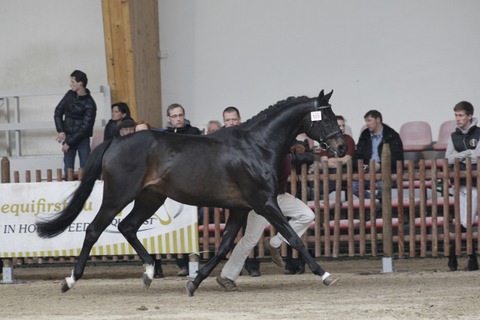
First, the ponying. This is where things are getting just a bit freaking ridiculous. Thank goodness I taught him to pony when he was still small, because…

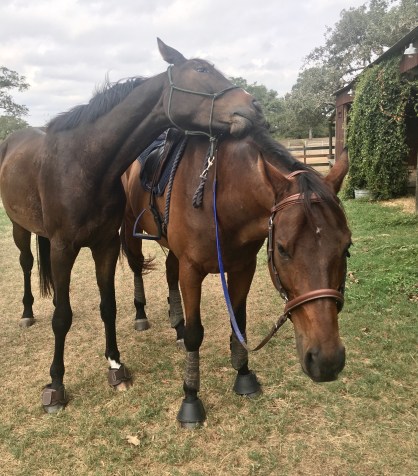
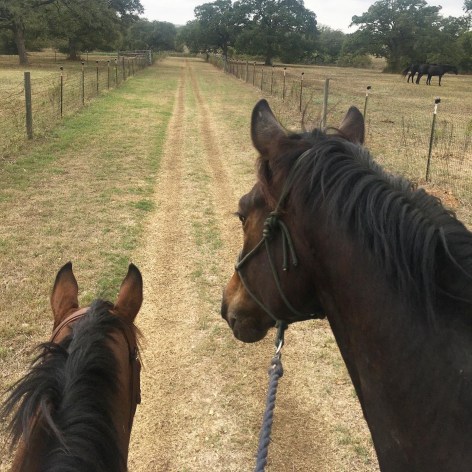
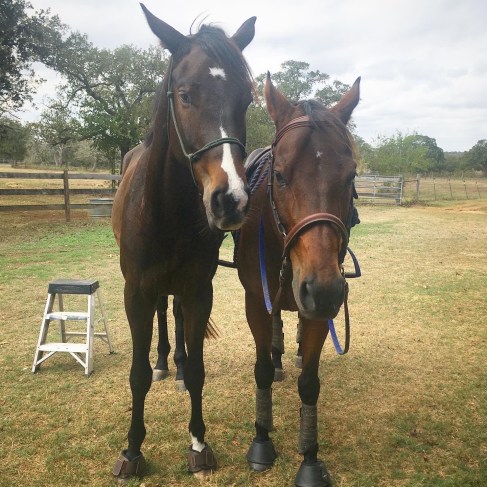
at this point who’s ponying who anymore? It’s almost comical. It’s like I’ve got a damn brontosaurus on a leash. Poor Henry with his average height and low set neck.

Yes, poor Henry. 

I haven’t sticked Presto in months, therefore, by my supreme logic, he’s still the same size he was the last time I sticked him. New plan: never stick him again. Really though, I don’t think he’s added much more height lately, but he is definitely filling out. I switched both boys over to Bluebonnet Omega Force when we moved, and while I think it’s too soon to say for sure, I’m liking how they look on it so far. Of course, Presto is also eyeballs deep in a round bale pretty much 24/7, which helps.

img_9526.jpg
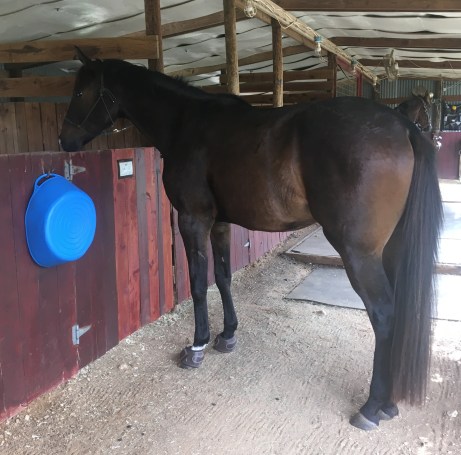
Dat booty tho

Anyway, the ponying was pretty uneventful. It’s to the point though now where Henry struggles to keep up with him at the walk, and Presto constantly has to check himself or shorten his stride. His legs are longer and his walk is naturally bigger and more swinging. But we took him around the entire property, up and down the little hills and across the natural ditch, and he took it all in stride.

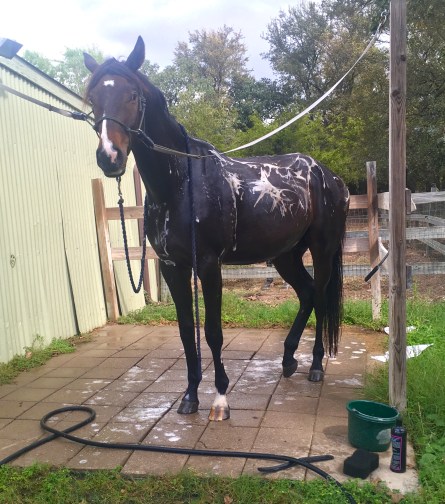
The bath though… that pissed him off. I don’t really understand why he hates baths so much, because he LOVES water. He likes to stomp in it, stand in it, roll in it. He even likes to stand in the rain. Why is a bath so different? BUT, jokes on him, because I finally have a real washrack at my disposal. Every barn I’ve kept him at before now has just had a hosing area, not an actual washrack, so bathing him has been annoying AF. But this time, much to his chagrin, he had very little choice but to stand still and accept his fate.

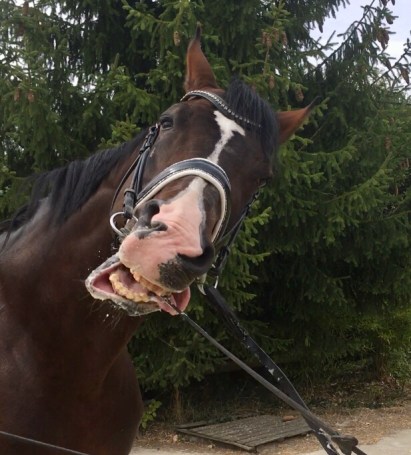
What do you think he’s saying to me here with that face?

So stand he did, and scrub I did, and let the record show that he was clean for at least an hour. I even made him stand in the barn crossties under the fan until he dried, because I’m extra mean and horrible.

His missing chunk of heel continues to give him no problem, knock on wood, and is already growing out some. He’s had his feet trimmed twice since The Incident and the farrier is happy with how it’s looking. Hopefully the heel continues to grows back in normally and we don’t have any cracking. We shall see. Until then I’ll be over here trying to resist making a countdown clock for his 3rd birthday.

Oh shit, I just realized… it’s time to start shopping for his birthday hat…

It’s In the Blood: 2019 YEH Championships

Is there anything more exciting than an American young horse championship? Okay, maybe… but not too many things. Looking at the potential superstar horses of future is really fun. Before we dive into the details though, I do have to say: breeders, owners, importers, riders, PLEASE for the love of all that is holy, make sure your horse’s pedigree is entered in some kind of online database. I spent more than 6 hours researching all the YEH entries to try to get enough pedigree information to come up with numbers and details, and it was tedious AF. Between horsetelex, rimondo, hippomundo, allbreed, pedigreequery, equine access, the irish horse register, webpedigrees, and good ol’ google, I was able to dig up and piece together the vast majority, but jesus H. That was ridiculous. It is 2thousandfreaking19.

Image result for head wall gif
how I felt during this entire process

If you don’t want to enter your own horses or don’t know how/where, send them to me and I’ll gladly enter them all for you. I’m not sure how we’re supposed to learn if we can’t even easily access a pedigree. Also, I’m convinced that there’s a special place in hell for people who own papered horses, make the show name different from the registered name, and then choose to put “unknown” as the parentage for the horse’s USEA or USEF recording. I think I’ve found my new biggest pet peeve. DO NOT DO IT. I AM JUDGING YOU.

Okay, moving on.

Image result for young event horse usea

Let’s start with the 4yo’s, and I’ve combined the West Coast horses in with the East Coasters. Same judges, two days apart, so the scores are comparable. The highest scoring 4yo (also the highest scoring horse of the whole 2019 YEH Champs) was Courtney Cooper’s Excel Star Time to Shine, an imported Irish horse by Luidam (by Guidam) out of a Cavalier Royale mare. If those names sound familiar to you, they should… they’ve been mentioned before in these In The Blood recaps of 5* horses that I keep forcing you to read. Luidam died in 2017 but is the sire of an up and coming young stallion that was getting a lot of buzz when we were in France last month – Candy de Nantuel.

Image result for luidam stallion
Luidam

Those certainly weren’t the only “familiar” bloodlines in the field, though. Names like Ramiro B, OBOS Quality 004, Quite Easy, Jaguar Mail, Contendro, Mighty Magic, Heraldik xx, Clover Hill… we’ve seen them time and again in some of the top horses in the world.  In fact, those same sires were in the pedigrees of the horses competing in the 6 and 7yo World Championships on the same day in France. It bodes well for the quality of horse that we’re seeing in this country. Even more encouraging is that 68% of the 4yo field was bred in North America.

There were two full siblings, by Jaguar Mail out of a Primitive Rising xx mare (making them 90% blood!). Some googling showed that there were actually 3 full siblings born that year via embryo transfer, all owned by Boyd.

that time I made googly eyes at Jaguar Mail

The average blood percentage for the 4yo field was 64%, with thoroughbred being quite popular and close up in the pedigrees, as we’ve rightly come to expect with eventers. Eight horses (25% of the field) had at least one full thoroughbred parent. There were 3 full thoroughbreds, one by Bernardini, one by Hunt Crossing, and one by Warrior’s Reward.

Two entries in the 4yo field were sired by what have generally been known as hunter stallions here in the US – Cunningham and Escapade. There’s also one by dressage stallion Sezuan.

Image result for cunningham stallion
Cunningham (Cassini x Contender) – maybe not such a surprise

As far as scores go, the highest dressage score and overall second place of the East Coast (and the winner of the US Event Horse Futurity) was Double Diamond C by Diacontinus out of LePrimeur mare. West Coast horse Keep Calm, by Biscayo (by Contendro) out of a Numero Uno mare, slightly edged him out for the overall best dressage score by just .2 points. The highest conformation score of the entire YEH Championship went to Keepsake, by the thoroughbred stallion National Anthem xx. Keepsake was also one of only two horses on the East Coast to get a General Impression score over 9.

Moving on the the 5yo’s, I sure hope Tara Tibbetts is reading because she’s gonna LOVE this. The West Coast winner (3rd place overall) with the highest combined jumping score of any 5yo was the full thoroughbred Mucho Me Gusto, by Macho Uno (by Holy Bull) out of a Ghostzapper mare. He raced 10 times before starting his eventing career last year.

The overall winner of the 5yo was FE Celestino, a German bred horse by Ce-Matin (by Cellestial) out of a Betel xx mare. He scored 30 out of 30 on XC, the only horse to do so.

ce-matin
Ce-Matin

The percentage of North American bred horses drops a bit in the 5yo group, to 54%.

Dipping further into the field, we again see some big names in eventing breeding, just as we did with the 4yo’s. There are more OBOS Quality 004 offspring, another Quite Easy, Riverman, Master Imp xx, Lux Z, Shannondale Sarco, Balou du Rouet, and so on. The average blood percentage of the 5yo field was the same – 64% – with 8 full thoroughbreds. Of all the 5yo’s, 37% had at least one full thoroughbred parent.

Some of the TB names on repeat were National Anthem – who had a direct offspring in each group, AP Indy – who is represented THREE more times, and Distorted Humor. It’s notable to me to see AP Indy show up as the sire’s sire on three horses, all through different sons – Bernardini xx (that offspring was out of a Gold Tribute xx mare), Malibu Moon xx (offspring out of a Brahms xx mare), and Dance with Ravens xx (offspring out of a Broad Brush xx mare). Distorted Humor showed up through sons Understatement xx (offspring out of a Welsh Cob mare) and Distorted Reality xx (offspring out of an Atticus xx mare).

Image result for ap indy
AP Indy

Lovers of a less traditional event horse – yes you did read that right, there was a Welsh Cob/TB cross in attendance. MFS High Octane has a full TB sire and is out of a mare by Brynarian Brenin ap Maldwyn, the same sire as 5* horse Honor Me.

The feel-good story of the weekend definitely goes to full TB mare Not Ours (registered as Small Batch, by Cherokee’s Boy out of a Broken Vow mare) who came out of the New Holland kill pen as a 2yo having already raced 7 times. Not Ours placed 2nd overall in the East Coast 5yo’s, with the second highest dressage score and second highest XC score.

All of this is even more exciting knowing that we’ll finally have a 6 and 7yo international event next fall. Will we see some of these 5yo’s again in the 6yo 2* class next year at Morven Park? I guess we’ll find out…

It’s In The Blood: Mondial du Lion 2019

Putting together stats on younger horses is always a bit more difficult. It’s harder to find info about them and harder to dig up complete pedigrees, which makes all the stats more challenging. I spend a lot of time digging through the depths of the internet trying to piece things together. One day we’ll have a nice, official, all-inclusive database right? A gal can dream.

Image result for mondial du lion

But anyway, it’s Mondial du Lion time again, one of my favorite events of the year. It’s the World Championships for 6 and 7yo horses held every fall in France, with 6yo’s competing at 2* and 7yo’s competing at 3*. Some of the very best 5* horses in the world competed at MdL on their way up the ranks, with a whopping 35% of 2018’s entire WEG eventing field having competed at Lion. My research has shown that it doesn’t even necessarily matter how they place – some future superstars finished way down the leaderboard in their year – but just having competed here seems to give them a leg up. Lion is touted by riders as being a fantastic and essential learning experience, with a bit tougher courses than these horses have seen so far, and certainly A LOT more atmosphere. They tend to leave MdL much more seasoned, regardless of the score. Last year’s 7yo winner, Asha P (who has a stallion full-brother, Araldik), was just part of the gold medal winning Nation’s Cup team for Germany at Boekelo.

Looking at this year’s 6yo field, we see a lot of the typical bloodlines we’ve come to expect from watching the 4* and 5* horses: a lot of jumper breeding, largely holsteiner and selle francais, mixed with blood. The average blood percentage of the 6yo’s (the ones that I could verify for sure, anyway) is 51%. Six horses (14% of the field) have a full thoroughbred parent, and another 3 have a full thoroughbred damsire. The thoroughbred stallion Esteban xx has two offspring in the field, one Belgian Warmblood and one Holsteiner. Esteban is well-established as a sire of eventers, with multiple offspring having competed through 4* and 5* level.

Image result for esteban xx
Esteban xx

The 7yo field boasts a similar average blood percentage at 50%, and also has 6 horses with a full thoroughbred parent. Interestingly, only one of those is the sire, the other 5 are full TB dams. An additional 7 horses have full thoroughbred damsires.

Several other stallions are represented by multiple entries across the two divisions. Trakehner stallion Grafenstolz (who we met in France last month) is the sire of 5 horses, Mighty Magic (also met in France last month) is the sire of 3, Quite Easy is the sire of 2, Rock Forever is the sire of 2,  King Size is the sire of 2, OBOS Quality 004 is the sire of 3 and damsire of 1, Shannondale Sarco is the sire of 2, Ramiro B is the sire of 2, Cavalier Royale is the sire of 1 and damsire of 3. Spoiler alert: you’ll see some of these names again next week in the Young Event Horse Championships recap.

I will probably never mention Mighty Magic without using this picture, get used to it

A few dressage stallions are represented as well, something that you see sometimes at the middle levels but is quite rare at 5*. Most of the ones in this field, though, are not too surprising if you look at the actual pedigree. Rock Forever, while a Grand Prix dressage horse himself, is quite jumper-bred, from Ramiro, Landgraf, and Grandus lines. The stallion Catoo (sire of one of the 7yo’s) has a similar story – he had a GP dressage career but is completely jumper-bred. One stallion that is perhaps less expected to see as an event horse sire is Vitalis, sire of 7yo Victor 107, from dressage lines Krack C, Jazz, and Donnerhall.

Image result for vitalis stallion
Vitalis

As we’ve become accustomed to seeing by now, the French and Irish are sat almost exclusively on horses bred in their home countries. Only two French riders have non-French bred horses, and only two Irish riders have non-Irish bred horses.

Another fun fact – Leprince des Bois, another horse that we saw last month in Europe, was a 5* event horse in his own right (competed at Pau, Badminton, Luhmuhlen, and Burghley under Kai Ruder) and is the damsire of one horse – a Selle Francais ridden by none other than Chris Burton. He finished 7th in the 6yo class here at Lion last year.

Want to watch Mondial du Lion and try to pick out your favorite future superstar? The live feed is on their home page, along with links to the start lists and results.