Cross Country and Bitting

Ah yes, the good ol’ fashioned “how to make eventing safer” debate. Depending on who you ask, there are all kinds of things to blame for safety issues. I’ve heard everything from the death of the long format, to the change over to the popularity of the warmblood, to the footing, to the course design, to the speed, to the technicality, to the level creep, to the fence construction, to the way riders are brought up and trained, to money, to pressure, and even tack choices. To be honest, I think there’s some truth to be found in almost all of them. It’s not a simple situation, and I don’t think there’s one answer. At the end of the day we’re still galloping horses at solid fences, and there’s still a lot that could go wrong.
PHPrelimTrak
like a rider missing a distance, for example… ahem.

First, though, I think it’s important to acknowledge that, statistically, eventing has gotten safer over the past 10-15 years. The fall rate has dropped, including that of rotational falls, since that data started being tracked. There’s no disputing that. We definitely do hear about mishaps more these days, in the age of social media. Everything that happens, at any event, anywhere, is common knowledge within hours. At the same time, I also think it’s true that here’s also more improvement to be made, and more we can be doing.

It’s always interesting to me to hear the perspective of top professionals on this issue. Some of them just kind of shrug and point to rider responsibility, but others have clearly given it a lot of thought and spent a lot of time formulating their opinion. A few days ago Horse & Hound posted an except from Eric Smiley‘s new book “Two Brains One Aim”, in which he talks about how he thinks that a trend toward bigger and harsher bitting setups have led to increased danger on the cross country phase. The full except can be found at the link above, and I highly recommend giving it a read, but I pulled a few quotes that jumped out at me.

Two Brains, One Aim

I first noticed the desire to achieve greater control when the minimum weight restriction was removed from the eventing cross-country phase in 1998 (previously all horses had to carry 165lbs (75kg), made up with lead weight if necessary, for the cross-country phase). At the same time, courses started becoming more technical. These two changes brought control into focus as lighter riders were now riding big, “scopey” horses, and they needed better control to negotiate the more technical courses. The short fix was to find a bit that offered more control.

Asking a horse to gallop at Preliminary (US) or Novice (UK) cross-country speed of 520mpm before he is comfortable with a fast canter (350–400mpm) has every chance of triggering his natural response of “run.” The moment speed becomes a conditioned response to the rider shortening her stirrups and getting into an open space, the rider feels the need to control it. Now problems arise and the perception is that brakes are needed.

The range of bits and gadgets is endless. Some of the most popular are:

The three-ring or bubble bit.
➤ The elevator.
➤ Rings and pulley reins in various forms.
➤ Curb chains — excessively tight.

Every one of these is a potential disaster waiting to happen! The bits I have listed above, and others like them, have an action that encourages hollowness in the horse’s way of going that is detrimental both on the flat and over fences.


But by using bits that encourage an incorrect way of going, we create many problems for ourselves and the horse:

➤ The jaw shows resistance.
➤ The head comes up.
➤ The neck goes hollow.
➤ The shoulders become blocked.
➤ The steering becomes delayed and unresponsive.
➤ The back becomes less “through.”
➤ The rider stops using her legs for fear of more speed.
➤ The horse’s hind legs are less engaged.
➤ The rider’s hands become the dominant aid.

Spend a day watching cross-country and you will see some unsightly pictures. Look more closely and there is also a trend: most of the ugly sights are control issues. Look more closely and you will see these control issues will also have a bit issue. Course designers cannot make the jumping phases of eventing higher or wider in their effort to separate competitors, so they have had to use their imagination to test the control of horse and rider.

To produce a suitable canter or gallop, the horse must allow himself to be balanced by accepting the rider’s leg aids. These aids should engage the hind end in a way that doesn’t produce speed, but encourages the horse to accept the contact and the resulting adjustment to speed in a round and rideable way. Failure to do this makes it difficult for the horse to see, assess, and take responsibility for his part in the jump.

Eric’s perspective is one that I haven’t heard many people mention, especially not this in-depth. I don’t necessarily think it’s always true across the board, but I’m sure any of us can sit here and think of many scenarios for which it certainly does apply. You definitely see some wacky bitting rigs on cross country (y’all know how I feel about ML’s choices) and many times, sooner or later, it does end up going the way that Eric says.

Image result for marilyn little bit
This photo from Boekelo will never stop making me cringe

Of course… bad things happen in snaffles too. That’s an undeniable fact. I also think that not every horse can go in a snaffle, no matter how much we want them to. His perspective does get me thinking, though. I found myself going “he’s not wrong…” to a lot of what he’s saying. Examples of misusage of bits and equipment can be found across the board in all sports – most just don’t have as much inherent risk already at play as ours does.

It makes me take a closer look at what I’m doing, and the equipment I’m using. Yes, Henry goes cross country in a snaffle, and yes, we work on adjustability from seat and leg EVERY. SINGLE. DAY. But are we good enough at those things? No, probably not.
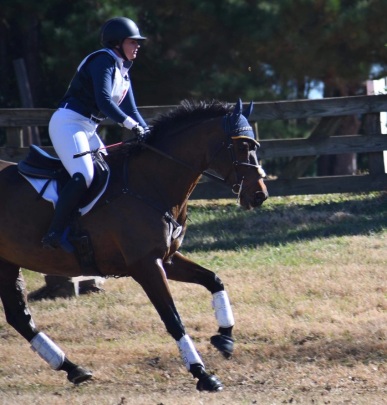
PHPrelimgallop1

What are your thoughts on Eric’s perspective? Do you think that there’s an issue with bitting (or, really, a constant quest for ever more control over the horse) across disciplines? Do we cover up basic training issues with bigger bits? And does that eventually catch up with some of us later on down the road? Whether or not you agree with what Eric is saying, I hope you at least think it’s as interesting to ponder as I do, applied both to what you see from others and to what you see with yourself and your own horse.

Oh and totally by random happenstance, I noticed that Trafalgar Square has a 20% off sale today (use code LOVEHORSES), and they carry Eric’s book. I haven’t read it, I have no idea how it is, but I ordered a copy for myself this morning!
Mid-Week Mashup

I have a lot of little things today that are kind of random but this week is full of exciting stuff, so bear with me here…

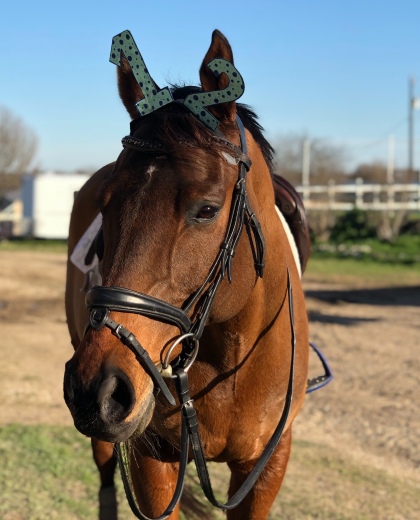
First, and most important, today is Henry’s 12th birthday! Time is flying, guys. How is he TWELVE already??? Sometimes I wish I could just stop the clock so he could stay this age forever. I love him so much, it’s borderline ridiculous.

And yes, it’s possible that I raided the office supplies to make him a headband at work yesterday, so that I could take birthday pictures.

Second – I have TWO giveaways running right now and both of them end tomorrow, so if you haven’t entered yet, today is the day! The first giveaway is based here, through the blog, for the US Event Horse Futurity. It’s super easy to enter and there’s a gift card and saddle pad up for grabs, check out the post if you haven’t seen it yet.

The other giveaway is through my Instagram and there’s a $100 Riding Warehouse gift card up for grabs! It’s worth a shot, free money is awesome.

Semi-related to the first giveaway – if you’re not following the US Event Horse Futurity on facebook, you’re really missing out. I am loving all the vlogs posted by the trainers so far, showing what they’ve been doing with their Futurity horses and what they’re working on. There are some awesome little training tidbits in there, and it’s really interesting (at least to me) to see how these different riders start their horses. Yesterday they posted the second of Doug Payne’s entries, Quberon (one of my early favorites), and showed what he’s been doing during his first couple months of training. Doug talks about how he starts his horses under saddle, when he introduces jumping for the first time, his thoughts on their first horse shows, etc. It’s so educational, I’m loving it. Can’t wait to see more of these from all the different riders!


Henry has a fancy new bit on the way! Riding Warehouse is carrying Neue Schule bits now, which is dangerous as hell, and after much deliberation I settled on giving the “Tranz Angled Lozenge Eggbutt Bit” a whirl. He’s been going in a KK Ultra for dressage for a few years now, so I’m interested to see how this one compares and see if he likes it. You never know with Henry, he’s a delicate flower. I’ve heard a lot of really good things about the Neue Schule brand though, so I’m cautiously optimistic.


And last but not least, I’ve finally found a couple of horse-related podcasts that I like! I’m a big podcast fan, but I’m also really picky, especially when it comes to content (or on the more shallow end of the spectrum – people’s voices). I want to learn something from a podcast, or at least feel like I’m really engaged in the subject matter. I haven’t found many that have kept me consistently coming back for more.

The first one I’ve really been enjoying is Major League Eventing. They interview bigger name event riders, which isn’t something that would typically grab me, but I like the conversational style and the questions they ask. It’s more interesting than I originally thought it would be, and I’ve listened to most of the episodes by now.

MLEpodcast

My favorite one is Big Talk for Breeders, which… I KNOWWWW, most people aren’t going to be interested in, but hear me out. An Irish showjumping breeder (which – the host has a very pleasing Irish accent, that makes it a winner already) interviews some of the most successful sporthorse breeders in the world. The first episode was a little rocky for me, but each episode after that has gotten better. The host asks really good questions, and I’m always so fascinated to hear all the different approaches when it comes to breeding. There aren’t many episodes yet, but I’m looking forward to more.

This weekend is our next Prelim HT (the weather is looking more and more cooperative – except its supposed to be 85 degrees on Friday, WTF?) and then next Tuesday, Michelle and I fly to Ocala for USEA’s YEH/FEH symposium. Not gonna lie, it’s possible that I’ve already plotted out a few tack shops to hit on the first day. For uh… ya know… research.

What are you guys up to this week? Any cool things you’re loving right now?


State of the Presto

I was thisclose to calling this post “State of the Ballsack” instead but it includes more than just the current status of Presto’s nut-removal situation, so I had to be more inclusive. Oh, and btw, the state of the ballsack is: empty.

IT’S WHAT?

By last Tuesday/Wednesday the last of the swelling was pretty much gone from his sheath, and everything has looked normal since. No more cold hosing or forced exercise, and I don’t feel sorry for him anymore.

Which means… back to “work”! Which, for Presto, really just meant another long-lining and ground driving session.

img_3597

This time, though, we ditched the halter, and I clipped the lines directly to his bit. This was his first time having anything actually interacting with his mouth directly, so before we started the session I did some very basic “pressure on this side means move your head this way” lessons at the halt. The idea of yielding to pressure is nothing new, so he had that figured out pretty quickly. Then we started on a small walk circle and practiced whoa. He knows the voice command well, so I started with the voice command and a teeny bit of pressure on the reins. He wasn’t a big fan the first time.

But we did it a few more times, and each time was better. By the 5th or 6th time, I asked with just the lines, no voice, and he stopped. I mean… he gave me the stink eye about it, but he stopped. So then we went on to ground driving at the walk, and turning using the lines like long reins. That went a little easier, and he was actually quite responsive to the basic idea of following his nose. Much better than when we’ve done it in a halter. Things are getting serious, y’all. Boy genius right here.

very smart
much brains
img_3546
bigly IQ
What?

Oh, and that cob size bridle is definitely too small for him in the crownpiece now. It was barely workable last fall, but now the ear notches are not lining up with his actual ears, and everything up there is a bit… snug. The rest of the bridle is still okay though. For FEH classes this year (since 2yo’s have to show in a bridle) I will probably end up having to use Henry’s bridle’s crownpiece and then put the rest of the cob parts onto it. Awkward baby horse also has an awkward baby head.

We did hit a bit of a snag when I put him back in crossties. I used to crosstie him almost daily, but for the past few months I’ve mostly just been straight-tying him wherever there’s space. It was as if he’d forgotten the countless hours we spent learning how to stand still and straight in crossties, without wiggling. He was all over the place with his butt. Little Sir will now be crosstying again quite regularly, because I can’t stand wiggling.

He stands like a freaking rock when I tie him to the stocks. I have no idea why, but let’s not look a gift horse in the mouth.

It’s funny – for as relatively unpleasant as all of his extra attention was during his castration and recovery, he still seemed to enjoy it. I left him totally alone for a couple days last week but as soon as he saw commotion in the barn, he just stood there at the gate, staring in like he wanted desperately to be a part of whatever we were doing. That’s his signature move these days. He really craves the attention and I think he likes having something to engage his mind. Presto is so much like his mother in that way, always looking for something to do. If he inherited her work ethic I will be absolutely thrilled.

On Sunday the weather was too gross for regular turnout so I stuck him out with Henry in the arena.

img_3685

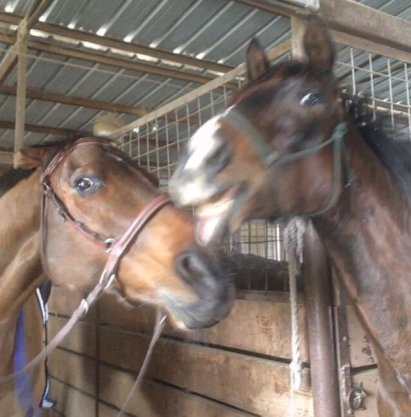
I’ve noticed that Presto has stopped doing the submissive chompy “baby face” thing to most horses anymore, but he still does it to Henry all the time. They’re almost the same size at this point so it’s a little amusing, but I think Presto has a healthy fear/respect when it comes to Henry. Which is fair. Henry is ruthless.

They did play a bit though, which was entertaining, mostly because Henry was more wild than Presto. There were airs above the ground from both of them though.

He’s like a little baby noodle, so flexible
Henrybucking
Henry probably thinks he’s really bucking

This week I’m going to make an effort to get an actual conformation picture of Presto, so we can start his little throughout-the-year comparison. I think I’ll stick him on those days too, and track his height in centimeters since that’ll be a little easier/more accurate to see the smaller height changes. Anything else y’all would be interested in seeing me track on a month-by-month basis with Presto? Since, ya know… this is hopefully the last post with specific details about his ballsack…

Winter Ruins Everything

BIG FAT HEAVY SIGH.

I suppose I should have known that winter still had another trick up her sleeve. The end of January was just so nice, and so warm. I got lulled into a false sense of confidence, excited about a full calendar and ramping up for spring.

img_3586
last week I was wearing a t-shirt and the ground was dry enough to jump, I MISS THOSE DAYS

We had grand plans to head up to MeadowCreek this past weekend to do some XC schooling. I was very excited to be heading somewhere besides Pine Hill. I love PH, don’t get me wrong, but that’s where we always school and there’s nothing on their course that Henry and I haven’t already jumped. I was looking forward to some new challenges and a change of scenery. Plus the first show of the season is at MeadowCreek, and I really wanted to check out their Prelim course.

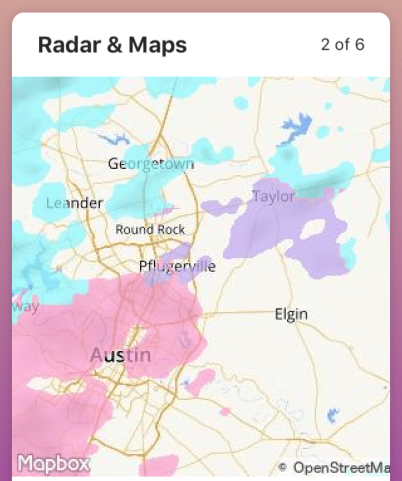
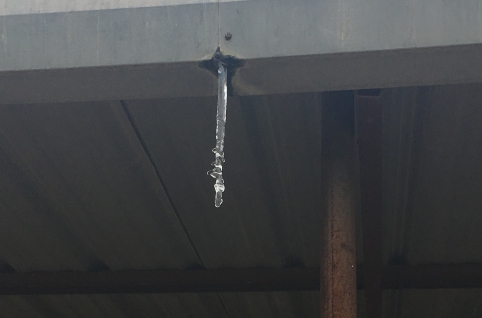
Originally we were supposed to get a gross cold front on Friday, but it was supposed to stay above 40 and be relatively dry. Miserable, but still workable. And then Friday rolled around and it was actually 32 degrees and frozen shit was falling from the sky.

img_3607.png
Our radar is never pastel. I don’t even know what all the different colors mean.
img_3613
we also never have these
img_3614
Texas winter storm, y’all.

But… hey… we’re eventers. As long as the ground is good, we’ll tough it out for XC. Dressage maybe not so much, but XC – heck yes. We got the all clear for schooling, so we got up on Saturday, loaded the horses, and off we went.

And then, when we were only about 20 minutes away from the venue, Trainer called and said she’d just gotten there and it was definitely way too wet to school. UGH. But we were already close, and we had Dobby with us, who could at least benefit from having a look around the facility, so onward we went. Trainer was right, it was REALLY wet. Squishy mud everywhere, to the point where I didn’t even want to get on to hack. So Henry rode 2 hours in a trailer to unload, stand in a stall while Dobby scoped out the place, get back in the trailer, and ride 2 hours back home.

img_3633
I FEEL THE SAME WAY

And then it basically spat rain on and off for the entire rest of the weekend. It was cold, it was wet, and it was disgusting. The ground is so saturated at this point that any little bit of rain immediately turns things to muck. All I got to do with Henry all weekend was a walk hack. So much for productivity.

I was waiting to send in my MeadowCreek entry for their March recognized show until after this schooling-that-didn’t-happen, so now I’m feeling a little up in the air about what to do. I’m looking at the forecast for the next couple weeks and wondering how good the ground will actually be in a month’s time, as we head into what is typically our wettest time of year. Henry is NOT a mudder, even with big studs in, so I’m definitely not looking to run his first recognized Prelim in potentially questionable footing. Plus all 3 phases at MeadowCreek are run on grass.

I’ve got 2 more weeks until closing date, so at this point I’m kind of just waiting to send my entry in, watching the weather and hoping that everything will dry up. I’ll really only be able to afford a couple of recognized shows this spring, so if a show gets cancelled or I have to scratch after closing date and I lose my entry fee, I’m just kind of screwed. Of course, there are also only a couple of what I would call “inviting” Prelim courses in Area 5, so if the two shows that I have in mind don’t work out, I’m not sure what my fall back plan would be. My options are limited.

img_3585

We’re entered in another Pine Hill horse trial this coming weekend, although I think we’re all a bit skeptical that it will actually happen, at least in it’s full format. They are wetwetwet and it’s supposed to rain more there today. The January one was cancelled, so I’m not sure what will happen with this one. There has been talk of modifying the XC course to take out the areas with the worst footing, if need be. At this point I’ll take anything, even a CT, although we really need some XC too. Whatever we can get. Come on weather, I’m finally trying to For Real do this thing that I thought I’d definitely never do, and you’re killing me here. Especially because, in a few short months, we’ll be winding things down due to heat. SO MANY HEAVY SIGHS.

In better news – keep an eye on my Instagram this afternoon for a fun giveaway! There will be free money up for grabs. Everyone loves free money.

US Event Horse Futurity (and giveaway!)

Alright, I’ll say it: the US produces horses that are just as good as the ones in Europe. Having seen and/or been involved with breeding programs on both sides of the pond, I believe that this is true without a doubt. And I’m not a commercial breeder, so I feel like I don’t have any bias in this one.

What Europe does have, that we do not, is a solid and well-established pipeline for bringing up and training their young horses, and a way to connect the talented ones with good riders. This, obviously, helps tremendously when it comes to sourcing good young horses as potential upper level mounts for their own riders. I often find myself wondering particularly about France… you so rarely see a French rider at the top international levels on a non-French bred horse. The same is often true of Ireland and Germany, as well. So if we believe that we produce horses here that are just as good as theirs (and I do), yet most of our upper level horses are imports – what are they doing that we’re not?

The biggest missing link in our chain seems to be in connecting the breeders, and thus the horses, with good young horse riders and producers. We don’t really have a program in this country that highlights riders that are particularly skilled at bringing up the babies, and we don’t really have any program to help bridge the gap between them and the breeders. At least… that used to be the case.

Futurity

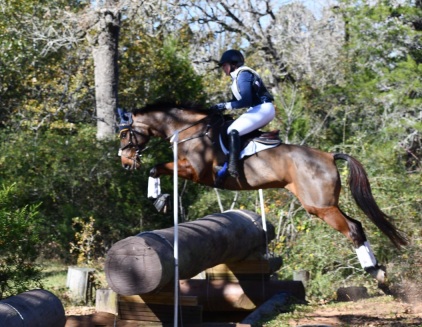
New for 2019 is a brand new program, the US Event Horse Futurity. The Futurity is the brainchild of US breeders Laurie Cameron and Elizabeth Callahan, both of which have produced successful upper level event horses (Quantum Leap, in the top photo, was bred by Elizabeth Callahan). They, like many other breeders, have faced hurdles when it comes to connecting their best horses to our best riders. We have programs like FEH and YEH that highlight the horses once they get to competition level, but – how do we get them there? If you don’t already have a relationship with a rider, how do you find one, and how do you promote your breeding program within the US eventing community, to professionals and amateurs alike?

The purpose of the US Event Horse Futurity is laid out thoroughly on their website:

Purpose 

  • To develop a market for purpose bred /produced event horses through media exposure and publicity
  • To develop and promote a pool of professionals who are willing and able to develop the young event horse to the top levels of the sport
  • To develop and align a network of breeders, trainers, and riders to develop the pool of young horse talent in the US
  • To engage the general public into the world of young horses and Young Event Horse Training 
  • To develop a fan base for young horses and young horse trainers

For it’s first year, the basic outline of the Futurity is simple: it’s open only to US-bred horses that were purpose-bred for sport, and are turning 4 in 2019. There are 12 horses entered, and each paid an entry fee of $525. The money goes into a pot, and will be given out as prize money to Futurity horses that compete at the 2019 4yo Young Event Horse Championships at Fair Hill. Here’s the official prize money breakdown:

  • 10% to the breeder of highest scoring Futurity entrant
  • 50% to the highest scoring Futurity entrant
  • 25% to 2nd place Futurity entrant
  • 10% to 3rd place Futurity entrant
  • 5% to 4th place Futurity entrant
  • Ribbons to the Highest scoring horse and reserve
  • Ribbon to the fan favorite entrant (chosen by polling the week before the Championship)

Fan favorite? This is where things get really fun and unique.

We all know that a big part of what makes a program successful is the support it gets – both from the participants as well as from the public. If you can get the public involved and interested, not only is it good for the program itself, but it’s also good for the horses, the riders, and the breeders that are participating. After all, a big part of the purpose of the program is to increase public awareness, and help spotlight the quality of horses that we produce right here in the US. So, the Futurity wants to encourage public involvement as well.

Part of the requirements for the Futurity participants include monthly blog posts or videos so that fans can follow along on each horse’s journey as they aim for YEH Championships. You’ll get to see and hear about how the horses are coming along, what they’re working on, and get to know more about the riders and horses behind the scenes. For people like me, not only is this fun and engaging, it’s also a fantastic learning opportunity. How often do we to peek behind the curtain and get details about how a dozen different 4 year olds are being developed toward the same end goal? Not only is this interesting from the breeding perspective, IMO it’s interesting to anyone in any discipline that has or might someday have green horses.

The blog posts and videos will be posted on the Futurity’s facebook page, and they have an Instagram account that will post regular updates as well. They have already done introductory posts for each of the entrants, so you can learn a little bit about them, their history, their bloodlines, see photos and videos, and maybe pick an early favorite. There’s also a full entry list on the Futurity’s website.

Aside from all the prizes available for the horses, special prizes will also be awarded to the fans that interact most with the social media pages (via likes, comments, and shares). There will also be a winner chosen from the pool of people that voted for the horse that ends up winning. Yep, that’s right, YOU CAN WIN STUFF too! Just by interacting with a facebook page and/or Instagram account.

I am a big believer in what the Futurity is trying to accomplish here, and I really want to do whatever I can to help support it. The program is completely run by volunteers, as well as being self-funded, so having public support is going to be really important. I’m not a rider, and I don’t have an appropriate horse that can participate, but I do have a little bit of a public platform. What I REALLY want to do is encourage participation. I want people to follow along on social media and see how the year goes. I want people to see the kind of horses we’re producing here. I want these riders to get a chance to show us all how good they are at bringing along young horses. I want us all to learn more about what really goes on in the first year of an event horse’s career. So to help encourage more of you to follow the Futurity, I’m offering my own little prize package incentive.

Want to win a “Have a Great Ride” saddle pad from Ride Heels Down and a $25 Riding Warehouse gift card? I’m going to make this really easy, with 4 different ways to win. Pick as many as you like!

futurityprize

Let me know in a comment which entry options you took! I will draw a random winner from the pool of entries (and yes, I will verify the follows and likes) so the more entries you get, the better your odds of winning. And remember – the more you like and comment on the US Event Horse Futurity’s social media accounts throughout the year, the more chances you get to win prizes from them as well!

I’m really excited about this program, and I think it could be exactly the kind of thing we need to help us start bridging that gap between US breeders and US riders. How neat would it be to someday have a winning US team all sitting on US bred horses? How neat would it be for all of us – pros and amateurs alike – to be able to easily connect with US breeders and good young horse producers, and be able to get nice horses without having to go to Europe to do it?