
Yesterday USEA rolled out a brand new feature to their membership: ERQI ratings. What the heck is ERQI? In USEA’s words:
The ERQI (EquiRatings Quality Index) is a risk management tool that assigns a value to each USEA competing horse. The ERQI is calculated as a probability, a number between 0 and 1, with horses closer to 1 showing statistically higher levels of positive performance in the cross-country phase. ERQIs are displayed on each horse’s profile in a color code representing the level of risk the horse carries on cross-country. The ERQI is built on the ‘data footprint,’ (the past results) of each horse, and applies a marginal gains approach to improving fall rates.
Basically, layman’s terms, Equiratings takes the horse’s record and uses that to decide how likely you are to die on XC at each level. The more you progress up the levels, and the more clear rounds you accumulate at each level, the more boxes turn green and yellow.
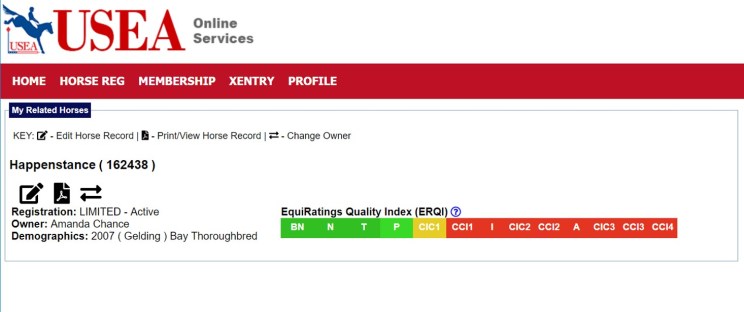
- Green/Light Green: Horse at this level is competing with the normal amount of risk.
- Yellow: Horse at this level is competing with a slightly higher level of risk than normal.
- Orange/Amber: Horse at this level is competing with a much higher level of risk than normal.
- Red: Horse at this level is competing with the highest level of risk.
They started a program like this in Ireland a couple years ago and saw a decrease in falls on XC at the higher levels. This year the US is trying it out, and Britain and Australia are supposed to be the next ones up on the docket for some kind of implementation.
The ratings are attached to each horse, not each rider. As a risk-assessment tool, I think it’s pretty neat. In this sport I feel like the more information we have, the better our decisions will be. You can only view the ratings attached to horses that you have shown or own, so they aren’t public.

But what does this really mean? Not much. At this point the ERQI ratings are purely informational and don’t determine qualification for anything. We still have the same qualification criteria for Prelim and above that we had before. So far (the verbiage USEA uses makes it seem like this may change in the future) they’re really just meant to be another data point that riders can use to help them make better decisions on what to enter or where a horse is at development-wise.
Granted, for most of us low level people, it’s a bit inconsequential. There’s also a lot that these ratings can’t take into consideration. It’s looking for clean rounds, and we all know that at the lower levels it’s possible to have a clean round but still be kinda scary. It can also only use results from USEA-recognized shows, obviously, so any results at schooling shows (or shows in Canada, for those near the border) aren’t included. There are definitely holes here, but there are some things that just can’t be measured in data points and probably never will be.
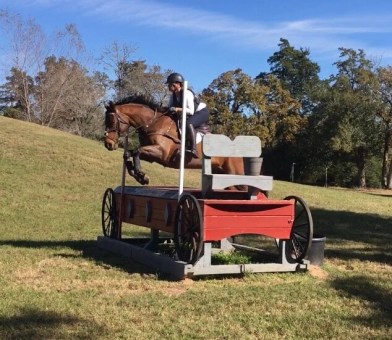
Is the ERQI a be-all, end-all tool that should be used as THE deciding factor for what a horse and rider are capable of? Probably not. Like this thing is pretty convinced that Henry and I would not die if we ran Prelim, whereas I’m over here like “I dunno, I’m like 50% sure that we might.”. So there’s that.
Interested in learning more about ERQI? There’s a handy dandy FAQ page already on the USEA website here.
What do you guys think of these new ERQI ratings? Will it have any influence on your competition schedule? Do you think it’s a useful tool? And, maybe more interestingly, do you think this kind of assessment tool has the potential to spread to other sports in the future (ie jumpers with a “clear round” rating)?














 breedrideevent.com