YEH/FEH symposium day 2

Our flight back from Florida last night didn’t get in til like midnight, so I’m moving a little slow this morning, but better late than never?

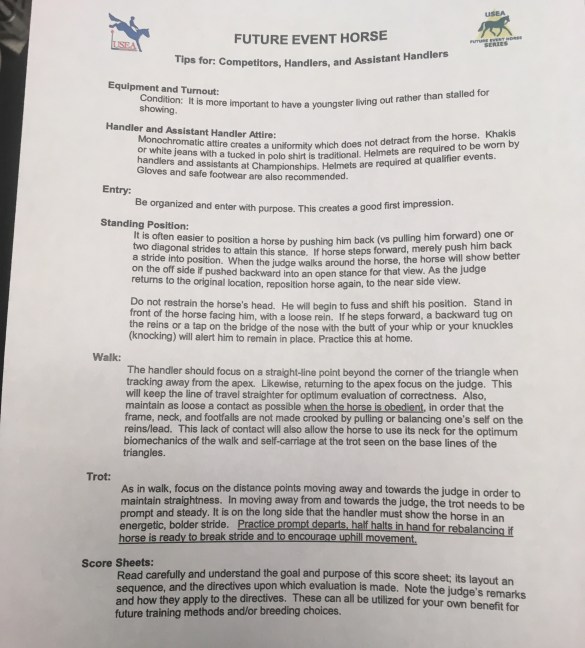
Yesterday was the Future Event Horse side of the YEH/FEH symposium, with yearlings through 4 year olds, looking at them on the line and (for the older horses) under saddle and in the freejump chute.
img_4080
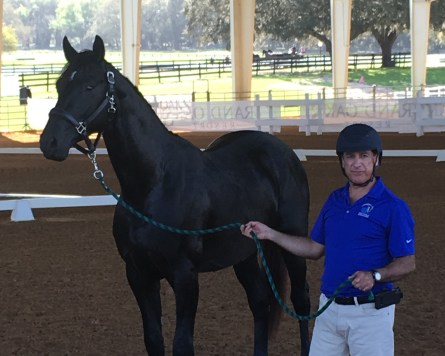
3yo colt

We kicked off the day by talking about judging conformation, and what to look for.  Holly Simenson, the North American director of the German Oldenburg Verband, joined Championship judges Robin Walker and Peter Gray for input on this part. She wasn’t such a fan of using the triangle to present the horses, saying that in her experience it’s too easy for the horse to get crooked, which in turn can make it look like they have irregularities or imperfections in their movement. She prefers showing the horse in hand against the rail of the ring, keeping the horse straighter. But… our FEH format uses the triangle, so that’s what we used.

The first demo horse of the day was a lovely full TB yearling colt. All of the judges mentioned how difficult it was to judge yearlings, which I think everyone can agree with. Holly noted that in her experience, the prettiest yearlings often end up being the plainest and least athletic adult horses. She also said that for event horses especially, athleticism is the quality that is of the utmost importance. Robin and Holly both agreed that since they can be so darn ugly at that age, and change so quickly, what they really look for in the yearlings is a good type and ground covering gaits. In this case good type means something that looks more like a TB, and ground cover means one that has a lot of reach underneath the body with the hind legs and easily covers a lot of ground in the paces. They want to see that the horse “walks with it’s body” – ie the back is supple enough to allow the horse’s entire topline to move as it walks.
img_4087
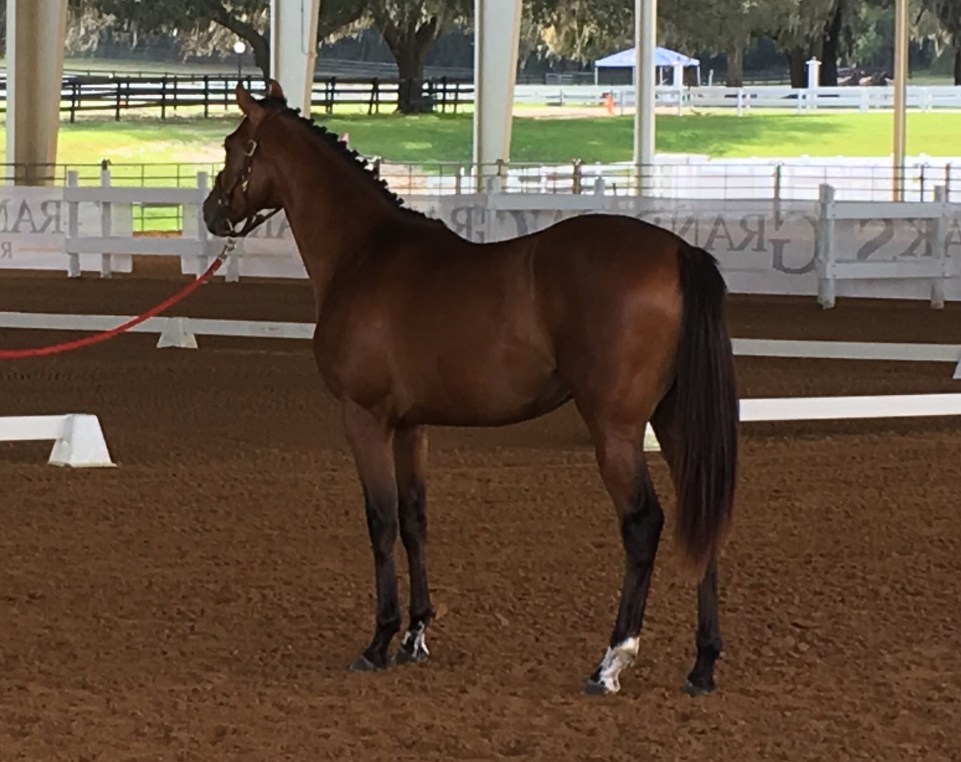
Lovely 2yo colt by Herald 3

They also want to see that the horse has correct limb conformation. Holly stressed to the breeders that if a foal has a some kind of deviation, it’s important to address it as soon as possible. If you fix these issues before 6 months of age, the bones in the lower leg will align correctly and it won’t be a problem. However, if you wait until after that age, the alignment will not change, and any changes you try to make to get the limbs to look straighter will only put them under more stress.

From there we saw some 2 year olds and some 3 year olds, both colts and fillies, from a wide variety of bloodlines. We discussed each horse’s conformation and gaits as a group, and the judges gave their thoughts on how they would score them. Robin cautioned the judges not to get too nitpicky, and reminded everyone that just like with the YEH judging, what they’re really scoring with the gaits are whatever the best moments are that the horse offers, and to remember that they’re looking for horses that look like eventers.
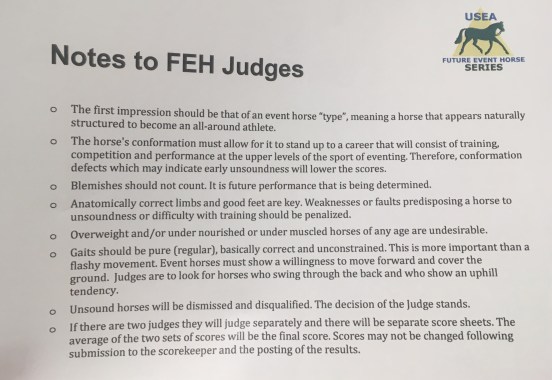
Which led to more discussion about just how important it is for the horses to be properly prepared, and for the handlers to be educated on how to best present their horses. You could have a superb quality horse, but if it’s such an idiot that the judge can’t see any good moments of movement, or if you don’t know what you’re doing and fail to show the horse to it’s potential, then the judges have no choice but to score what they saw. So, prepare your horse, learn how to present it in hand well, and everyone will have a better and more successful experience. Robin especially was very passionate about that part. A couple of the horses were quite poorly behaved and presented, so I can easily see how frustrating it would be as a judge for that to happen in a class. They looked like nice horses, but we couldn’t get an accurate idea of just how nice they might be.

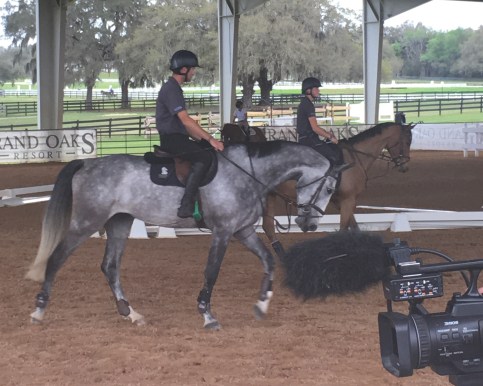
After that we moved on to a mock 4yo FEH class, so basically a w/t/c flat class. This is judged much the same way, where they’re looking for the horse’s absolute best moments and scoring those. One thing that was common here is that the riders did not generally show their horses well at the walk… the judges want to see one that is really MOVING and marching and swinging through it’s back. They don’t care if you do it in your jump saddle or dressage saddle, or if the horse is all that solid in the connection yet – they just want to see the best possible gaits you can show on that day. Ground covering, supple, and forward, with an active hind end.
img_4088

From there we went over to the freejump chute. First Robin covered the specs for the chute and the distances, and then talked about the equipment he uses (gloves, helmet, a short rope). Safety was of utmost importance here, as he wants to make sure that the horses are safe, confident, and have a good experience. Again he stressed the importance of working on this enough at home so that the horses know what to expect in the jump chute, have learned how to go through it properly, and are confident about what’s being asked. If the horse isn’t prepared, the judges aren’t going to be able to see the horse’s best efforts, and it’s unfair to the horse to show up somewhere and have to do something it’s never done. A lack of preparation for any of this stuff seemed to be a big sticking point for Robin throughout the day.

Matthias Hollberg, a GP showjumper, helped run the freejumping side of things. He noted right off the bat that not every horse that freejumps well will jump well under saddle, and some that just seem ok in the freejumping will jump better under saddle, but almost all who freejump really poorly will also jump poorly under saddle. It’s a good indicator, but not necessarily a be-all-end-all way to gauge talent.

They were looking for horses with safe forelimb technique, a good use of the body through the air, and an intelligence about how it went through the chute or learned from any mistakes. If the horse hit a jump, they wanted to see it come back through and be more careful. If he ran through and went past the distance, they wanted to see him come in the next time and slow himself down a bit, not just keep making the same mistakes. There were a few good horses, and a few bad ones, some who had never been freejumped, and some who had. Again, it was a good variety of experience and quality. Mattias urged the judges to watch the horse’s withers as they came through the chute – he wanted to see the horse raise its withers and round its topline over the fence, not just move its legs and stay flat/stiff in it’s back in the air.
I also have to mention that I was really impressed throughout both days with how well-prepared, well-handled, and well-presented Matt Bryner’s horses were. Super professional and mindful of the horses, and clearly someone who does the work at home to make sure they are successful at the shows. In a country where we generally have a lack of good young horse producers, he was a standout to me in this crowd.

It was a really educational day, and as a FEH participant and someone who brings up young horses, I got a lot of good tips for how to better prepare and show my horse. Definitely worth a long day sitting on the bleachers! I would recommend these educational symposiums to anyone from breeders to young horse owners to riders. This is a lot of the basic education that we’re missing in this country, and to be able to go get a crash course, see lots of nice horses, and hear from such a variety of professionals in one place is a really fantastic opportunity.
YEH/FEH Symposium Day 1

This is a tough life I’m living here in Ocala this week y’all. I’m sweaty and sunburned and spent all day yesterday looking at/talking about horses. On a Wednesday. In February. This does not suck.

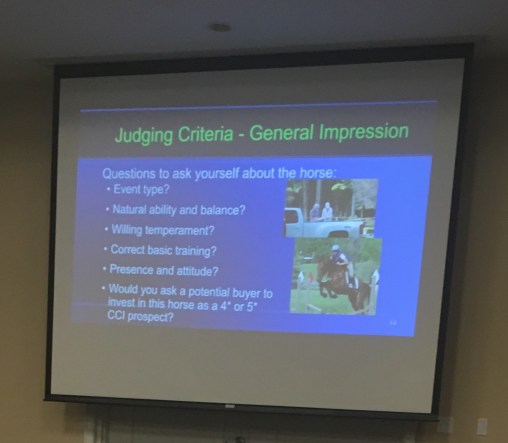
Anyway, Day 1 of the YEH/FEH educational symposium was dedicated mostly to the Young Event Horse side of things. In the morning we were in the classroom, and Marilyn Payne kicked things off with an overview of the YEH judging, what they’re looking for, and what new changes there are for 2019. I’m pretty familiar with all that by now, but I’m always into PowerPoint slides and bullet points.

Maxime Livio was in the room and commented that, in his opinion, he would like to see the pedigree considered in the judging. There was a lot of opposition to that, from basically everyone else, even if I tend to agree with where he’s coming from. It’s definitely important, especially from the “blood” point of view, but on the other hand it’s hard to make something like that a judgeable criteria.

From there we moved on to looking at videos of horses when they were 5. For this they used footage from Bundeschampionate of horses like FischerRocana and So Is Et, but were being sneaky by playing the videos first, getting opinions from Maxime and the judges in the room, and then revealing who the horse/it’s career was at the end. There were a couple videos of not-very-successful horses hidden in there, for contrast. It was kind of interesting. What made it most interesting, IMO, were Maxime’s comments. He has a keen eye for a horse and is very good at explaining what he’s seeing, what things he can look past, and what things are dealbreakers.

Amid all of that conversation, my favorite notes of the day came about. Maxime said that there are 5 basic criteria he’s looking at when he’s evaluating a horse for top level (modern long format) sport, and he puts them in this order:

1) Pedigree. Maxime wants to see lots of blood, a horse that is capable of galloping for 10-12 minutes and still having some stamina left at the end. He said that when horses run out of stamina, that’s when things get dangerous.

2) Soundness. This is where he looks at the conformation, the straightness and correctness of the limbs, the lungs and cardio system, and obviously gets a vet opinion.

3) Personality. Mainly: heart. He wants a horse that really has a strong desire to do the job, is always looking to go forward to the next fence, and will always try to please it’s rider. He used FischerRocana as a prime example here of a very average quality horse that has so much heart, it makes her into a great horse.
4) Jump Quality and 5) Movement. These were kind of lumped together for him.

He went on to explain that the reason he ranks them this way is because more importance is given to the things you cannot change or improve. You can’t change the fact that the horse’s type is too heavy or pedigree is lacking blood. You need soundness obviously, but good management can improve it slightly, so there is a little bit of possibility for improvement. He felt that personality is mostly innate, but that it could also be improved upon a good bit with correct training and riding. Jump quality and movement, he said, have the most capacity to improve, and in his opinion can even be improved as much as 70%. So he starts with the things he can’t change as the most important qualities when he’s looking for a horse. While the ranking order of these characteristics might change depending on what type of horse you’re looking for, I like his approach of placing more importance on the things you can’t change. That’s a smart way to think about any horse purchase.

My favorite horse from the videos was Andreas Ostholt’s very successful 4* horse So Is Et (by Sunlight xx), who did not do very well at BuCha

I loved how Maxime broke this down. It was very well thought out and reasoned, and it’s nice to see a rider so invested in the importance of pedigree and desiring a lot of blood in his horses. This theme carried on into the afternoon sessions as well with the demo horses, which I’ll get to in a minute.

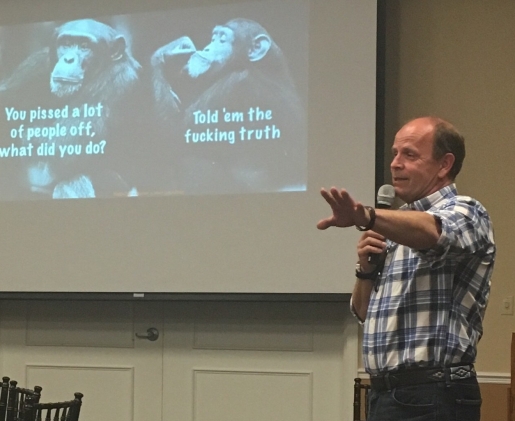
After looking at the videos of the 5yo’s, Christian Schacht did a presentation on conformation. Despite having what most would consider to be boring subject matter, Christian was super entertaining to listen to. He knew how to add humor to keep people engaged. As for the confirmation parts, his big emphasis was on the horse’s balance. He wants a horse that isn’t too downhill as to be on the forehand but also isn’t too uphill as to be inefficient in the gallop and jump. He also likes to see hocks that are a bit lower and closer together, making it easier for a horse to sit and push off the ground at the fences, especially at deeper distances. He called the hooves “the second heart of the horse – no hoof, no horse”, ie also a very critical component.

img_4057
So entertaining

One passing comment he made that I thought was interesting was his observation that when horses toe out (not a big deal in his opinion) usually it’s more pronounced on the right front than the left. This is true for Henry and Presto, which is probably why it stood out to me. Oh, and he noted that slight roach backs are not uncommon in jumpers, and are often considered to help make the horse more powerful.

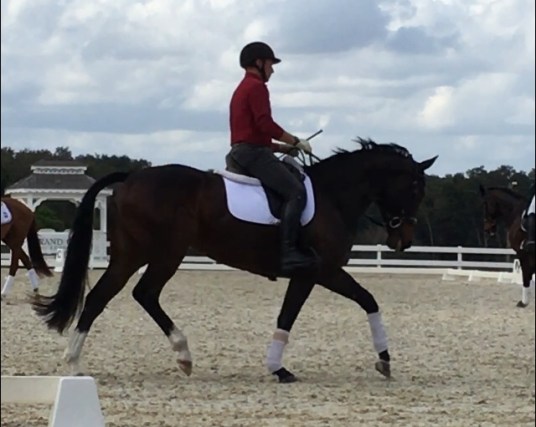
After lunch we headed outside to watch some 4yo horses do dressage. There were 3 very different types of horses, which made for good contrast. Maxime’s favorite was the chestnut OTTB. Yes, you’re noticing a trend with him and blood horses. 😉

A dressage ring full of very well behaved 4yos

Then we walked down to the XC field and got to see two groups of 5yo’s do a mock YEH class. There were 5 showjumps and then 7 or 8 XC fences. Maxime would comment on the horses after each of them went, and then the judges discussed how they would score them. The horses ran the gamut from unshown to a Bundeschampion, so it was really interesting to compare and contrast, and then hear all the opinions on what level the horse might have potential for. Maxime was generally more forgiving of little mistakes and green moments than the judges were, and wasn’t afraid to chime in to a discussion and offer his perspective or respectfully disagree. It made for really good conversation.

Maxime’s favorite horse of the day was the last one to go, a full TB that came off the track last year. Maxime liked it a lot, and then when it was revealed that it was a full TB, the like turned to love, and he declared that that’s the one he would buy. It’s funny to me that everywhere we’ve gone, the European riders really love and seek out the mostly or full blood horses intentionally, and place a lot of value on them. Here they’re often seen as “less than”. Many of the judges seemed surprised that a horse that nice was full TB, as if it was special IN SPITE of that. To Maxime, the horse was special BECAUSE of that. It’s an interesting dichotomy.
Overall it was a very educational day (although at times I wanted to hang myself with my lanyard at the talk of what “breed” of Warmblood each horse was. They’re registries, not breeds, and the registry tells you nothing about the horse’s bloodlines. Alas, I digress..) and I greatly valued having Maxime’s input. I found him to be very educated and confident in his views, yet also humble and open to discussion. He had a lot of great little quotable tidbits that were already captured perfectly by Leslie Mintz in this article. Go read it!

I was also impressed that pretty much every rider knew the pedigree of their horse and was able to recite it when asked. This is very encouraging to me, and a trend in the right direction.

Today we move on to the FEH side of things, with the younger horses in hand, and freejumping. I’m in horse nerd heaven.

Ocala Day 1: Spiraling

Michelle and I arrived in Ocala yesterday, and today we’re headed to the YEH/FEH symposium at Grand Oaks. We had a dinner last night at the Holekamp’s, but since our flight was so early, we had all afternoon to kill. What do you do in Ocala when you’ve got a spare 6 or so hours? TACK SHOPS. Because there are like a dozen of them.

We were so well-behaved, we started at the consignment store.

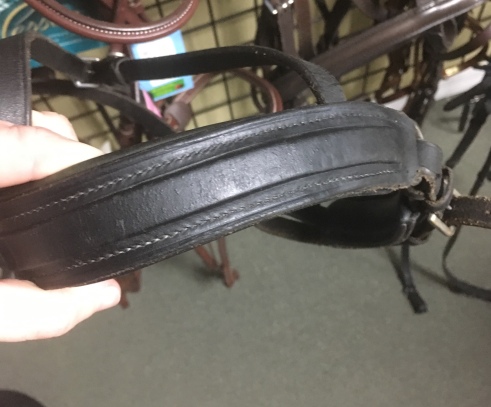
I liked this wide, square raised noseband
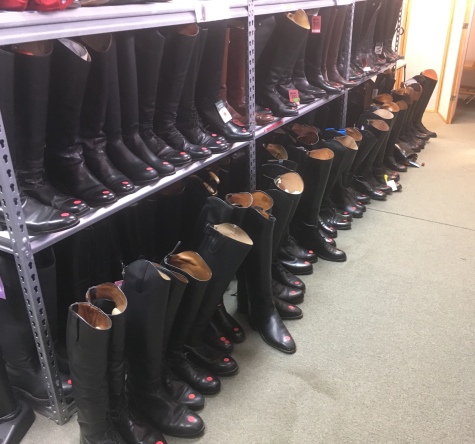
About half of the tall boots

Michelle found a few shirts there, but nothing caught my eye. I was so good.

You see where this is going, don’t you?

Then we went down the street to Tack Shack of Ocala. Again, we were trying to be reasonable, so we started in the building with the big clearance section. Again, Michelle found a few things (a halter and a couple shirts), but nothing spoke to me.

And then we went over to the main building. I was doing pretty well until I wandered into the bell boot section. Then I thought, “Ooo, I actually do need some new bell boots for Henry, the ones I bought him at Bundes are dying.”.

And I found some pretty navy fake leather ones.

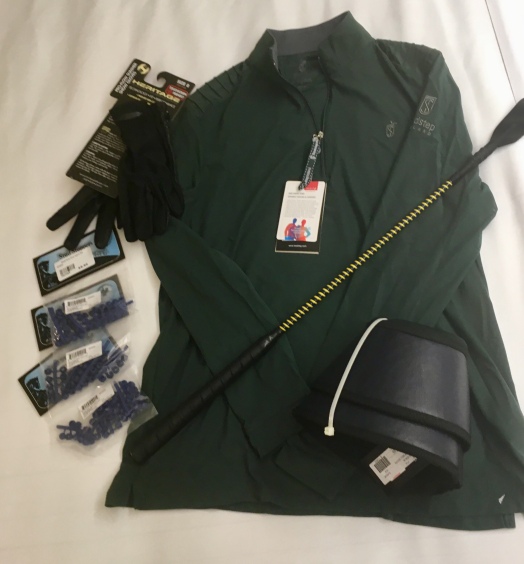
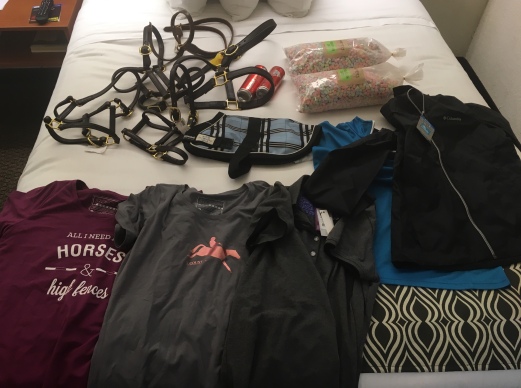
Apparently bell boots are a gateway drug, because then I spiraled. Half an hour later I staggered up to the counter in a stupor, plopping down a sunshirt, some gloves, a new whip, and the bell boots. Michelle was loaded down with halters in a variety of baby sizes, so I didn’t feel quite so bad.

So meshy though

After that we headed to lunch, where we watched horse racing on the TV’s at the bar while we ate. There’s a lot to be said for being in a horse-centric town.

And hey, what do you know, there was another tack shop in the same shopping center! What a hardship. Michelle came out of that one unscathed, but they had cheap stud plugs so I bought literally all of them.

We passed by a huge farm supply store, so we stopped in there because why not, and as soon as we stepped in the entry Michelle saw these:

She gasped and literally SHOVED ME OUT OF THE WAY to get to them and snatch up two bags. Now SHE was spiraling.

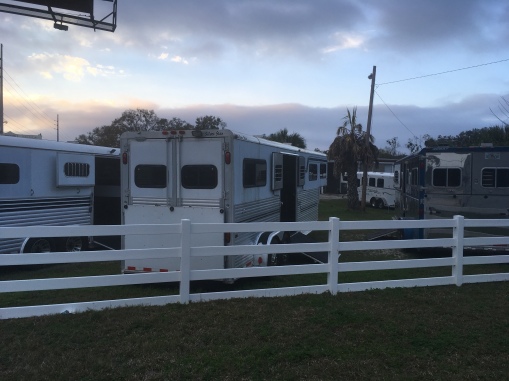
We headed back up toward where we were having dinner and passed by a big used trailer dealership that had a ton of head to heads (what Michelle has been shopping for) but they had just closed. But… there was a little gap in the fence… so… we let ourselves in to look around in all the trailers. They had left them all open, so it seemed like an invitation to me. Just forget about that whole fencehopping part.

Once we got back to the hotel after dinner we both laid out our acquisitions for the day.

Mine
Michelle’s

I’m not sure how to determine a winner in this case. Is it the person who got less, or the person who got more?

Either way, it was a day full of horses, and we made some new friends, got some pretty new things, and had a good time. Today we get down to business!

Pine Hill Feb HT – Cross Country

Not gonna lie, I think was maybe more nervous for the second Prelim than I was for the first. The first time I was just trying not to die – pure and simple, no further expectations. And then I didn’t die, thus it was awesome by default. But now we were back for another crack at it, with the goal of smoothing some things out and trying to make some improvements. There’s a lot more pressure in that. What if the first time was just luck? What if I came out and bungled it royally? Now I had to prove to myself that it wasn’t a fluke.

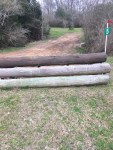
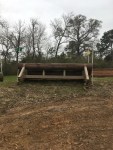
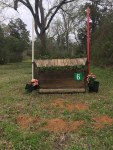
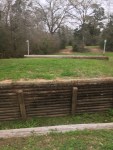
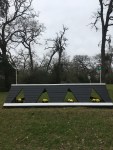
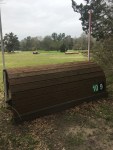
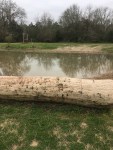
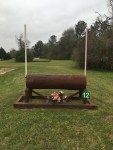
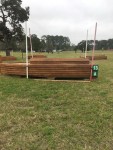
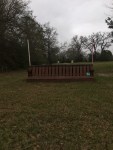
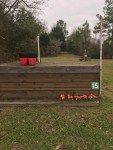
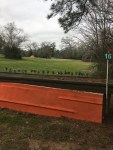
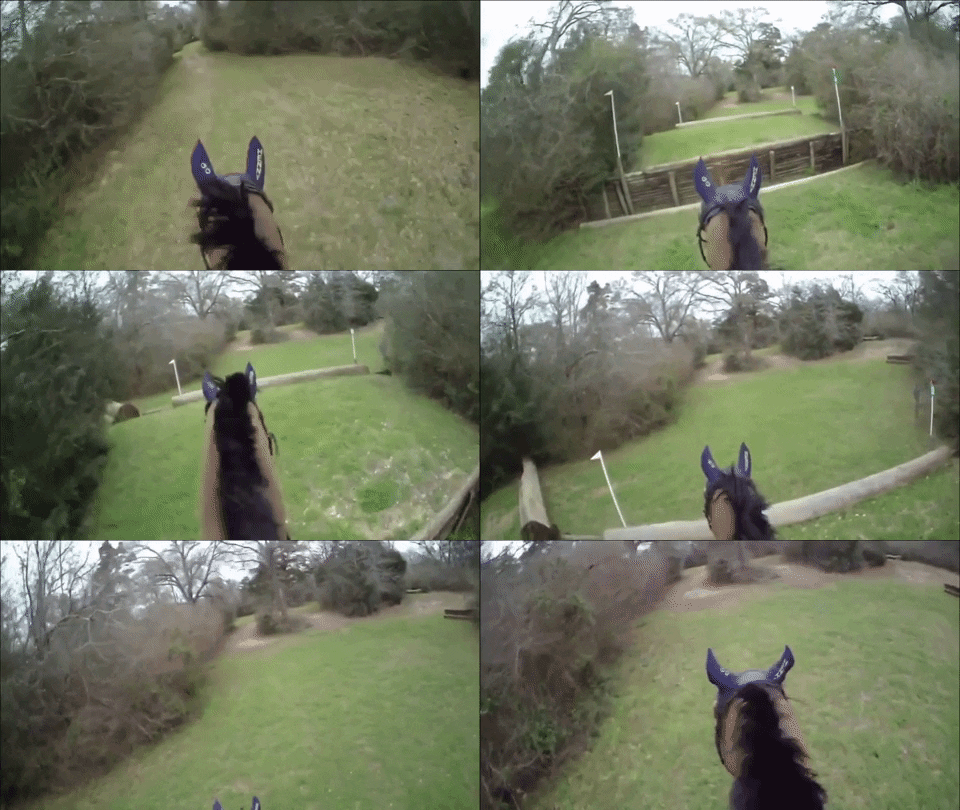
I was nervous a couple days before, but woke up on show day feeling pretty zen about it. And then dressage and stadium went well, and I was feeling a little more confident by the time cross country rolled around. I actually remembered to take pictures of the course this time, AND I had my helmet camera charged and ready to go! Miracles never cease.

Before we got there I was very concerned about the footing. We’ve had So Much Rain, and there were definitely spots on the course where there was still standing water and mud. Luckily most of the Prelim course runs through the higher ground, so while there were a couple of deep areas, none of it really effected the jumps themselves. The other levels had some course modifications because of the footing, but mine didn’t, so that part all worked out. The venue did a really good job of preserving the footing leading up to the show, and laying down sand in places where some extra grip was needed.

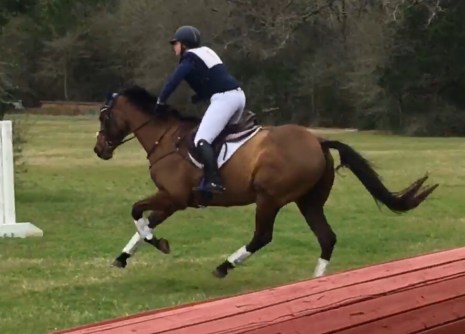
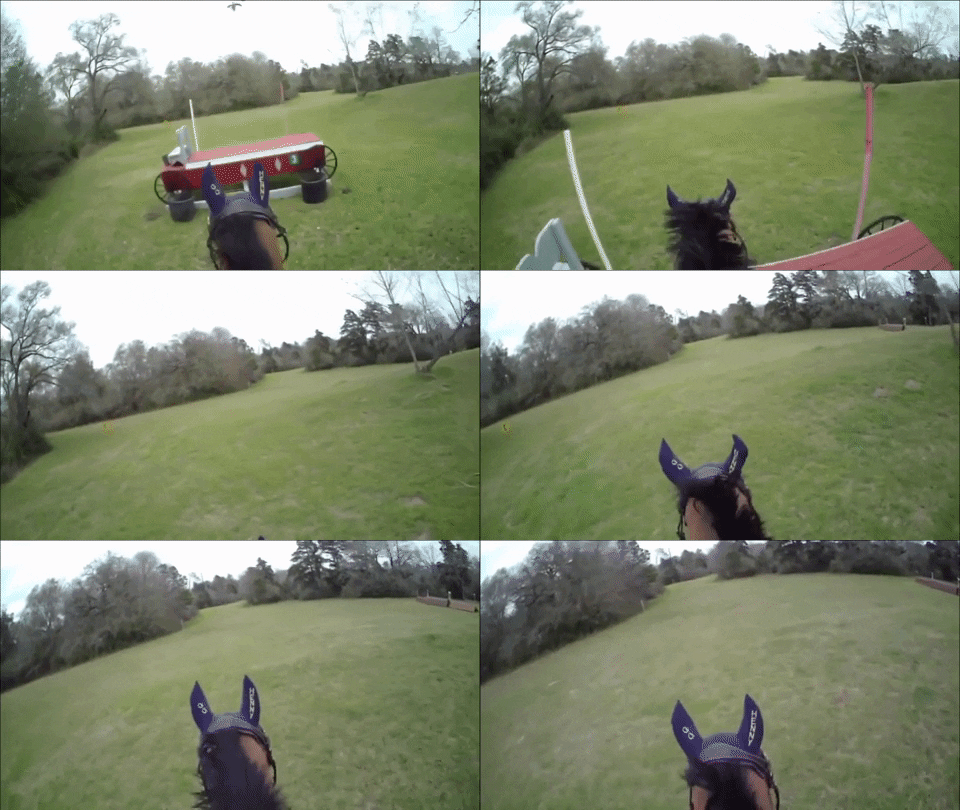
Since the footing looked pretty good, I decided to let Henry open up a little more than last time, carry a little more speed between the jumps, and see how he felt. Of course, I didn’t take into account that since the course was the same as what we did in December, Henry now knew exactly where he was going. He took off out of the box like his ass was on fire, just about leaving me suspended in midair like a cartoon character, and jumped the first fence like a rabbit. Not the start I had in mind.

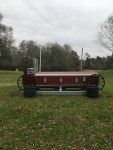
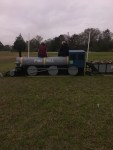
THE WAGON WAS FUN THOUGH

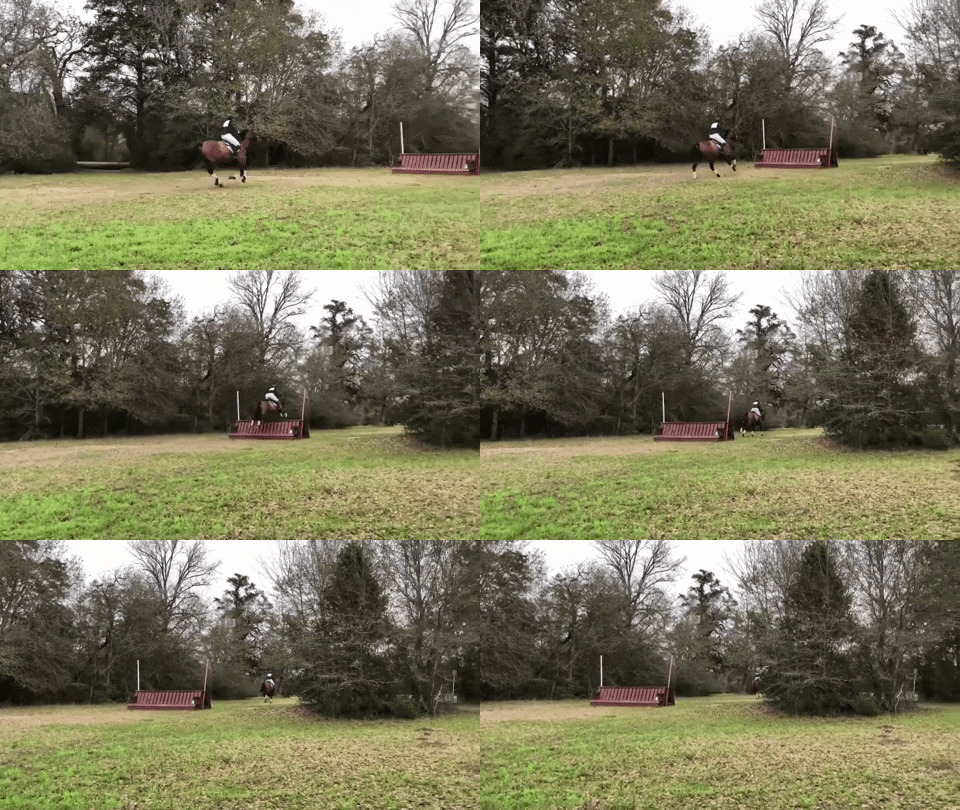
I landed from 1 and really pushed him up in front of my leg again right away, so I could rebalance and settle into a better rhythm. It worked, and within a few strides we were rolling. Henry was feeling very cocky, knowing exactly where he was going, and pretty much just told me to strap in and hang on. I steered, and I rebalanced on the approaches, but I’m pretty sure Henry would have done the course with or without me. He wasn’t rude about it, so I was okay with that, and I was glad that he was feeling confident. He flew over the rolltop at 2, the wagon at 3 (will that ever stop looking big? Probably not.), the combo at 4AB, and the log ramp with the drop at 5. I took a tug on the way to 6 that I shouldn’t have, stuffing him into a tight spot there, but he’s honest, so he went.

Irish bank – also fun. Glad I didn’t sneak in late at night and bulldoze it a couple years ago when I really wanted to.

We popped up and down the Irish bank, around to the chevron, and then to the trakehner. Things seemed to be going by so fast at this point, jump after jump after jump. I was trying hard not to micromanage him or shut him down between fences, so I pretty much just let him go along at the speed he felt most comfortable at. He was eager and full of run, so when we had long stretches, I just let him roll.

All the jumps at the water were good, and I let him open up a bit as we went back up the hill, hopping over the little bench out of stride. Then we steadied up quite a bit for the turn to the corner, galloped around the lake, and through a muddy spot that made me have to whoa a little more than I wanted with just a few strides before the boat table. The distance there was a little long, but he jumped the snot out of it for good measure.

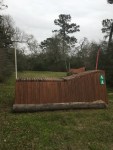
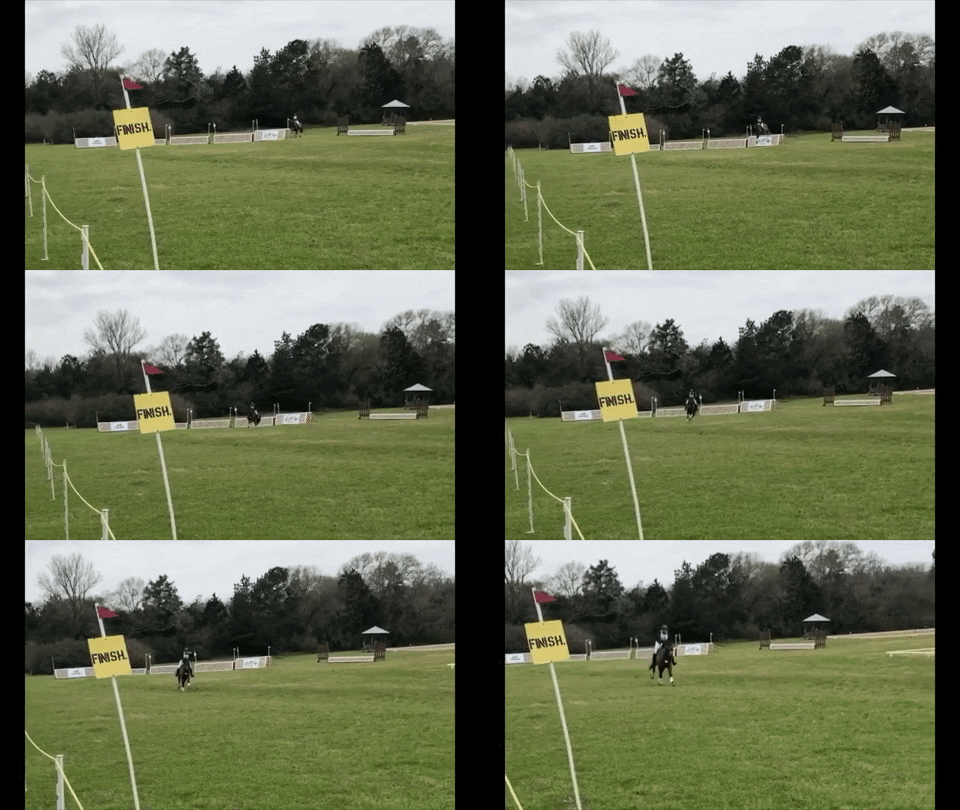
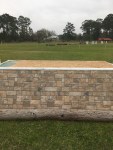
Then down the hill combo, rolltop to bank to chevron, back into the front field for the last two fences. He tried to be a little too athletic and jump over a muddy spot, almost tripping over his own feet in the process (god, that would have been an embarrassing way to end the day), but recovered well and hopped over the train car, then we finished up over the big stone wall. And just like that – second Prelim, in the books!

We were quite a bit faster this time than last time, and once again Henry was barely even breathing hard at the finish. They had a timer malfunction, so didn’t log my official time, but from my helmet cam footage I think I was about 20 seconds over, which would have been 8 time faults. Due to the timer malfunction they put me as double clear. I’ll take it, but in my head we’ll go with 8. Which I’m still super happy with, because last time we had 19, and this course is so twisty I think it would be nearly impossible for me to average 520mpm without being scary/dangerous.

I made a couple of mistakes and had a couple of bleh fences, but overall I was happy with how confident Henry felt and with the fact that I let him jump out of a more open gallop. It was nice to make the mistakes and have him not even blink about them. It helps me a lot mentally to know that I don’t have to be perfect, he can handle it if I’m a little bit wrong. There was definite improvement though from the December show to this one, and it was a big confidence booster for both of us. The first time wasn’t just a fluke!

img_3946-1
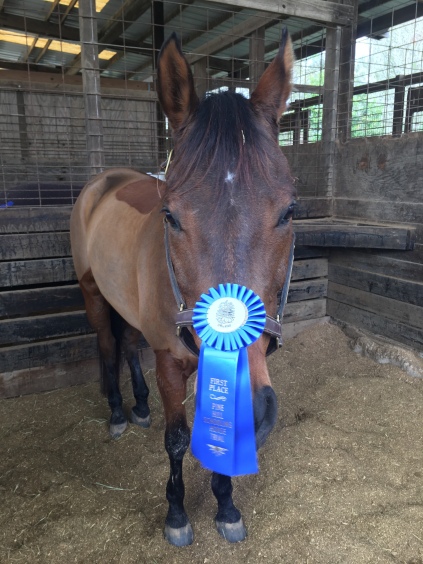
Don’t get excited, I was the only entry in Prelim this time too. He still earned it though.

I still have to sit down and make some kind of plan for the next 6 months, but hopefully there will be more green numbers in the near future!

Pine Hill Feb HT – Dressage and Stadium

Whew, what a weekend! I am a bit deliriously tired, but we’re flying to Ocala on Tuesday so I needed to crank out the show recaps before I leave. Apologies in advance if this post is rambly, disjointed, or makes no sense. I have a bad case of post horse show brain.

img_3873-1
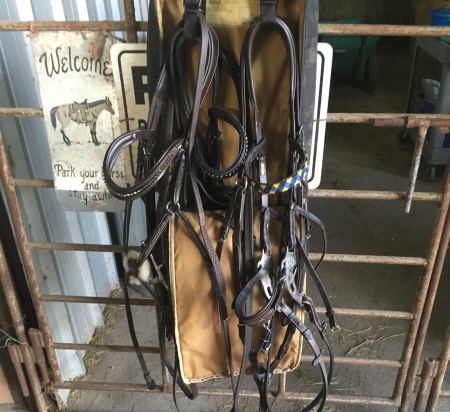
you know when you’re packing your bridles and you’re like “this sport seems excessive, but thank goodness I have a solid excuse for owning so many bridles”?

Hillary and I left early Saturday morning, hauling all 3 horses together in her trailer. It’s really nice having a show buddy again, since Henry and I have been mostly on our own for the past couple years. However, I had kind of forgotten what a MORON he is about having friends at shows. He spent most of Saturday screaming and spinning in his stall, and it took 45 minutes of leg yields and figure 8’s to get him to actually take a deep breath and relax under saddle. Neither of these things make me happy with a mentally delicate, ulcer-prone horse. He’s so dumb, too, because he actually hates other horses, and when they come near him he just wants to murder them, yet god forbid they leave? I don’t understand Henny logic.

img_3886-1
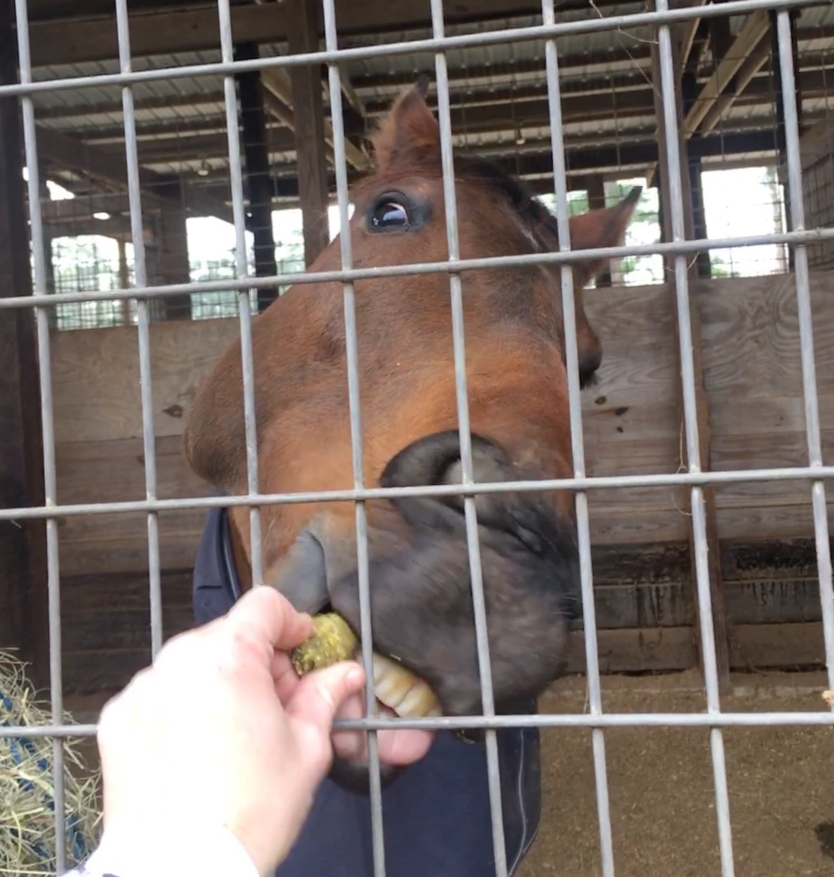
I tried bribing him with cookies to shut him up

He settled down a little by Sunday morning (the screaming was more intermittent, at least) and I got on at 7:30 for my 8:00 dressage time, not feeling really sure of which animal I would be sitting on. The Henry I’ve had for the past 6 months has been pretty rideable and much improved in the connection. The Henry I had on Saturday afternoon was the tense nutbag Henry that I had like 3 years ago. That is not a time period that I particularly wanted to revisit, and definitely not on horse show morning. Luckily he decided to table the Vintage Henry thing from the day before, and came out on Sunday as a much more modern version of himself.

img_3893-1
WHERE ARE ALL OF MY BESTEST FRIENDS?

The test wasn’t quite as good as our last attempt in December, he was still just ever so slightly scattered to my aids. There were some moments of improvement, like my leg yields last time said I needed more bend so I’ve been working on that a lot, and this time our scores for those were each a point higher. I couldn’t quite keep his haunches under control in the second 10m half circle at canter, and he threw in a flying change there as we came back to the rail, earning us a solid 4. Whoops. She dinged him a little in the collectives too, because he was chomping his mouth a bit the whole time… that was his tension showing.

It wasn’t our best test, but it was respectable enough, and still good for a 33.3. And, to be honest, a year ago I would have been THRILLED with that test, so it shows how much the dressage has improved for us. He’s been holding himself together mentally so much better than he used to, it’s like a different horse, and I really love how the Prelim A test flows for him. All the trot work in the beginning helps his brain settle.

We are getting consistently good at those first centerline scores, too bad we can’t maintain that once the real work begins

After dressage I only had an hour before stadium, so I went back up to the barn, let him pee and get some water, looked at my course one more time, and then tacked back up. I have become the queen of the short warm up for jumping phases so I walked into warmup at 8:49, cantered a couple laps, lengthened and shorted his stride a few times, made some square turns to lift his shoulders, jumped 3 fences, and still went up to the ring a few minutes before my 9am start.

My goals for stadium were:

1) Keep him in front of my leg. I’d rather make a mistake going too forward than make a mistake by pulling or getting stuck.

2) Ride the plan. There were some wonky turns in this course, and we made a pretty specific plan in our course walk on the best way to ride them, so I really wanted to keep my head in the game, focus, and execute the plan as best I could. Again, if I make a mistake then I make a mistake, oh well, but I didn’t want it to be because I panicked and lost focus.

3) Keep. My. Chin. Up. At. The. Base.

And, omg, it actually all came together.

We tapped a couple, and it wasn’t mistake-free, but I stuck to the plan and they all stayed in the cups for a double clear round! I got him a little bit deep to the big vertical at 2, but kept my chin up and he was able to get us over cleanly (that “chin up” trick is really kind of a miracle for this horse). Bless Henry’s little heart, he is not the most talented or athletic horse in the world but he’s got plenty of try. He stayed in front of my leg, I was able to keep his balance up and in front of me out of the turns, kept coming forward, and I actually had some whoa this time when I needed it. He was brilliant.

Trainer and Friends were screaming their fool heads off when we crossed the finish, and I too was pretty freaking excited to finally get a double clear round at this height. I wasn’t sure it was possible, to be honest. It’s a good feeling when all of those endless hours of work finally pay off.

like I won the damn Olympics or something LOL

It was also pretty nice to still be sitting on our 33.3 after stadium, and a part of me kind of just wanted to withdraw and go home, because I didn’t think we could top that. But of course that would be silly, because there was still cross country, and that’s the best part…