There was kind of an informal blog hop going around about this, although I forget now who all did it (my brain is on shaky ground these days – PLEASE FOAL ALREADY, MARE) … so if you participated and want to leave a link to your post in my comments, please do. But the premise was asking who can ride your horse – both ability wise and “allowed to” wise.
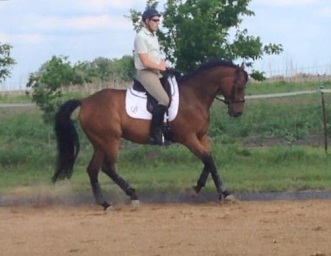
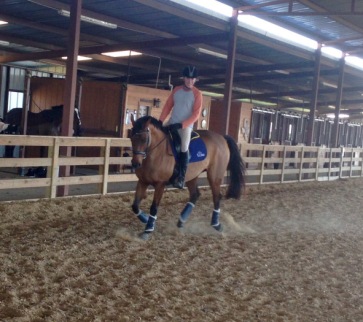
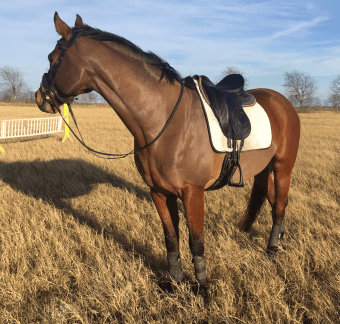
Henny with Dressage Trainer. Pretty certain I will never replicate this.
I feel like if I’ve done my job reasonably well, pretty much anyone should at least be able to get on and tootle around. I’ve spent a lot of time trying to make this horse more rideable (because I think that being really rideable is always a great thing for a horse to possess) so I like tossing someone else up there every once in a while and watching them push the buttons. Pretty much any rider should at minimum be able to get on and w/t/c and point the horse at some jumps. I harbor no delusions of grandeur about my ability as a rider: I don’t think I’m so special that I’m the only one who can ride him without messing him up. In reality he’s been putting up with my shit for quite a while, so he’s gotten to be pretty good at it by now. I have no qualms about giving just about anyone a leg up under my supervision, and most people who have experience with a forward-thinking horse should have no problem riding him.
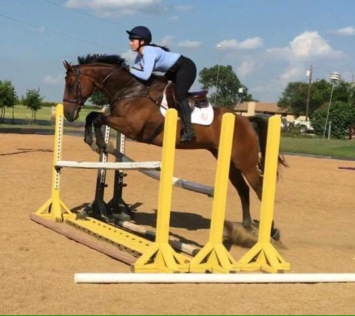
with blogger HIllary
The difference is supervised versus unsupervised. If I’m sitting there watching, I can control the situation and what the person does/doesn’t get to do. People also tend to be on their best behavior with the owner watching. So in that scenario, there are very few people who wouldn’t be allowed to ride my horse. Only exception: people with really bad hands. Y’all don’t get to come near Henny, sorry. Take up knitting or something.
with Bobby
But unsupervised rides mean that I have to trust you to have good judgment about my horse and what is appropriate. It’s one thing to trust someone to just pilot him around for fun while I watch. It’s another thing entirely to be trusted with a solo ride. The people I’d trust for that are limited mostly to the pros I’m comfortable with and friends who I know have a similar approach as I do.
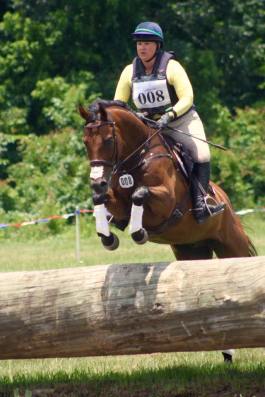
Henny with event trainer
Otherwise, as long as a situation is under my control, I feel like it’s good for my horse to get exposed to as much as possible, including different riders. What about you?
Today is 330 of Sadie’s pregnancy and she’s still hanging in there. Yesterday she started biting the stall walls a bit and smooshing her butt into things… last time she did that for about 3 days before she foaled, so I’m hoping she’s going to repeat the same pattern. Funny, because last time she went 332 or 333 days (there is some debate on breeding date) so she’s literally on the exact same schedule so far. If she foals in 2-3 days I will give her extra treats for consistency (did you hear that, mare???).
How to give both of your moms a heart attack
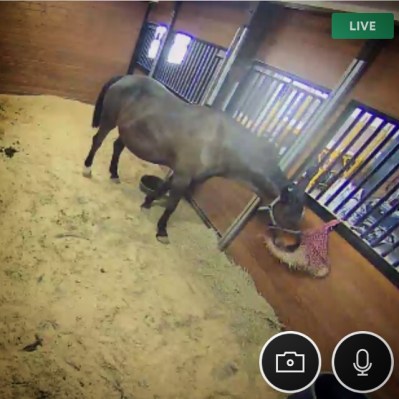
In the meantime Michelle gave me access to the stall cameras so that I can see Sadie myself (sorry, it’s all part of their home security system so I can’t give it out to everyone). Really I think it’s because at least 4 times a day I was texting her asking how Sadie was and Michelle was tired of my shit. Either way, now I can pull up Sadie’s camera whenever I want! Which has been a lot. Like… A LOT. Sometimes I can’t stop watching her. Granted, most of the day she usually stands outside in her paddock where I can’t see her, but that doesn’t stop me from checking compulsively. And then taking screenshots when she does anything remotely interesting.
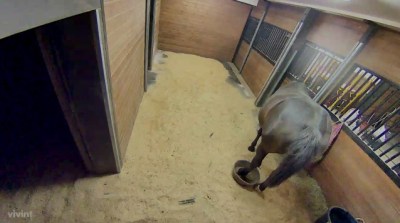
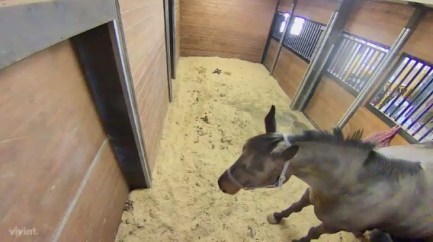
like standing in her food panor visiting with her bird friendsor trying to sit in her wateror smooshing her butt into the wallor telling Michelle to text me and ask for extra cookiesor just generally looking huge and cute
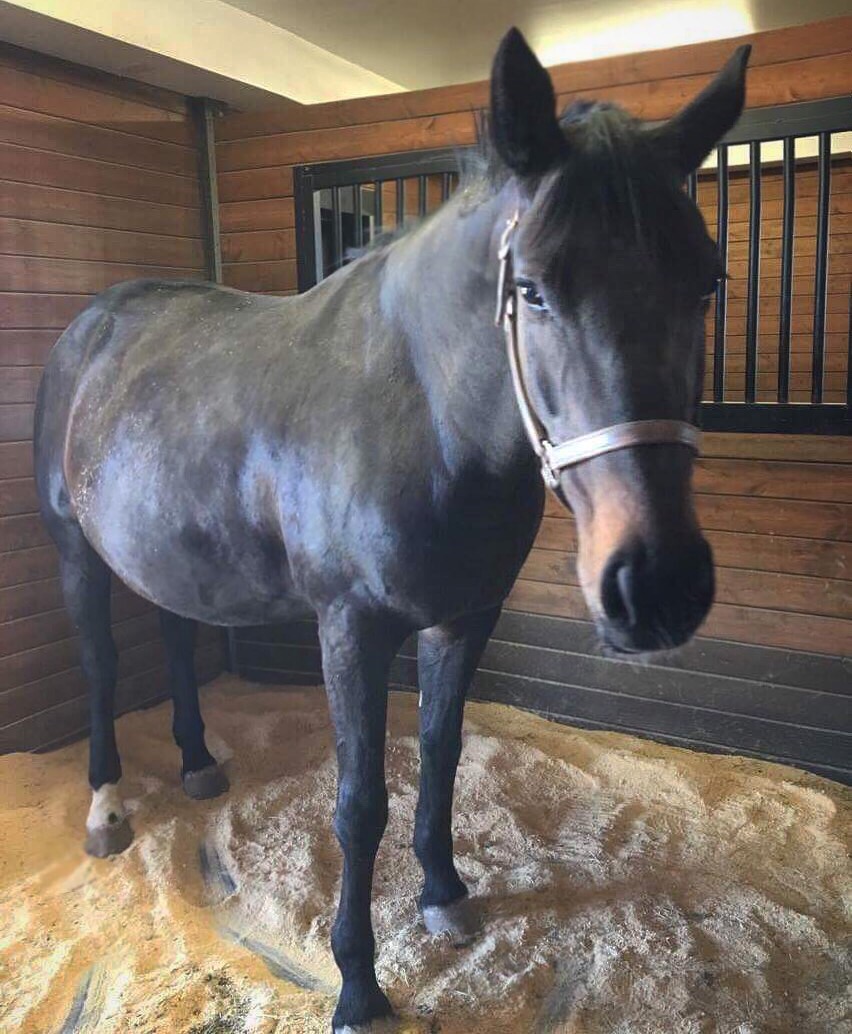
It’s FatMareTV 24/7 around here! Love having the cameras though, it’s lessening my anxiety a little bit. This morning she looks even more uncomfortable, keeping her butt pressed against the back wall and alternating between biting at her sides and attacking the stall wall. It’s definitely ramping up. I swear her topline looks a bit different today too, like her shape is changing.
When they’re not feeling totally miserable, this is what she and Lissa spend most of the day doing:
I’m gonna stand on my rickety little soapbox for a minute here and preface this post with this: regardless of whether you’re a breeder or not and regardless of whether you own a young horse or not, learning how to evaluate a horse’s potential for a future career is a skill that every horseman needs. It will make you look at your horses (and any potential future horses) in a completely different way. If you ever get the chance to attend any kind of sporthorse conformation/young horse evaluation clinic – take it!
I had so much fun at Marilyn Payne’s Young Event Horse (4 and 5yos under saddle) judging clinic last fall that when I saw a Future Event Horse (yearlings through 3yos judged in hand) clinic being advertised up in Dallas, I jumped on it immediately. Baby Horse might not even be here yet, but two of my favorite things are breeding and eventing, so it’s only natural that anything FEH/YEH is right up my alley.
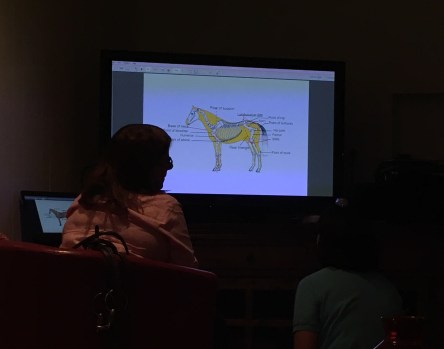
The clinician was Eileen Pritchard-Bryan, a breeder and well-known eventing/FEH/YEH judge and steward. We started on Saturday morning with a lecture on conformation and what traits you’re looking for in an event horse (vs dressage horse or jumper). There was a whole lot of technical stuff with angles and dots and lines that would take a million years to cover thoroughly, so here are just some of my notes:
The lumbosacral gap should be no more than 1-2″ behind the point of hip.
“Pillar of support” – when drawing a straight line down the groove of the forearm, the line should come out ahead of the withers on top (for lightness of forehand) and go through or just behind the heel on bottom (too close to toe: foot injuries, too far behind heel: soft tissue injuries).
Lower stifle = better gallop and more jumping ability.
The lower the point of elbow, the better (more clearance from the rib cage for galloping).
Point of shoulder to point of elbow should be barely less than 90 degrees.
Neck should be longer than the hind 1/3.
Back at the knee = deal killer
Toeing out is better than toeing in
A lot of the sporthorse conformation stuff isn’t new to me, having been around the breeding industry, but there were a few subtleties pertaining specifically to eventing that I found very interesting. I spent a lot of time that evening looking at pics of different eventing and jumper stallions (and pics of Henry, of course).
Mighty Magic
Heraldik xx
Jaguar Mail
After the conformation lecture we talked a bit about the FEH classes in particular, proper turnout, tack, apparel, etc. Then the participants went and got their babies and got to practice in-hand presentation. I have some notes about that part too:
For FEH, the walk is most important because mirrors the quality of the canter. You want lots of swing through the back, groundcover, overstep, and straightness.
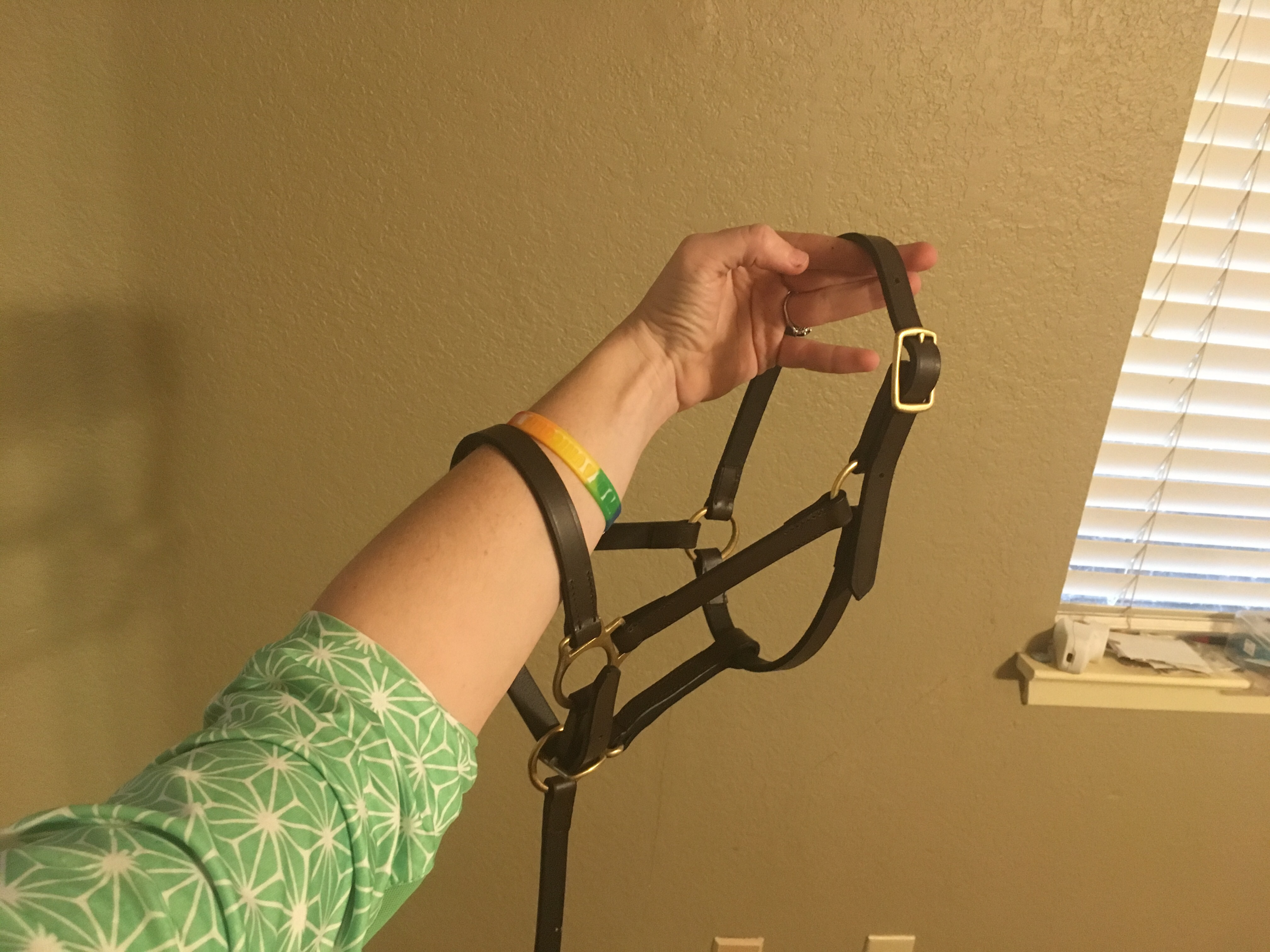
The tack and handler should be subtle. Basic bit and bridle (2yo and 3yo), no full cheeks. Khakis, collared shirt, gloves, appropriate shoes, helmet on handler. Riding attire is ok. Leather halter on yearlings with leather or dark colored lead.
To reposition horse while standing up for confo: if you need to move a hind leg, take one step forward, if you need to move a front leg, move one step back.
Always be aware of where the judge is and reposition yourself and the horse in relation as necessary.
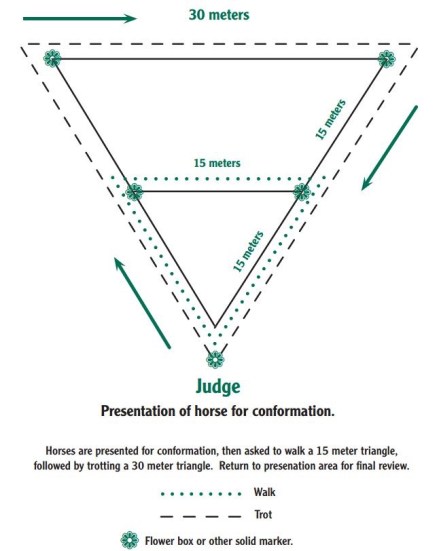
It is very important to move STRAIGHT away on the first and last leg of the triangle (a wiggling horse can sometimes make the horse look like it has a movement defect that it actually doesn’t).
Practice practice practice at home so the horse learns what to expect. Always be patient and take your time.
Just like dressage, the judge can only score what they see on that particular day. Given how quickly young horses change, this can lead to a variance in scores depending on the time of year and stage of growth.
the triangle
I think until you actually do this stuff, it seems fairly simple. You just stand there, then walk, then trot, then stand there again right? Hahahahaha. No. There’s SO much more to it. Presenting horses in hand really WELL is an art form and requires a lot of showmanship, practice, training, and knowledge. Even just a tiny tweak in how a horse is standing or how they hold their head or how straight you can get their body in the trot can make a BIG difference in the impression the horse gives to the judge. I learned a lot of this nuance last summer at Coco when we were practicing our jog-ups, but Eileen had additional useful suggestions, especially when it came to dealing with the short attention spans and sometimes overexuberant behavior of the babies.
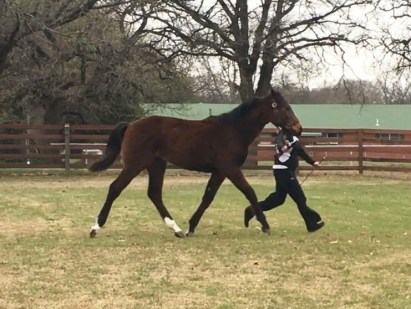
this yearling filly was very well-behaved
In the afternoon we also got to see a 4yo do his YEH dressage test and discuss it as a group, then we chatted a lot about breeding and eventing over wine and then even more over dinner. Eileen and I have similar taste when it comes to bloodlines and stallions, so it was fun to talk to her (and the other clinic participants, of course).
I also heard that there’s a new 4yo FEH class, for those who wish to move at a slower pace with their young horses. The 4yo FEH has an in-hand conformation portion followed by a group under saddle portion (cantering separately). I thought this was a BRILLIANT addition, great for horses that are a bit less mature or just not ready to be jumping courses yet. So the 4yos get to choose between FEH and YEH.
Sunday was shorter, with a “mock show”. Everyone got to apply what they learned the day before and present their horses to Eileen for judging, complete with score sheets. It was fun to stand there and hear her comments about each horse and see what her scores were and why. Definitely gives me A LOT of insight into FEH and will help me decide whether or not I want to pursue those classes with my own horse. And if we DO, now I have an excellent idea of exactly what they’re looking for and how best to prepare Baby Horse for those competitions.
It was a superb and very useful clinic! I would highly recommend something like this to ANY sporthorse breeder, owner, or rider. Totally worth the audit!
Back in the old days, foal watch was something that could span the course of weeks. Sleeping in the barn, getting up every couple hours to check on the mare, obsessing over every little change in her demeanor. Then somebody figured out milk testing and everything got a whole lot easier.
There are “official” milk test kits on the market, like Predict-A-Foal or Chemetrics, but you can accomplish the same general type of testing with plain old pool testing strips – ones that measure pH and calcium. It’s pretty simple really… you collect a little bit of “milk” (which may or may not look like actual milk until foaling. Sadie’s is still more yellow and clear-ish.), dilute it with a specific ratio of distilled water, and then use the strip to test it.
what not-quite-milk-yet milk looks like
Some people rely solely on the color of the milk to tell how imminent foaling is, but some mares don’t really produce much until right at foaling time, and others may not have true white milk until the very last minute either. Testing the calcium content and the pH of the milk are more accurate indicators than just using color alone.
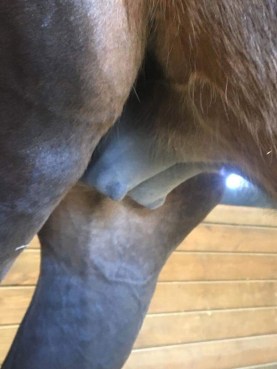
udder is filling out!
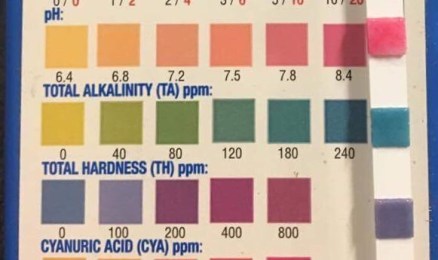
Beyond getting the ratio of milk to water correct, it’s actually a super simple method of testing. As the mare gets close to foaling, the pH will drop and the ppm of calcium will increase. Once you hit 200ppm of calcium, you’re probably within 24-48 hours… 400-500 usually means you’re imminent (although some mares can have a big spike in calcium a day or so in advance). Using the calcium in conjunction with pH gives you a little bit of a closer window, since pH drops dramatically just before foaling. Once your calcium is high and your pH is low, baby horses are about to happen.
We care about the pH line and the calcium line (total hardness). In this case the pH is still high and the calcium is still low.
Granted, you don’t want to constantly be testing the milk or you run the risk of depleting the colostrum. As the mare’s udder starts to develop, testing every few days is fine until the numbers start to change, and very little milk is required to test. Although this method of testing works well on most mares, you’ll find one sometimes that doesn’t go by the book. Still though, it typically helps reduce the sleepless nights to just one or two instead of MANY.
So, what does all this mumbo jumbo really mean? It means I get to go audit the FEH/YEH clinic in Dallas this weekend, because Sadie’s still testing low on calcium and high on pH!!! We’re not super close.
Last week Alaine at Spotted Dressage asked one of the most seemingly simple and yet usually complex questions in the equestrian world:
What Do You Feed & Why?
I’m a total nerd about this stuff and find it really interesting, so I couldn’t resist this one. Henry currently gets:
6lbs per day of Triple Crown Senior
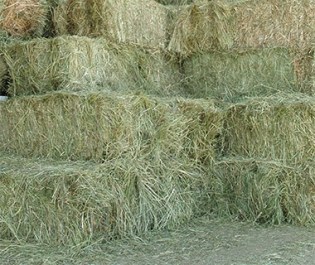
4-6 flakes of coastal hay
grass or coastal hay in turnout
1 flake of alfalfa per day (1/2 am, 1/2 pm)
free access to salt
I pay bit extra on top of board for premium feed and I buy my own alfalfa, but I’m a huge believer in nutrition and think that high quality feed and hay are absolutely vital to the overall health of my horse. I’m really picky about ingredients and what Henry eats, and more than happy to pay extra to get something good. I definitely won’t feed anything that has some kind of grain by-product as a major ingredient.
Henry used to be on TC Complete but made the switch to TC Senior last fall. He’s getting plenty of forage these days, with lots of hay plus his alfalfa and grass, so I opted for lower starch and lower total NSC. The Senior is still 10% fat, over 1500 calories per pound, and made from high quality ingredients, but has about half as much starch as Complete. Henry isn’t a super hard keeper, per se, but he is a thoroughbred event horse that works 5-6 days a week. He still has energy, although I’ve noticed a decrease in nervous energy since the switch. I don’t know if that can be attributed to lower starch or if he’s just growing up a bit, but so far the Senior is working out really well for him. I like that it’s grain free, and I love that it’s not a dusty pellet.
Coastal hay definitely isn’t my favorite, but it’s really difficult to get anything else around here. Luckily the barn’s hay is at least good quality coastal squares (the rounds tend to be yuckier and can definitely give them a potbelly look), so it works.
Aside from the “what”, I also think the “when” is equally important. The less time he spends standing around with no forage, the better. He gets alfalfa and hay with his TC meals, and has access to hay or grass as much as possible. Really the only time he doesn’t have forage is in the middle of the night, which is when he’s finding a nice fresh pee spot to sleep in anyway.
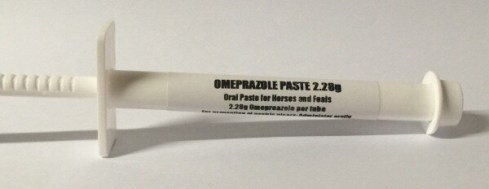
You’ll also notice Henry’s lack of supplements. That’s because I kind of hate most of them and have a lot of opinions about the supplement industry that probably no one will like. I’ll spare all of us and just not even start down that road. I don’t hate them all; Henry has been on a few different oral supplements in the past (one for his lungs, and magnesium) but nothing has really made enough difference to stick. His feed already has probiotics and vitamins in it, so no need to add any of that, and if I’m going to do a joint supplement I’d much rather do it IM than oral. He does get omeprazole when we travel, but that’s in paste form.
stay away, ulcers
What do your horses get? I’m really interested to hear what other people feed their horses – it’s so interesting to me to see what everyone does and the reasoning behind it. Equine diets are fascinating!









 breedrideevent.com