I feel like I need to start off this post by saying that I am not a complete and total AI hater. I do think there are some legitimate uses for AI, particularly when it comes to the medical industry, both human and equine. This post really has more to do with the marketing side of things, be it social media images, advertising from brands, videos, event flyers, sale ads, the copy for social media posts and blog posts, etc. That is the bone I’m choosing to pick today, because this is the thing that I’m seeing most rampantly at the moment. I think a lot of brands/companies/people in this industry don’t understand the potential long-term impact of what they’re doing, both to themselves and to others.
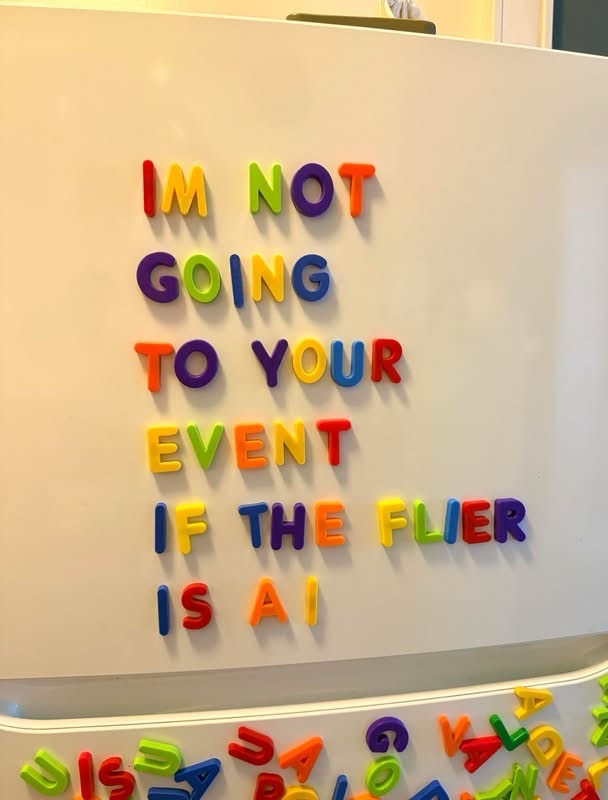
I feel like at least a few times a week, I’m in some brand’s comments on social media, letting them know that I am disappointed to see the use of AI in their marketing. The response is always interesting, and has been quite varied, but I feel like we can talk about that a little bit later. Let’s start off with identifying some of the most common things that I have seen lately.
There have been many brands, including some really big ones, using generative AI to produce videos of their products. You can always tell when a video is AI generated, if you know what to look for. I’m also seeing it very commonly used to create photo backgrounds for products – so a photo of the product that someone has put into an AI platform and asked it to give it a background or also perhaps slightly change something about the product itself, or the overall image. Or to generate event/sale flyers, or the copy for posts.
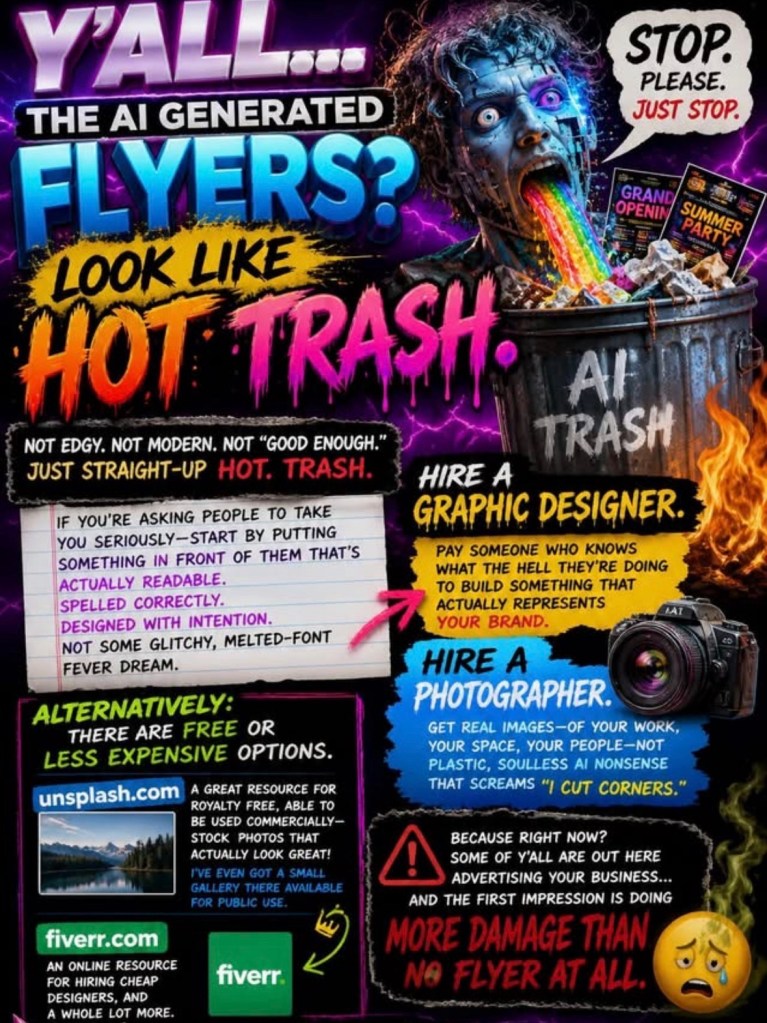
What seems to have completely taken over social media, particularly Facebook, is the ChatGPT-generated captions and graphics. The graphics are always very easy to spot with their trademark fonts and layouts… these AI platforms have a very specific style that honestly makes my brain hurt a little bit. They all look the same, and they’re all massively overdone, usually with plenty of detail inaccuracies when you start looking at them closely.
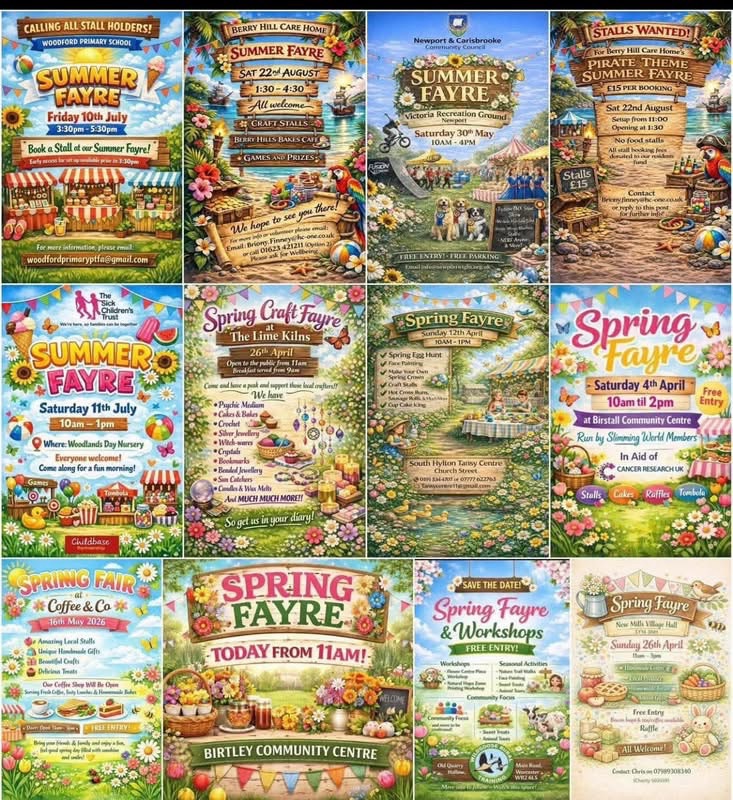
I personally would much rather see a shitty drawing in Paint or a badly made Canva flyer or a slightly out of focus picture or a spelling/grammar mistake. Why? At least those seem authentic and real and human.
The captions in particular are where everyone has really gone wild. There are some very big accounts that post nothing but ChatGPT-generated captions. Usually quite long ones, where it looks like a rant about a specific topic, or an educational post. Every time I see those I can immediately imagine exactly what these people have put into ChatGPT as a prompt to generate these posts. Again, you can spot them from a mile away. I always wonder what’s the point in interacting with something that was written by a machine? It took someone 5 seconds to generate a post that was designed specifically to entice you to interact with it, for the sole purpose of generating social media interaction. Miss me with that nonsense.
There is absolutely no question that the use of AI has definitely gained a strong foothold within equestrian social media as well as its marketing. The real question is: is this actually a bad thing? And why or why not?
I’m sure it would surprise absolutely no one to hear that my opinion is that I think it’s absolutely a horrible thing and I hate it. To the point where, if I see it more than once, or if there’s a discussion about it and the business owner or brand or creator digs their heels in and defends their AI usage, I immediately unfollow all of their accounts. Is that an extreme response? I don’t know. But I do know that the only way I can really make my opinion heard – and more importantly felt – is by removing myself from their potential base of supporters. Voting with my feet and/or wallet, if you will.
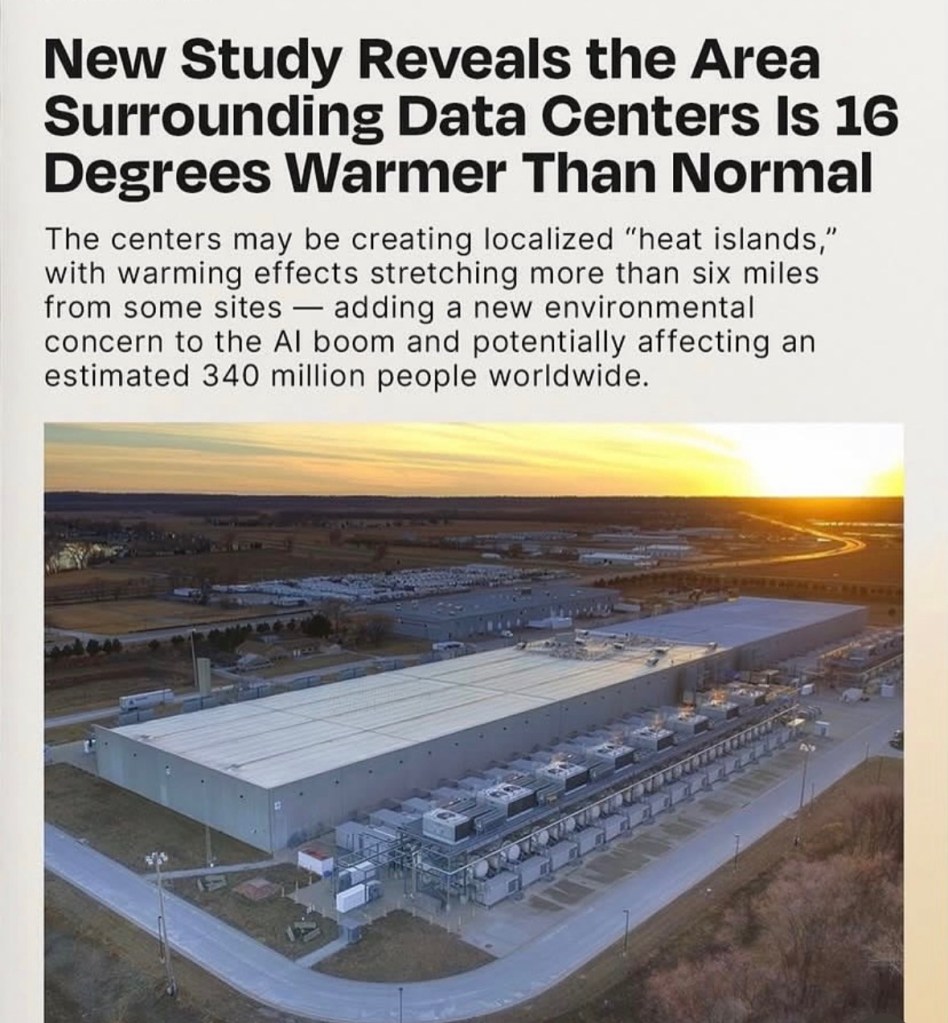
Why do I think it’s such a bad thing? As horse people we have to start with what is perhaps the most obvious and impactful thing for our industry, which is (in my opinion) the environmental aspect. Data centers are popping up at an alarming rate, driven largely by this surge of unchecked AI use, and many of the places that are being targeted to build these data centers are more rural communities. These data centers have terrible impacts on the local environment, and the rapid installation of them will have a definite impact on the global environment, whether you have a data center near you or not. According to Pew Research Center there are currently more than 1,500 new data centers in development nationwide, with heavy emphasis on the South and the Midwest regions (often in already marginalized communities that have little power to fight back, and in places – I’m looking at you, Texas – where they really CANNOT handle more strain to their power infrastructure or water supply).
In this day and age, being a horse person must come hand-in-hand with being a steward of our environment. The impacts to land are real, and we are already feeling it in this industry. From event venues disappearing, to the cost of land rising year over year, not to mention the climate impacts that affect crops and the ability (and cost) to feed our horses… if you aren’t a champion of environmental causes, I think you’re being shortsighted and naïve.
The second big thing, in my mind, is the impact that this has on the human brain. There are already multiple published, peer reviewed studies about how using AI is making us collectively dumber. Is this really the time in human history where we want to reduce everyone’s ability to think deeply, creatively, and critically? Well, I suppose there’s a large group of people that would really love that and benefit from it, but for humanity as a whole it’s sad at best and terrifying at worst.
The third big thing to me, and yes I do say this as someone within the industry, is that it cuts out the human element. Sure, you can have ChatGPT write a blog post or a caption for your Instagram reel in just a few seconds. But I would caution people to pause and consider what it is that actually makes someone connect to and identify with a person, a brand, a product, etc. When everyone’s marketing looks and sounds the same, with nothing genuine or authentic about it, what’s the difference between your brand and someone else’s?
Authenticity and originality have always been key elements of what makes a person or a company or a brand successful. It’s what makes a blogger interesting to follow, or makes one brand’s products stick out more than others. When you think back 10 years or so, when blogging was really in its heyday, the people that were most interesting to follow were the most authentic people, the most interesting people, and those who had something different either within their story or within the way they told their story. It wasn’t bland or cookie cutter, and it didn’t sound like the same person wrote every single thing. Think about your favorite store/brand/creator… why are they your favorite?
When it starts to feel like every image and word is being generated and fed to me by a machine, you’ve lost my interest completely. I will admit that as someone who does copywriting for a living, I’m probably more sensitive to this than most people. I can spot AI-generated content from a mile away, and I have no interest in consuming it. To me not only does it lack creativity, but it looks lazy, and there’s nothing about it that makes it special or warrants any of my attention. If you didn’t put in any effort to create it, why should I put in any effort to consume it?
Another huge issue I have with AI is that all of it, literally every bit of everything it knows, was stolen from somewhere. The vast majority of articles or books or captions or paintings or drawings or photographs or music that have been fed into AI was without the permission of the person who created it in the first place. That person gets absolutely no credit and no compensation. When it comes to this type of use, AI is one big giant theft machine. That machine uses the work of real people and slightly modifies it to generate something to your specs, and the original creator gets no benefit. Do you know who does? The huge companies that own and run these AI platforms. Not only is this morally wrong, but it will also have deep and lasting impacts on the job market, and force many creatives out of the space. Is that really what we want, a future where everything looks the same and has no personality or creativity behind it whatsoever?
I know there will be a lot of people defending their AI usage by mentioning the cost factor. Does it cost more money to pay a copywriter or a photographer or a social media manager? Of course it does, because you’re fairly compensating them for their work, ideas, time, and creativity. You’re not doing that with AI because these companies stole it from other people to begin with.
As I said earlier, when I see these accounts using AI-generated content, I generally try to give people the benefit of the doubt and start a conversation about it. The response has varied greatly. Some people have attacked me for questioning their use of AI at all. Others have just deleted my comments and any other negative comments. I have had a few fruitful discussions with people who genuinely didn’t know any of this. I’ve also had many a discussion where they definitely knew this and just don’t care. Those are the most disappointing I think, because it makes me question your core values in everything you do.
If there are business owners out there reading this, I urge you to consider how the use of AI within your marketing affects your brand’s reputation. While it might seem quicker and more cost-effective up front, believe me when I say that people can absolutely tell you’re using these tools. This can give the consumer a feeling that the business isn’t honest and does absolutely nothing to build brand loyalty or built a lasting relationship with your consumers. Your business should have a voice, and not a generic one. Also consider that using AI-generated (or even AI-improved) images to represent real products can lead to legal issues with misrepresentation.
There are things that AI does well, but marketing, authenticity, and reputation-building are not among them.
What I’m hoping is that sooner or later everyone else will get tired of this as well, and we’ll swing back towards a trend and desire for individuality and creativity. I think it’s already begun. But for now, it’s disheartening to see how many people and brands have jumped aboard the bandwagon of AI with seemingly little consideration to the drawbacks. Whether you use AI or not, whether you love it or not, I’m asking people to just think about the long-term ramifications. Not just to the environment, or humanity, or your own morality and ethics, but also to the long-term reputation of themselves or their brand.
What is it that you want to be known for? I think we should be asking that question now more than ever.


I love everything about this post. I also deeply hate AI, especially for everyday things that a person can do fairly easily. The environmental impact is immense and it is sad that many people don’t understand or care about these impacts. AI flyers are horrendous, it takes a few minutes to make a decent flyer on Canva, or hire a professional person!! Keep fighting the good fight! I will too.
LikeLike
Hi.
Can you share a list of brands that you are un-following? I would like to make sure that I am not patronizing them.
What I find especially heinous is that companies accept AI slop that they would fire a writer or designer over.
I think about the wallstreet journal article where they had a claude snack machine and they managed to make the snacks/supplies free. AI is a dollhouse. Looks legit from the front but it’s missing essential components to be a real house.
LikeLike
I was SO GLAD to see this post! I agree with you 100%. I work in academia and the basic lack of understanding of how AI works that I see in young people is truly alarming. There certainly are some very smart people doing incredible things with generative AI (specifically) that have clear societal benefits, but that is the exception right now. I hope we can get back to a place where the greater good outweighs corporate or individual gains, but we are a long ways from that right now.
LikeLike
I’m glad I’m not the only one feeling that way about AI!! I do think it has its place and value (mostly in the medical field like you mentioned), but that the masses are using it carelessly, bombarding the social spheres with crap that is just completely useless, if not detrimental!
People’s critical thinking ability is already questionable on a good day and this is going to take it next level. Unfortunately I work in an industry that started shoving this down our throat; people are now proudly confessing writing emails with AI!… All I want to say to them is: I’m sorry, did you forget to bring your brain to work today?…
LikeLike
Always a thoughtful read. I’m personally very conflicted with AI use. I work in the tech and pharma industries, doing document writing and business efficiency improvement (operational excellence/Lean Six Sigma). I’m basically required to use it at work, and it’s been very, VERY useful for both aspects of my job. Prime example: I was given a long (40+ slide) PowerPoint presentation and asked to create an instructional procedure from it, formatted in the company template (which I generated myself because I learned long ago that very, very few people know how to correctly format in Word). I uploaded the PowerPoint and Word template to Copilot, and with the professional license (purchased by my company) had it generate the document AND format it for me. It cut my personal time down from several hours to about one hour spent reviewing the AI-generated content and fixing a couple of minor formatting errors: and the information never leaves the internal company system, so Copilot can’t format anything else in that template (this is a pro license feature) unless it’s internal to my company. This is one document, of hundreds I work with, so using Copilot has increased my productivity by reducing the amount of time I spend literally copying work that already exists in some format. Instead of mindlessly copy/paste, I actually use my brain to review content and don’t have to re-format much!
Aspect 2, overall business efficiency: Meeting Minutes! The corporate world expects minutes to come out promptly after every meeting, though few people *actually* read them. Now, with AI transcribing and generating the minutes, I’m not wasting hours consolidating minutes that nobody’s going to read anyway. They’re also far more accurate than I’d ever do myself.
BUT I also see how it’s really not a good thing in marketing, or literally any other creative space. I also think the people who would benefit from and WANT the general population to become dumber and lose all critical or independent thinking skills are the same people pushing out the AI to the general population…
LikeLike
I also absolutely despise almost all AI & I agree completely with you! I wish you would call out the brands that you have had negative interactions with about this, as I don’t want to patronize them either!
LikeLike
What ticks me off the most is actual publications using it. You write a magazine? GREAT! I want to read what you as a human have to say. But using AI for your publication? What’s even the point? I hate it all so much.
Agree that it can be useful and wonderful for medical type things. I think there are plenty of spaces where AI isn’t a bad thing. But any of the creative fields is not the space for it. It’s gross.
LikeLike
On the cost front…
Using AI costs the companies providing it. They’re losing money on every transaction. Every one. This is not sustainable.
They’ve outsourced the environmental damage to the rest of us and they’re trying to get us hooked on using AI so they can raise prices and recoup the trillions of dollars they’ve poured into it.
It’s only cheap now because this is enshittification at scale. But that free ride will end when Altman and the bankers pouring money into AI want their exit strategy.
And that’s before we talk about all of the stealing that went into creating LLMs in the first place.
LikeLiked by 1 person
THANK YOU. I work in a knowledge field, and don’t have a ton of pressure to use AI, thankfully, but I am horrified by the number of people who outsource their brains to it in other contexts. I was in a meeting recently where we were brainstorming fun names for a new organization, and everyone else in the meeting was asking AI for ideas. You are actively killing brain cells and thought process when you do that. I don’t care if it’s easier. Do things the hard way.
LikeLiked by 1 person
Omgod. Your flyer of Frankstein vomiting — brilliant! Agree with everything you wrote.
LikeLike
Your part about humans getting dumber is why I question a lot of the ways ai is being used in the medical industry as well. Staffing, supplies, sure, we need the help. Writing doctors notes for them, so they never actually think the information through, worries me. Double checking radiologist work, cool. Spoon feeding docs down algorithms so they stop making their own decisions, bit scary. I have to hand hold enough docs to know ai will be making all your decisions, and I’ve seen it hallucinate enough to be worried. Also, dang it, stop giving away our art and creativity. That is ours, let ai argue with Word and putting 2 pictures next to each other.
LikeLike