
The astute observers among you may have noticed that my name was not in fact among any of the event results from this weekend. That’s because things changed drastically last week after my last post.
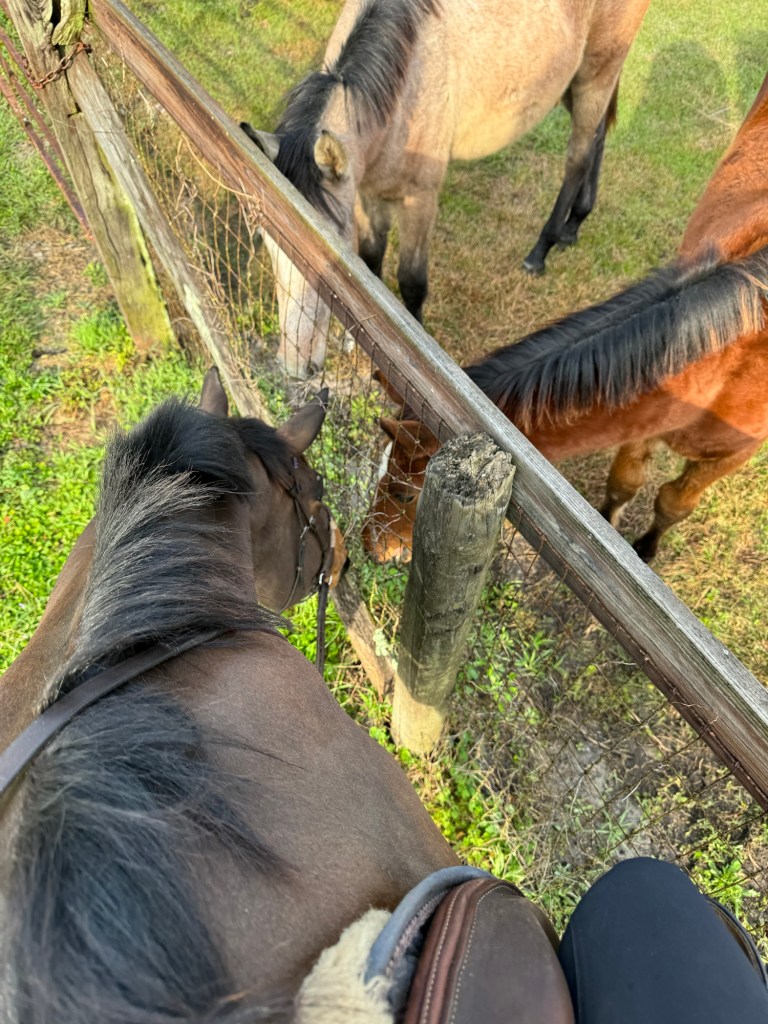
When I last left off, I was getting ready to take Presto to jumper rounds on Wednesday afternoon.
I did take him to jumper rounds. We did not actually jump anything.
Let me back up a bit and give some context to this story, because in actually I think it truly began months ago.
If you remember, around the time of the September Stable View, Presto started being inconsistently and randomly hesitant to jump down off of banks and across open ditches. We had that 20 at Stable View at the down bank, and I came home and had my vet out for a general exam and to check for any lameness. You may also recall that we found jack shit, and in fact he was quite incredibly sound (verified by her app which said his gait symmetry was perfect).
And then like two days later was when he did the foot bruise debacle that put him on stall/tiny pen rest for a few weeks. I brought him back and he’s felt quite amazing since then actually, as far as how he’s moving and jumping. He’s got more power and balance than he ever has.
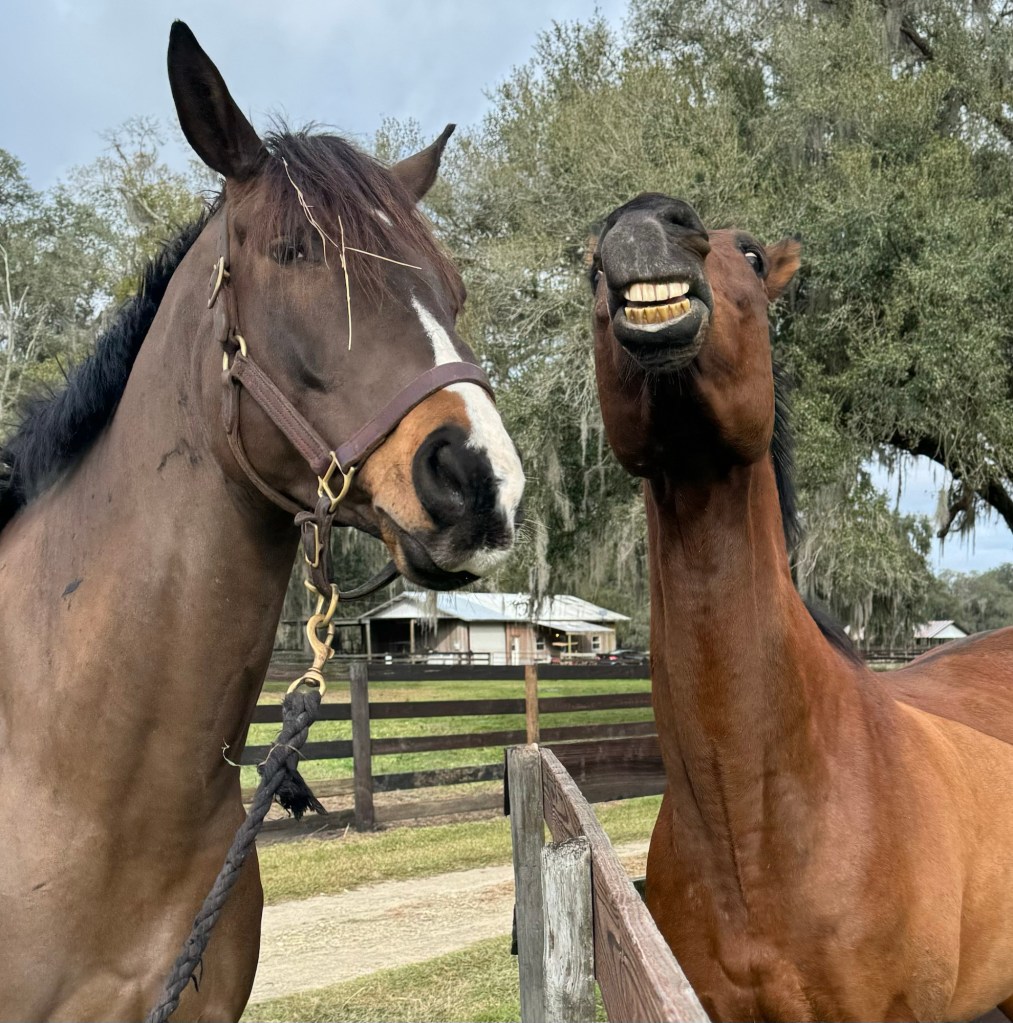
But still, something has been just a little bit not quite right sometimes. The ditch/bank issue remained, he was still being randomly weird about them on occasion… maybe like 5% of the time. Honestly I thought I’d done something wrong and he’d stopped trusting me about it, and we just had to rebuild the confidence and expectation.
The Sunday before last we had a jump lesson, and it was really out of character. He jumped, but he was being pretty unrideable and rank about having to whoa in the lines. We ended up just doing a gymnastic, and though he finally settled, he ended the lesson with more of a concerned look on his face. Usually he finishes lessons with a “yeah I know, I am the most amazing horse that has ever existed” look on his face. We all noticed his mood and thought it was odd. But… horses aren’t machines and can have off days.
On the following Tuesday night I tuned into Ride iQ’s weekly Ask an Expert, because their guest was my vet, doing a talk on Equine Ulcers. She’s the one who’s done all Presto’s work, she did Argo’s scope when he first got here, she also does our chiro, etc etc. Anyway… there was a point where she was talking about unusual ulcer symptoms that she’s noticed in event horses in particular, she mentioned two things that snagged my attention.
1) they can sometimes be reluctant to jump down banks/across ditches (because of the motion causing the acid to splash the top of the stomach, she theorizes). She mentioned this as being a symptom in horses that have ulcers at the top of their stomach, which is uncommon.
and
2) be forward and yet also kind of perpetually behind the leg. This is Presto to a T, I dunno how many times in the past 6 months that I’ve described him as “the most forward and yet simultaneously most behind the leg horse I’ve ever ridden”. I just assumed it’s because I suck as a rider.
Those things were very much sitting in my mind the next day as we headed to the jumper show. We got there and Presto was clearly very unsettled from the moment he stepped off the trailer. Staring off into the distance with his heart pounding, being reactive, explosive, and just dramatically not himself. Even after 45 minutes of walking and trotting around the warmup, it did not improve. The horse can be a little ridiculous and silly sometimes, but not like that. He’s usually got 5 minutes of Fuckery in him and then he’s ready to carry on. My gut said something just wasn’t right, and I had a hunch that it was his stomach. I ended up not even leaving the warmup. I scratched, loaded up, and came home.
I called my vet on the way home and talked it through with her, and she agreed that we should scope him for ulcers. I scratched the show for the weekend and made a vet appointment instead.

She came on Friday morning and god, y’all… his stomach is a mess. He has grade 2.5-3 ulcers on the top of his stomach (the notes on her report say “Areas of eroded squamous mucosa in the fundus, which is an unusual presentation.”. Honestly, does this horse ever do anything that isn’t unusual.

What’s interesting is that my vet said this is the fourth mid-upper level event horse she’d seen this in recently. She doesn’t yet have a theory as to why.
We talked over treatment options and she gave me a “budget” one and an “all out” one. There is no question, we are doing the all out. I’ll figure out how to pay for it, I’m not taking shortcuts with anything with this horse and his health. I also asked her what the heck else I can do to prevent this from happening again.
Mind you, I feed our horses in ways specifically meant to be stomach friendly. They live outside, get lots of forage, eat forage-first feeds, get alfalfa 30mins before their grain meals, get ulcergard during long travel, has a very regular schedule, a calm environment, etc. The horse looks fantastic, has a super shiny coat, is moving better than he ever has, and is super outgoing and enthusiastic. It’s not one you’d look at and be worried about, or think was high risk. He IS a competition horse though (and, ya know, a HORSE in general) and eventing is a stressful job for any horse I think. Even doing everything “right” in his life to try to prevent this, his stomach is still a mess.
She agreed that everything I’m already doing is what she would recommend. The only additional thing she said is to add Ulcergard before any XC school, in the chance that the acid splash from jumping down and across is contributing. His scope also did reveal that he seems to produce a bit more acid than usual, so she thought it might be worth looking at a daily preventative (she’s not typically a supplement enthusiast, but she suggested a few that have actual research behind them) to try to help give his stomach a bit more of a natural barrier of protection.
I haven’t really stopped beating myself up for missing this and probably never will. In retrospect I feel like this probably started with the June Stable View trailer incident, and really kicked off once his workload started to increase again. To be fair, he displayed absolutely none of the real “traditional” ulcer symptoms. And he’s naturally kind of a spooky dingaling, so behavior-wise it’s hard to tell with him sometimes. That doesn’t stop me from feeling like a whole idiot. I know this horse so well, I feel like I should have cottoned on sooner than I did.
I’m very very glad we found this before we started our competition season but I still feel really guilty that he’s been doing his job with his stomach looking like this. This hasn’t happened overnight. It makes me think that adding an annual gastroscopy might be worthwhile to consider.
A few people have asked me why I opted to scope and not just treat. There are a few reasons. 1) there’s no point throwing money at a problem that may not exist. 2) If you don’t really know for sure what issue you have, you have no idea how to modify that horse’s lifestyle to make the changes required to try to avoid having the situation arise again in the future. Like… how the hell would I have known the ulcers were at the top of the stomach, or that he produces excess acid? 3) This is the most important one: Different types of ulcers require different medications/types of treatment. If he’d had ulcers in a different location, he would be on a different medication than he is now. If his ulcers had been better or worse, it may have affected what I do with him under saddle while he heals, how long I treat, and at what dosage. In the grand scheme of the cost of these medications and the well-being of the horse, paying for the scope is the cheap part.
So, if there are any takeaways from all this, I would leave you with these:
1) Listen to your gut. If you think something is wrong, you’re probably right.
2) Watch or listen to (if you have the Ride iQ app it’ll be up in Podcasts soon) that AAE episode. It’s incredibly valuable.
3) Do the scope. Just spend the money and do the scope. If there’s even a question… scope.
 breedrideevent.com
I was in a similar situation recently, where my horse just wasn’t quite right. She went from finishing her grain in 15 minutes or less (she’s ALWAYS been picky and slow and has been scoped in the past, clear, and yes I know that’s a spot check but it means her pickiness likely isn’t [always] ulcer-related) to hardly touching it at all in the course of a weekend. I changed a couple of things, added a more stomach-friendly supplement, and gave her 2 weeks. Literally the Monday after I said, “That’s it, you don’t start eating better, I’m calling the vet on Monday” she started eating drastically better…
I would have scoped sooner, but it’s not so easy out here. There are only 2 vets “nearby” with scopes, and they’re both an hour and a half haul from me. AND it’s winter so roads can be icy…and I’m definitely out of their area for a farm call. If I lived in a city (or had we not been hit with a storm at the time), I probably would have booked her in that first week. But she wasn’t off in any other way either, just in one of her “no grain, thanks” moods. They just don’t usually last longer than a day or two, or she’ll finish “most” of it for a couple of days then go back to “all” of it. I just chalk it up to Mare Moods.
But in this case, the cause was likely a stressful weekend: we went foxhunting and I forgot to give Ulcerguard. She spent a lot of the day not eating (not for lack of offering, she had alfalfa in front of her but just nibbled) while also being Very Excited about foxhunting. Mind, she’s not new at it, but she LOVES to gallop and that’s one of the few times we can. The next day we went to a pair pace: more galloping and excitement, and minimal eating again. I did remember her ulcergard that day but I think it might’ve been “too little too late”. I suspect she started to develop something minor, and with careful management and maybe also the supplement, she healed on her own before it got bad. Who knows.
LikeLike
You do not suck! your human. We do the best we can with the information we have at the time. Thanks for sharing what it is really like to own horses and try to compete as an adult with a life and a farm.
LikeLike
Well… you have now put me in a total panic mode! Like you, I do ALL the steps to keep all my horse’s stomachs in good shape. I feel so bad for Presto. You had no idea, but your spidey senses sent you in the right direction. I am going to be even more diligent going forward. Did your vet recommend OTC stomach buffers/supplements? I would like to know what brands your vet recommended. Hope Presto is on a quick recovery path!
LikeLike
I would be interested in hearing about the supplements your vet suggested if you’re comfortable sharing. I have a mare that is highly ulcer prone, and I struggle to keep her happy. Gut X seems to have helped a lot when she was just at home hanging out, but it doesn’t seem to be doing the trick now that I’ve been putting her back into work and hauling out more.
LikeLike
I highly recommend listening to the linked Ask an Expert podcast; Dr Yates mentions a few in there that she likes.
LikeLike
I think your train of thought re the confidence etc seems like a fair assumption and as soon as it got worse, you responded. Without psychic skills, I don’t think you can do much better.
As a side note, I have a rising 2 homebred who looks so like Presto and sounds very similar in behaviour…and weirdly, he’s named Pesto. If he grows up like Presto, I will be very pleased!
LikeLike
As I read your post on IG, with the pics of his tummy, and now this longer explanation, my immediate thought was all those horrible GI problems he had as a newborn, and I wonder if there some sort of connection. I’ll never forget those pics of him with the muzzle on so he couldn’t nurse, to help his belly heal. 😦 No way to prove it, probably, but something to consider instead of beating yourself completely up over it. Maybe he had somehow learned to cope with an ouchy belly from way back then, and now that his job is finally getting him out of his comfort, I’m so bored with these heights, zone it’s rearing it’s ugly head. Good on you for listening to him every step of the way, and he’s lucky to have you as his human. ❤
LikeLike
Exactly what I was thinking, too. Amanda, please do NOT beat yourself up. You’ve done every single thing you possibly could right by this horse from the moment he was born
LikeLike
God, please don’t beat yourself up. if you have horses long enough, you’re going to go through this scenario. Cos horses don’t read the books. I commented briefly on your IG post but I’ve had 2 horses here I completely missed – and I’m a vet. One was a Welsh pony. ZERO risk factors, as he was a pasture fed pony who got ridden 2-3 times a week for 20 minutes or so. With the benefit of hindsight, he probably had ulcers for ages: he was “naughty”. In the end he started having recurrent bouts of colic and that’s when we picked it up: this was 10+ years ago though so in my defense probably less awareness. The second was my good endurance gelding, Joe. He showed NO typical signs – steady eddy, so well behaved, always a finisher at 50 miles but NEVER fast – didn’t have that classic big Arab trot (I thought). Never.Stopped.Eating. Always passed his vet checks. I put him on Omeprazole out of pure curiousity – I had started using it on my daughter’s mare – she was a fussy eater at rides and always quite ‘difficult” so we trialled it. She ate better but I guess the “difficult” is just her! Anyway – treated Joe with it and unlocked a totally new horse – big trot, wanted to hit the front, just all round more competitive. A wise endurance vet told me the lack of a big trot was probably him guarding his stomach from “splash”. I beat myself up on that one for a long time – he’d probably had ulcers for years. Nowadays, EVERY horse that comes to our place, barring unstarted babies, gets a 30 day course of omeprazole on arrival. All my competition horses get omeprazole the day of travel to a ride, the day of the ride, and the day of travel home if that’s the next day. Anything that gets “stressed” at home – injuries, illness, course of antibiotics, has to be confined for any reason – gets treated. Costs me a fortune! I don’t scope many horses – I just assume! If they do have them, the difference can be seen in 24 hours after starting treatment in many cases.
LikeLike
We always blame ourselves for missing these kinds of things. But horses are really stoic and sometimes it’s hard to know until you KNOW. You’re always looking to do right by your horses, and you did this time too. He’ll be feeling better really soon, and that’s because you figured it out and addressed it.
Similar boat with my dingaling, but instead of ulcers it’s Lyme. I figured it was probably ulcers for him too, but it wasn’t. Horses. They’re HARD!
LikeLike
I need to scope my horse. Thank you for this post.
LikeLike
I had one with grade 4 ulcers, and none of us knew. He was a beautiful shiny Friesian gelding, lightly training dressage at home, hadn’t competed in months, super chill dude. He never went without forage, spent all day outside with relaxed friends, got alfalfa 30 min before “grain” meals, and didn’t even get any real grain—only a ration balancer. In general we struggled to keep weight off this guy. We would never have known about the ulcers if he hadn’t colicked and been scoped in hospital!
LikeLike
A couple years ago, a passing comment from my assistant trainer was the only reason we found ulcers in Frankie. He was (and always has been) enormously chill at all times, he was going great, he had all day group turnout and lots of forage blah blah blah. I think he turned his head to bite at flies one too many times and this person said we should check. She was right. I felt so silly for not recognizing it sooner as his owner.
Granted, this same person also identified a minor gait asymmetry literally before the vet could pick it up, so she might also be part wizard. These horses, man. I wish they could just tell us what’s going on.
LikeLiked by 1 person