How to completely fry your brain in one easy step: sign up for a YEH judging workshop. I learned so much that I’m not even sure I can fully absorb it all. My brain is still mush. In the absolute best way possible, of course.

On Thursday we met Marilyn Payne and the rest of our group beside the dressage arena, spent some time talking about dressage judging in general, the YEH program specifically, and what they’re looking for. Then we started practice judging, first as a group, and then on our own, followed by a group discussion. I have to say, I don’t think I’ve ever been so interested in watching very basic dressage tests in my life. It was pretty cool to see that most of the time my scores were pretty close to Marilyn’s, though.
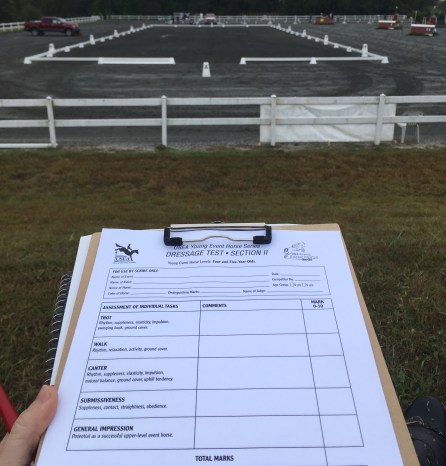

The way the YEH stuff works is a lot different from a regular dressage test. They don’t judge the YEH test by each movement, but rather by the overall impression you get as the horse performs it. As you watch the horse perform the test, you’re looking for it’s best possible walk, trot, and canter, and giving a score based on those “best moments”. We also gave an overall score for submission (where obedience and rideability came into play), and the impression of the horse as a potential future 3* or 4* competitor. The dressage portion counts for 35% of the final score.
In the YEH judging, you are truly hunting for talent. Riders who sacrificed brilliance for the sake of accuracy did not do their horses any favors in the scoring. I actually wondered if some of them really knew how the YEH classes are judged and what exactly the judges are looking for. There were many instances where we thought the horse likely had another level of brilliance lurking in there, but the rider just wouldn’t quite be bold enough to show it. You can’t score brilliance if you don’t ever see it.

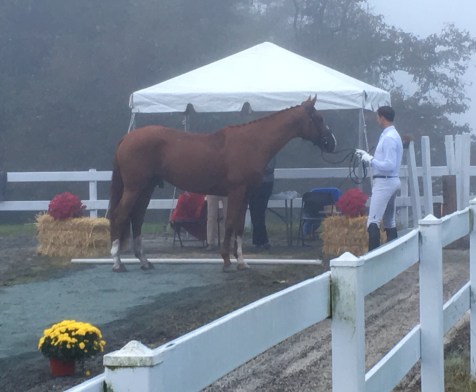
After we watched several of the 5yo tests, we walked back down to watch some of the conformation portion. We discussed what makes a good event type, things that were particular positives, and things that were particular negatives. The most important part of conformation is type – does it look like the right type of horse to be an eventer? We want something that isn’t too heavy or too light of bone. Something proportionate, with good feet, a good neck set, well-balanced, with correct legs and a strong hind end. You want a horse that looks as if it’s built correctly enough to stay sound at the 3* or 4* level. Of course, while conformation CAN certainly be a predictor of a horse’s future potential, there have definitely proven to be many exceptions. Conformation only counts for 15% of the final score.

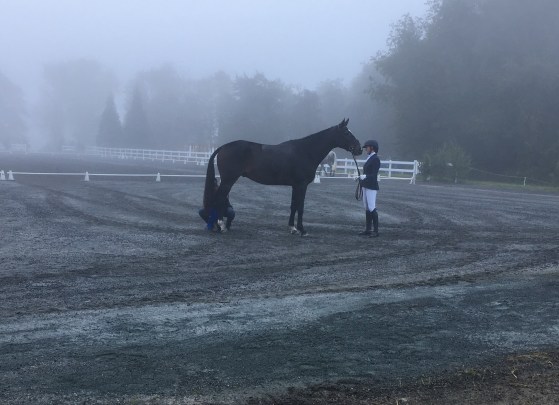

After the conformation lecture, we went back to the dressage and this time judged the 4yos. It was more of the same of what we did with the 5yo’s, really searching for that moment of brilliance in each gait and the overall impression of the horse’s potential. It’s hard to really see it in some of these horses, being so young and green, but it almost became a bit of a game to try to find that glimmer of what the horse might someday become.
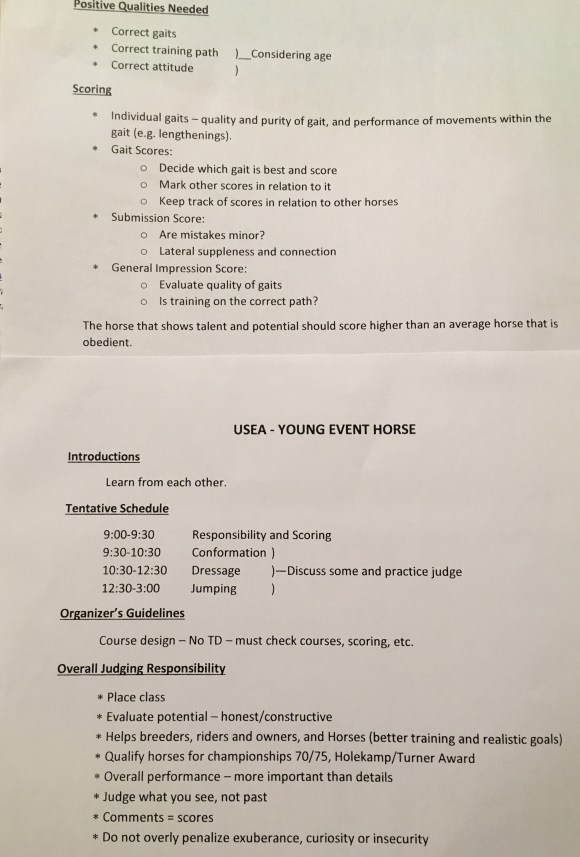
At the end of the day we compared our group scores to what the actual judges had, and while we were consistently lower than they were number-wise, we pretty much had the horses in the same order. A couple of things raised some collective eyebrows (especially one horse in particular in the conformation section), but overall I think there weren’t many surprises in how the order shook out.
Marilyn of course gave us homework… we were to walk the course for the jumping portion and be prepared with our thoughts/comments by the following morning, and we were to study the materials she’d given us on how the jumping portions are judged. Clipboards, folders, and pens in hand, we marched over to the jumping course to look it over, then lugged everything home and read about what was to come the following day.

Day 1 was definitely really long, but SO enlightening. As someone who is really interested in young horses, breeding, and the YEH program, what I learned was valuable beyond measure. To be able to sit with someone like Marilyn, in a group comprised mostly of judges, and hear/be a part of these conversations… wow. Just wow. I really think that having a good eye for a horse is super important, and this kind of thing is such a great way to fine tune it. Many thanks to the USEA and Marilyn for the opportunity.
Tomorrow, on to Day 2 (the fun part)!






 breedrideevent.com