I’m gonna stand on my rickety little soapbox for a minute here and preface this post with this: regardless of whether you’re a breeder or not and regardless of whether you own a young horse or not, learning how to evaluate a horse’s potential for a future career is a skill that every horseman needs. It will make you look at your horses (and any potential future horses) in a completely different way. If you ever get the chance to attend any kind of sporthorse conformation/young horse evaluation clinic – take it!
I had so much fun at Marilyn Payne’s Young Event Horse (4 and 5yos under saddle) judging clinic last fall that when I saw a Future Event Horse (yearlings through 3yos judged in hand) clinic being advertised up in Dallas, I jumped on it immediately. Baby Horse might not even be here yet, but two of my favorite things are breeding and eventing, so it’s only natural that anything FEH/YEH is right up my alley.
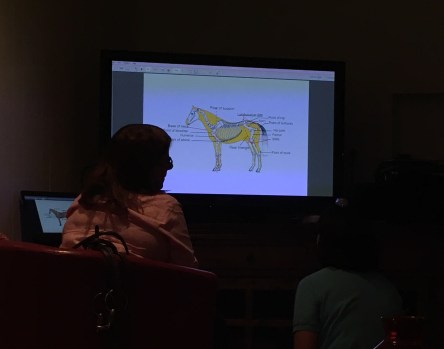
The clinician was Eileen Pritchard-Bryan, a breeder and well-known eventing/FEH/YEH judge and steward. We started on Saturday morning with a lecture on conformation and what traits you’re looking for in an event horse (vs dressage horse or jumper). There was a whole lot of technical stuff with angles and dots and lines that would take a million years to cover thoroughly, so here are just some of my notes:
- The lumbosacral gap should be no more than 1-2″ behind the point of hip.
- “Pillar of support” – when drawing a straight line down the groove of the forearm, the line should come out ahead of the withers on top (for lightness of forehand) and go through or just behind the heel on bottom (too close to toe: foot injuries, too far behind heel: soft tissue injuries).
- Lower stifle = better gallop and more jumping ability.
- The lower the point of elbow, the better (more clearance from the rib cage for galloping).
- Point of shoulder to point of elbow should be barely less than 90 degrees.
- Neck should be longer than the hind 1/3.
- Back at the knee = deal killer
- Toeing out is better than toeing in

A lot of the sporthorse conformation stuff isn’t new to me, having been around the breeding industry, but there were a few subtleties pertaining specifically to eventing that I found very interesting. I spent a lot of time that evening looking at pics of different eventing and jumper stallions (and pics of Henry, of course).


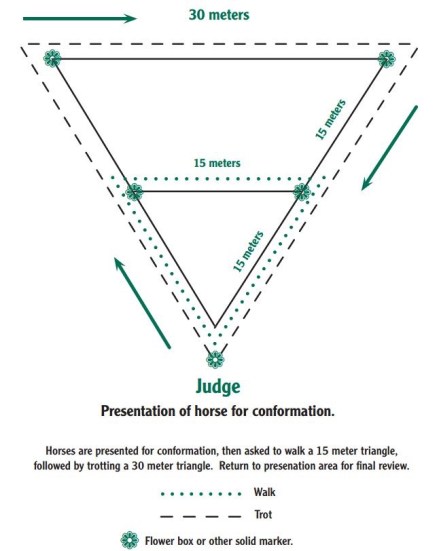
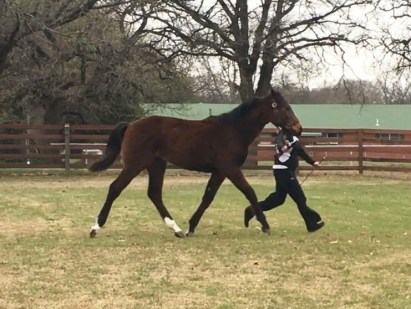
After the conformation lecture we talked a bit about the FEH classes in particular, proper turnout, tack, apparel, etc. Then the participants went and got their babies and got to practice in-hand presentation. I have some notes about that part too:
- For FEH, the walk is most important because mirrors the quality of the canter. You want lots of swing through the back, groundcover, overstep, and straightness.
- The tack and handler should be subtle. Basic bit and bridle (2yo and 3yo), no full cheeks. Khakis, collared shirt, gloves, appropriate shoes, helmet on handler. Riding attire is ok. Leather halter on yearlings with leather or dark colored lead.
- To reposition horse while standing up for confo: if you need to move a hind leg, take one step forward, if you need to move a front leg, move one step back.
- Always be aware of where the judge is and reposition yourself and the horse in relation as necessary.
- It is very important to move STRAIGHT away on the first and last leg of the triangle (a wiggling horse can sometimes make the horse look like it has a movement defect that it actually doesn’t).
- Practice practice practice at home so the horse learns what to expect. Always be patient and take your time.
- Just like dressage, the judge can only score what they see on that particular day. Given how quickly young horses change, this can lead to a variance in scores depending on the time of year and stage of growth.
I think until you actually do this stuff, it seems fairly simple. You just stand there, then walk, then trot, then stand there again right? Hahahahaha. No. There’s SO much more to it. Presenting horses in hand really WELL is an art form and requires a lot of showmanship, practice, training, and knowledge. Even just a tiny tweak in how a horse is standing or how they hold their head or how straight you can get their body in the trot can make a BIG difference in the impression the horse gives to the judge. I learned a lot of this nuance last summer at Coco when we were practicing our jog-ups, but Eileen had additional useful suggestions, especially when it came to dealing with the short attention spans and sometimes overexuberant behavior of the babies.
In the afternoon we also got to see a 4yo do his YEH dressage test and discuss it as a group, then we chatted a lot about breeding and eventing over wine and then even more over dinner. Eileen and I have similar taste when it comes to bloodlines and stallions, so it was fun to talk to her (and the other clinic participants, of course).
I also heard that there’s a new 4yo FEH class, for those who wish to move at a slower pace with their young horses. The 4yo FEH has an in-hand conformation portion followed by a group under saddle portion (cantering separately). I thought this was a BRILLIANT addition, great for horses that are a bit less mature or just not ready to be jumping courses yet. So the 4yos get to choose between FEH and YEH.

Sunday was shorter, with a “mock show”. Everyone got to apply what they learned the day before and present their horses to Eileen for judging, complete with score sheets. It was fun to stand there and hear her comments about each horse and see what her scores were and why. Definitely gives me A LOT of insight into FEH and will help me decide whether or not I want to pursue those classes with my own horse. And if we DO, now I have an excellent idea of exactly what they’re looking for and how best to prepare Baby Horse for those competitions.
It was a superb and very useful clinic! I would highly recommend something like this to ANY sporthorse breeder, owner, or rider. Totally worth the audit!




 breedrideevent.com