That’s enough. I’ve had enough. I give up, wave the white flag, surrender. Someone please explain why the third hurricane in 2 months is now barreling straight at Florida? I’m over it. Go away, Milton. It’s shaping up to be another bad one and I really just cannot.
TBT to two weeks ago, when I didn’t want to fling myself off a bridge
We found out from the last hurricane that our generator is not sufficient to actually run the pump to get water all the way down the lines to the farthest fields. So, being responsible, we immediately ordered another one, which was supposed to arrive last week. That would have been great, if it had happened. Instead, somehow the generator ended up in Nevada. There were zero others in stock that could be re-routed to us more quickly, so that one is currently on it’s way to Florida and set to arrive just after the hurricane does. Stupendous. Very helpful. Thanks so much.
In the meantime, the barn worker went MIA last week, leaving me to deal with not only 25 horses in my sole care, but also the cleanup from the last hurricane. I am now conjoined with the zero turn mower, I think. Rob managed to get most of the biggest downed limbs picked up, so as of today we’re like… mostly cleaned up from Helene? Ish. We don’t have enough fence material (again, ordered but not arrived) to repair the fences that really need to be done, so I sure do hope those things decide to stay together through this one. They’re braced as well as they can be.
My friend Lisa sent me this and honestly it was the highlight of the week
In the meantime, what little joy was left in my life was snuffed out by a perfectly timed abscess on Presto’s part. Did I panic last week and have the vet out for a lameness eval? Sure did. But we def have an abscess, it’s just the slowest moving thing in the history of abscesses and really refuses to come out despite the best continued efforts of me, my vet, and my farrier. So I had to scratch Ocala, which was set to be our first recognized event in 6 months. Does this completely derail my entire rest of the year plan? Indeed it severely does, thanks for asking.
He’s rude.
In addition to the vet visit for his footie, Presto also got both a gastroscope (good news, his stomach looks pretty good) and an endoscope (also good) last week. No I have literally no money left in addition to the dearth of joy, but again, thanks for asking.
There was a point last week where I had three (count em THREE) riding horses, none of whom were actually rideable for various reasons and all missing one front shoe. Now after a farrier visit at least I’m 1 for 3 being rideable. Henry is carrying the team. Not that it matters, since we’re about to get slammed with a hurricane again.
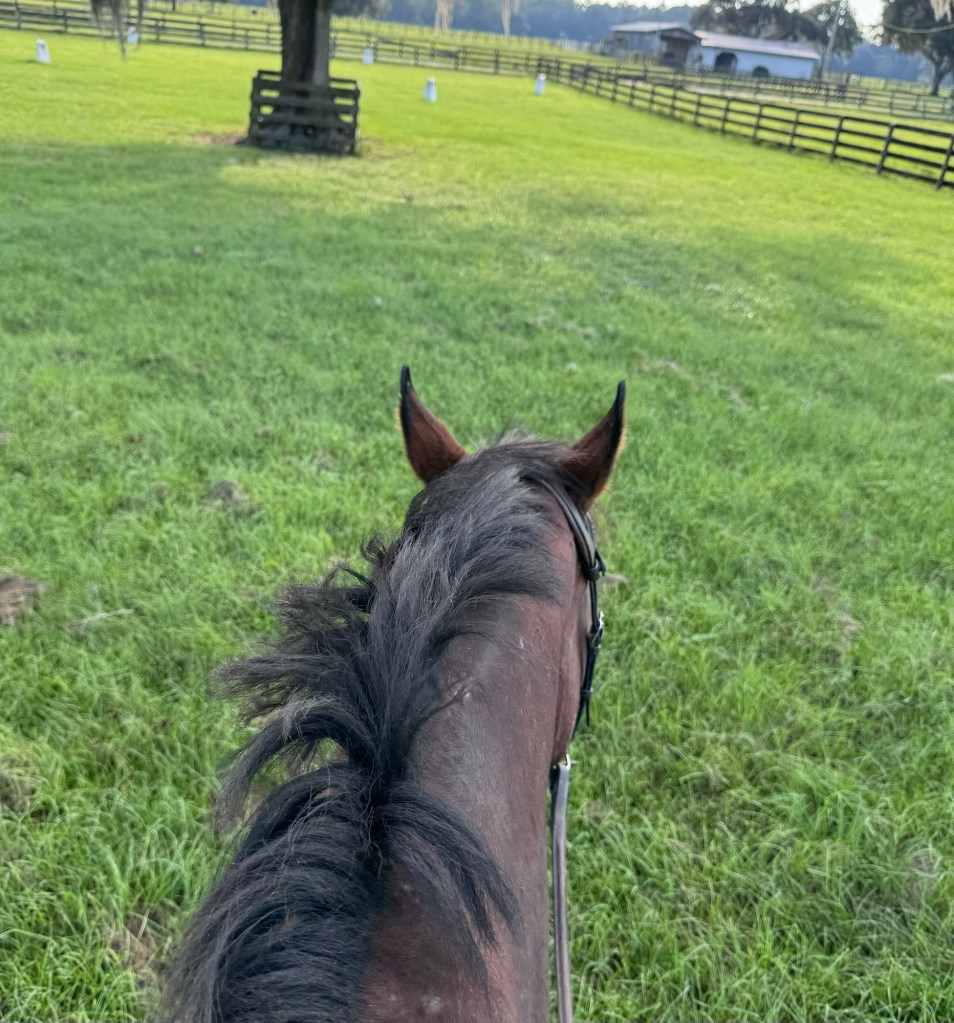
That one time I rode a horse
In case you can’t tell, I have no sanity left either. It’s been a long couple weeks and promises to get worse before it gets better.
Hurricane Helene has come and gone, and boy was she something. Her path was really similar to Debby, the last one that came through Florida in August. Other than that though, those two storms couldn’t have been more different. And honestly, for Ocala, Helene was probably a bit easier as far as lingering effects go.
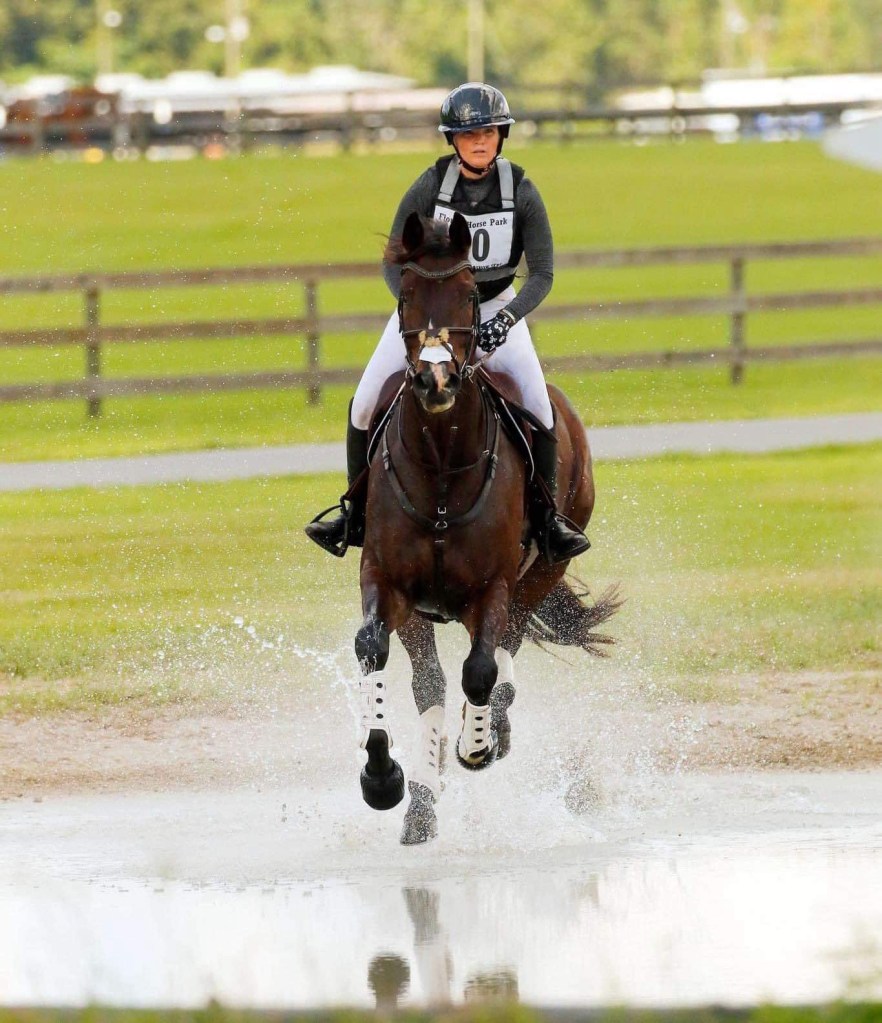
Presto floating above the water, as one does
We ended up on the east side of both storms, which is the worse side to be on. It gets all the rain, wind, and tornadoes. Debby and Helene were both big storms, with Helene the stronger of the two, but Helene was fast, whereas Debby was slow. For us here in Ocala, that meant Helene was much more violent, but she dropped considerably less rain because she came and went so quickly. Debby lingered, raining for almost 24 hours straight, dropping way more water. So while Helene dropped some trees and downed some power lines, she didn’t cause any kind of lasting flooding around here.
The same can’t be said of states north of us though, which definitely got hit much worse by Helene than we did. Even Aiken took a much bigger hit than Ocala, despite the fact that the eye was only like 90 miles from us when she made landfall. Helene marched north with spectacular rage, and it’s just devastating to see the absolute destruction she left in her wake. If you were in her path, I hope you and your horses and your farms are ok. Seeing some of these places in North Carolina and Tennessee that were literally just wiped off the face of the earth (and in some cases, the earth was wiped away along with it) is absolutely gutting. Mindboggling that a hurricane could do so much damage even that far inland. We absolutely got lucky here in Ocala.
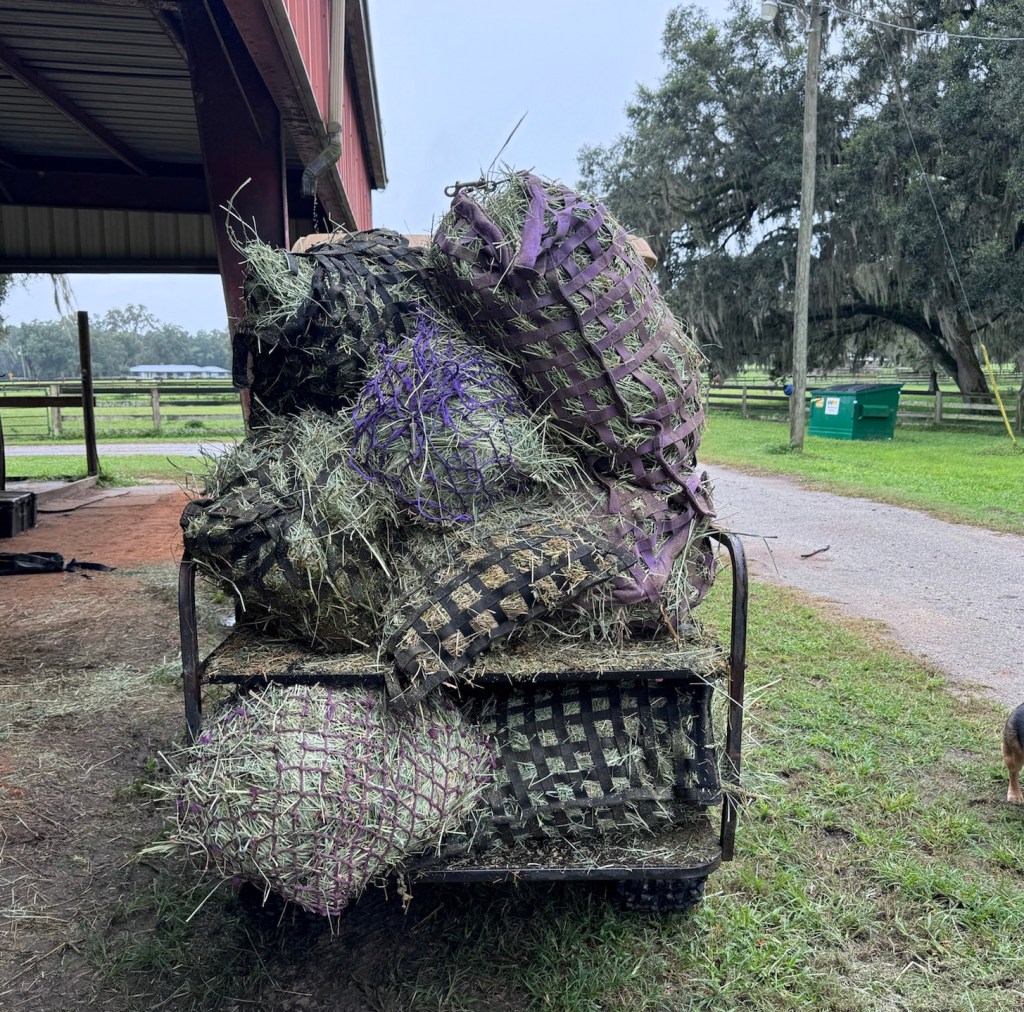
hurricane prep looks like this
I spent last Wednesday prepping for the storm, which mostly includes deciding which horses are gonna go where, putting away or securing anything that might blow away (stuff in the crossties, anything in the aisles, jumps, dressage arena letters, trash cans, etc), and hoarding water. Like most farms, we’re on a well, so if the power goes out the pump doesn’t work, which means we don’t have water. That’s a problem when you’ve got 25 horses.
On Thursday I did slightly change my plan of what horses were going where, when I saw exactly what direction the worst of the winds would be coming from. It was slightly different from Debby, and the wind speed was expected to be considerably higher. They were forecasting 50-60mph sustained with gusts potentially up to 90mph. The pasture horses stay out in the pastures during these storms, but I decided to bring the stall horses all up to the main cinderblock barn and put them in stalls that had fully enclosed doors. With winds that high, I wasn’t sure how the wood barns would fare, and I didn’t want them in stalls that had open top doors in case there was any flying debris.
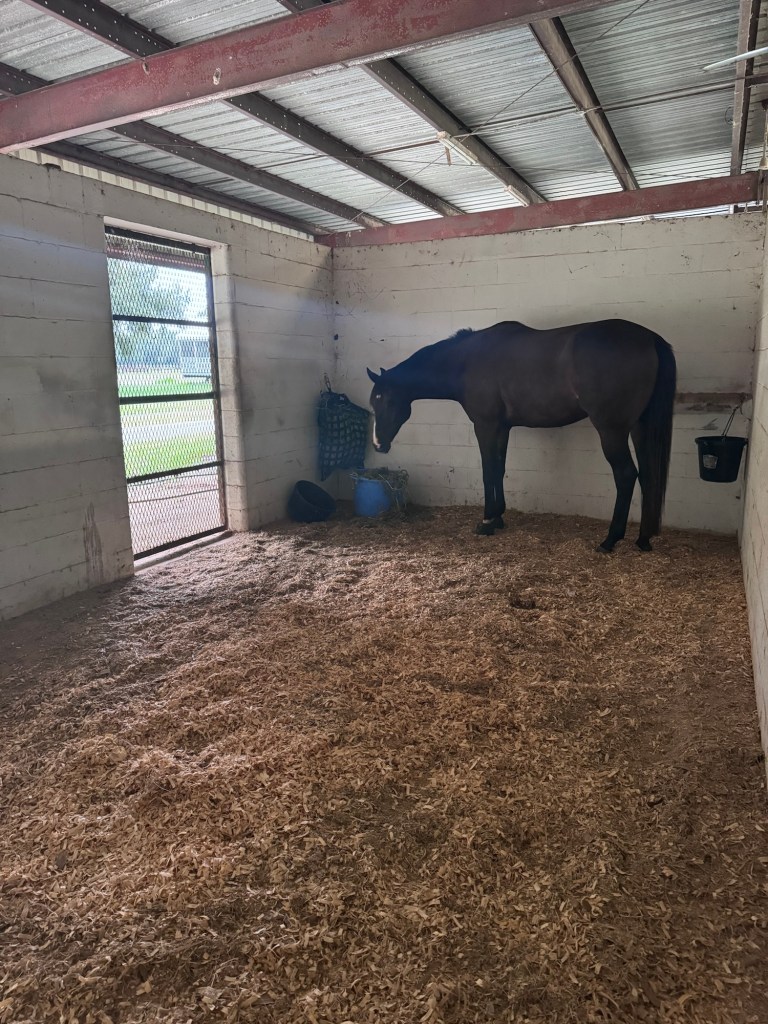
Presto took over one of the gigantic foaling stalls
So Thursday morning I prepped all those stalls with bedding, several water buckets, and two hay nets each. Helene was set to hit us overnight, so I wanted to make sure they had plenty of hay and water just in case something prevented me from getting up to the barn first thing in the morning. Andy and Rhett are also up at the top barn right now because Andy has a summer sore that requires 1) daily care and bandaging 2) turnout that involves no standing water. Those two kids got put in another giant foaling stall and I just gave them a whole bale of hay. They were delighted. Luxury hurricane suite.
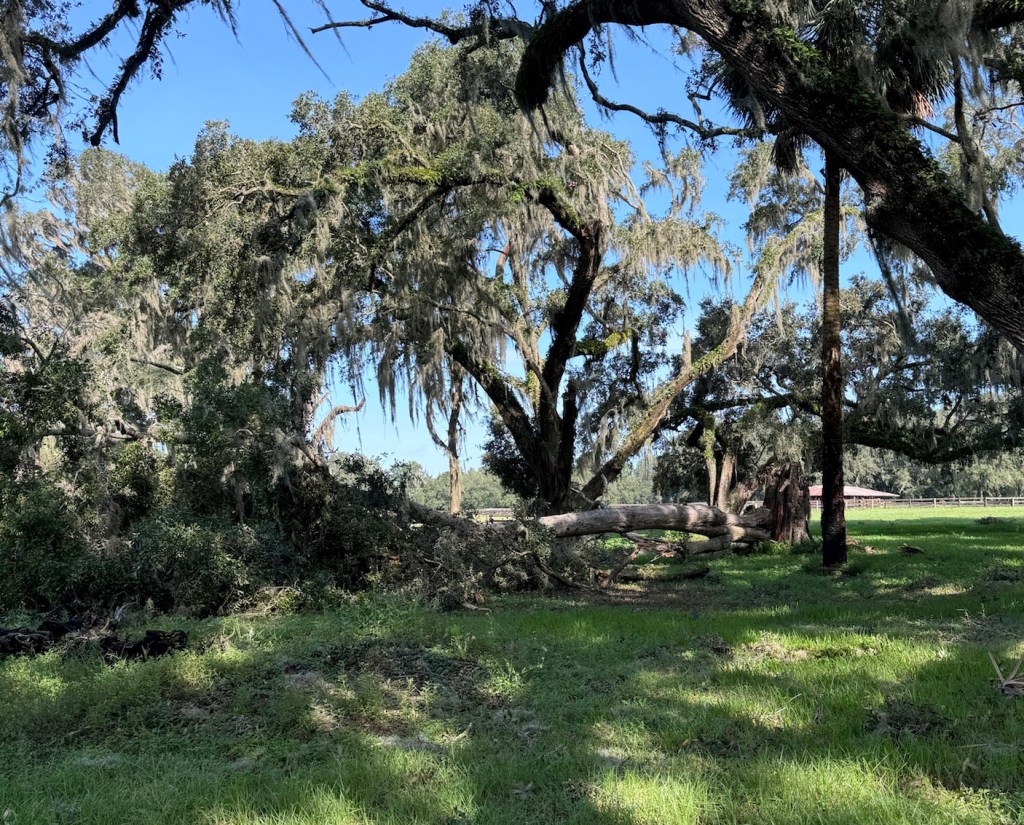
one tree down
I ended up bringing everyone in around dinner time on Thursday right as the first outer bands were starting to arrive. They weren’t most pleased about not being able to see each other (especially Hillary’s mares) but at least they were safe. I bid them all the best of luck, did one last pass around the farm, and then went to hunker down in my house.
Right around 8pm is when the wind went from breezy to rough, and that’s exactly when we lost power. I was kinda hoping we’d make it a little further into the storm than that, but nope. I basically sat there all night sweating (Helene was hot and humid) and listening to the metal roof rattle in a moderately concerning way while things pinged off the front of the house. I don’t think many of us got much sleep. Our tornado risk was quite high so I was mega paranoid about that too.
Honestly I think we got a little bit lucky with direction the wind came from. The weaker structures on the farm had a bit of a wind block from other things, and the house had the benefit of being a bit down and behind a tree line that helped block some. I mean, we did get smacked with lots of little branches from said trees, but that’s alright. And the biggest trees near our house that would be a problem if they fell, those are all behind it or on the other side.
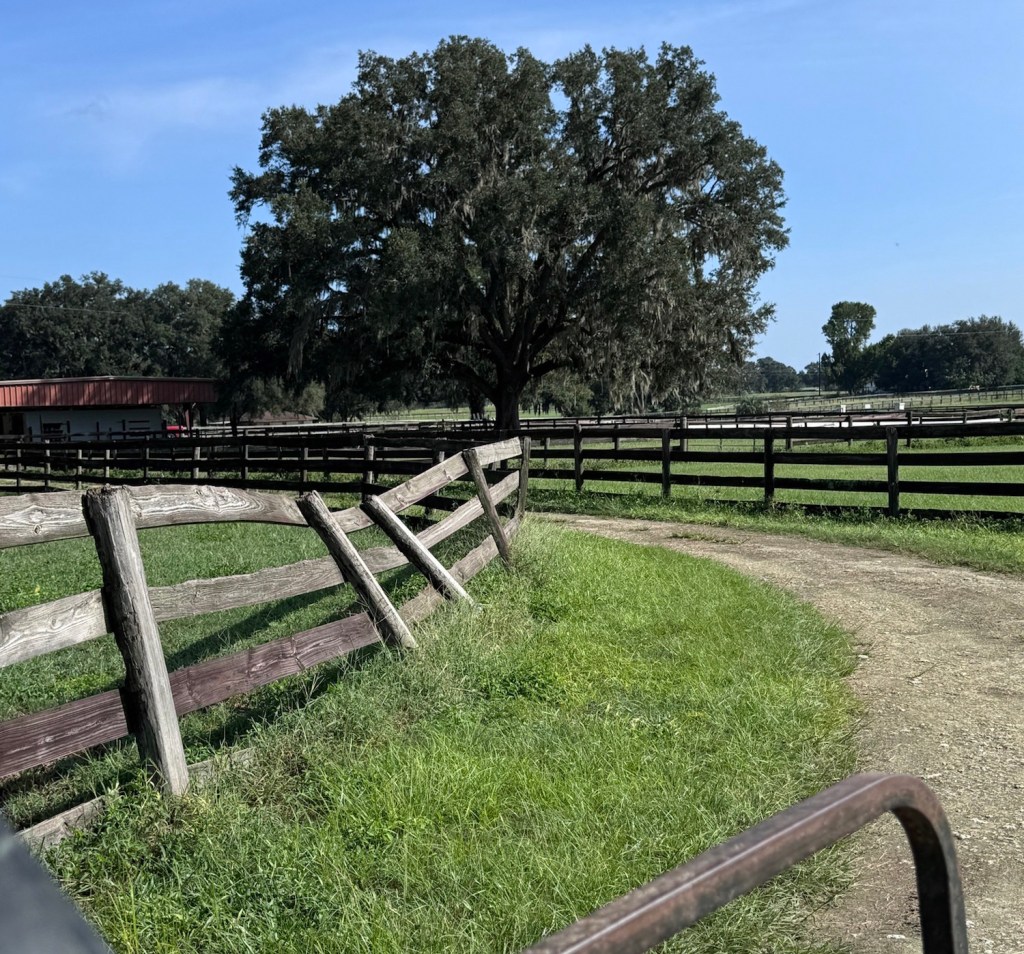
This section of fence tells you exactly where the wind was coming from
In the end the farm ended up losing two trees and having a couple spots of damaged fence, along with LOTS of branches and limbs down, but overall it’s much less damage than I expected. Most importantly, the horses were all happy and safe, and I was able to turn them back out the next morning.
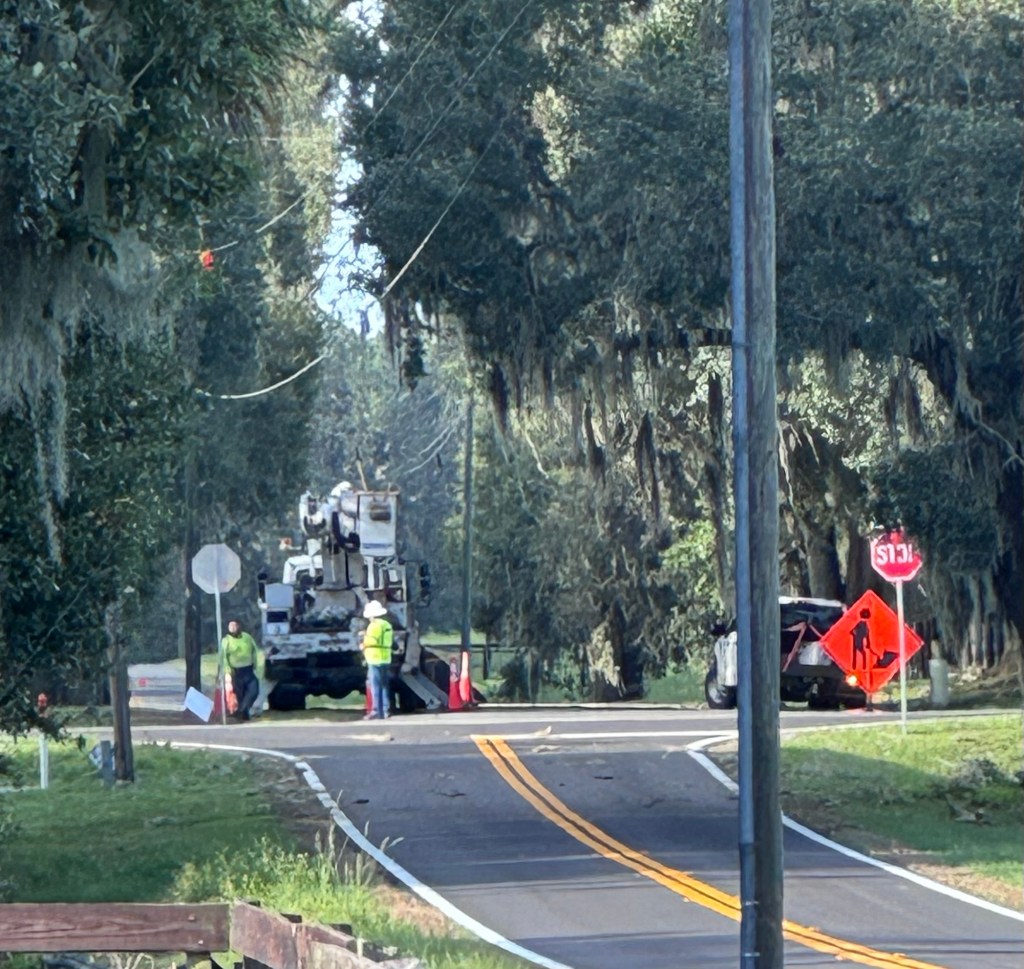
I wasn’t sure how long it would take to get power back… I was prepared for up to a week. But we also got lucky in that the major cities nearby (Ocala and Gainesville) didn’t have any widespread power issues, so all the linemen that had gathered nearby were able to get out to us in the rural areas a lot faster. And one side of the farm goes along a bigger road that connects the interstate to a nearby town, so we seem to have gotten some priority. There were 5-6 trees down on the lines between us and that town, but they still managed to get our power back on by dinnertime on Friday, so it wasn’t even out for 24 hours. Other people nearby got theirs back as late as Sunday or Monday, so I was happy to be among the first. It’s too dang hot to not have AC, and it stresses me the heck out when we don’t have water for the farm.
The real MVPs
I also lost cell service until late on Friday, which was annoying because I could see that people were texting and messaging me, but I couldn’t actually open any of it. I ended up driving into town in the afternoon to let people know we were alright.
Overall we definitely escaped Helene much more lightly than most of the others in her path, which I’m thankful for. Still though, of the hurricanes that have come through since I’ve lived here (I think we’re on 4 or 5 now?) she was definitely the angriest. Normally this far inland we just get some wind and rain, but this one was more wind than we’ve had so far. Did not love. Especially overnight when I couldn’t see what all the thumps and bumps were.
But Helene only dropped like 1.5″ of rain, compared to 8″+ from Debby. There was standing water for a month. Heck, there’s still standing water from Debby in the front corner where everything drains. At least Helene didn’t give us more of that.
Rubes helping with cleanup, one bit of spanish moss at a time
We’ve still got a ton of sticks and branches and Spanish moss to pick up, and some fence that needs to be repaired, but compared to the footage I’ve seen from elsewhere, it feels like we got off pretty scot free with this one. I would really love it if no more hurricanes would come this way for the rest of the year tho. I do believe two in 6 weeks was enough for me, thank you so very much global warming.
Truly did intend on making another post last week but clearly that didn’t happen. Let’s catch us up, shall we?
The cutest criminal
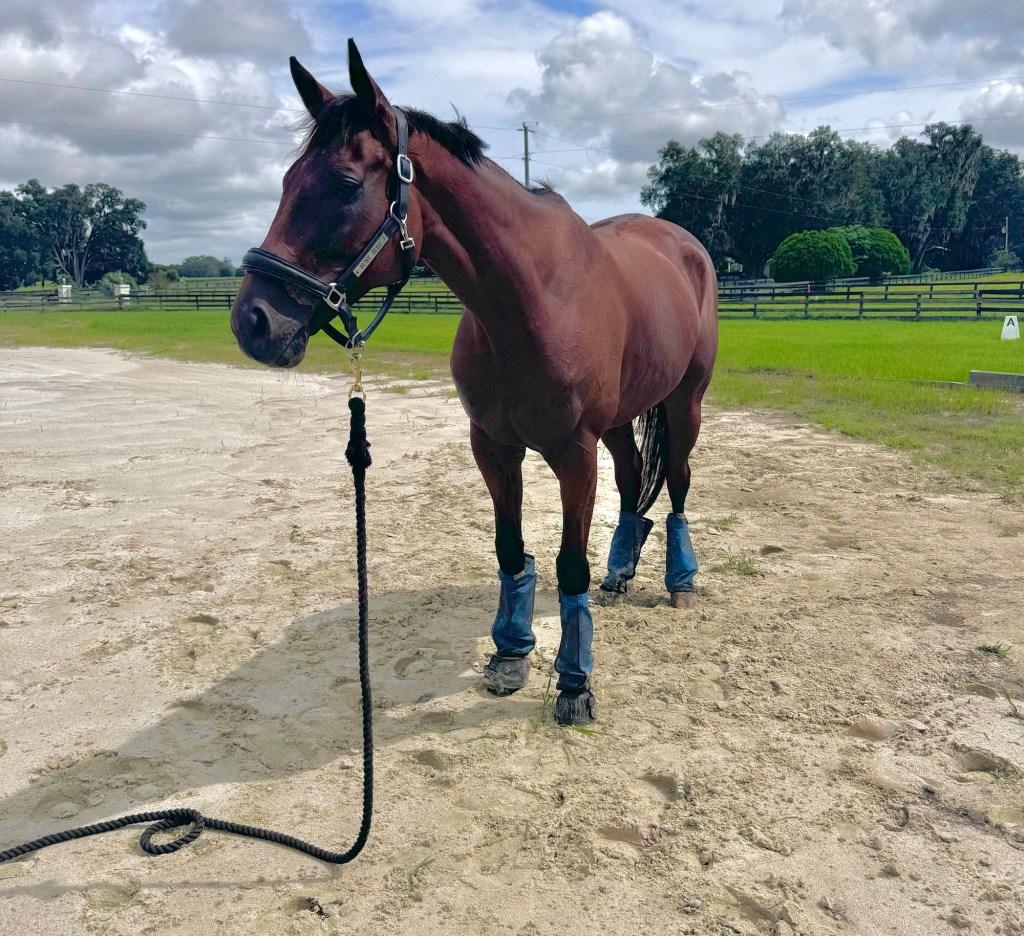
Rubes continues to eschew my efforts to keep 4 shoes on him. He got his left front put back on and proceeded to pull the right front literally hours later. And he took enough hoof wall with it to where if we nail something back on and he pulls it again, there’s literally gonna be nothing left. So now he’s going out in a wrap with a boot over the top and then wearing a canvas hoof wrap when he’s inside. Joyous times. All the horse’s feet (and my farrier) are really really really ready for the end of the rainy Florida summer.
Granted, there’s about to be a hurricane coming right at us later this week, so excuse me while I just internally cry for a minute. I can’t cope. You know what we don’t need? Another hurricane. UGH. We’re just finally drying out from the last one.
But that’s a problem for future me, so let’s talk about more fun stuff instead. Last week I had a jump lesson with Ellie, from which I have no media (Hillary is down and out from shoulder surgery and can’t even drive for a while yet, so I’m largely solo at the moment) but it was fine. It was pretty hot so Presto was a bit lazy, but we did the thing.
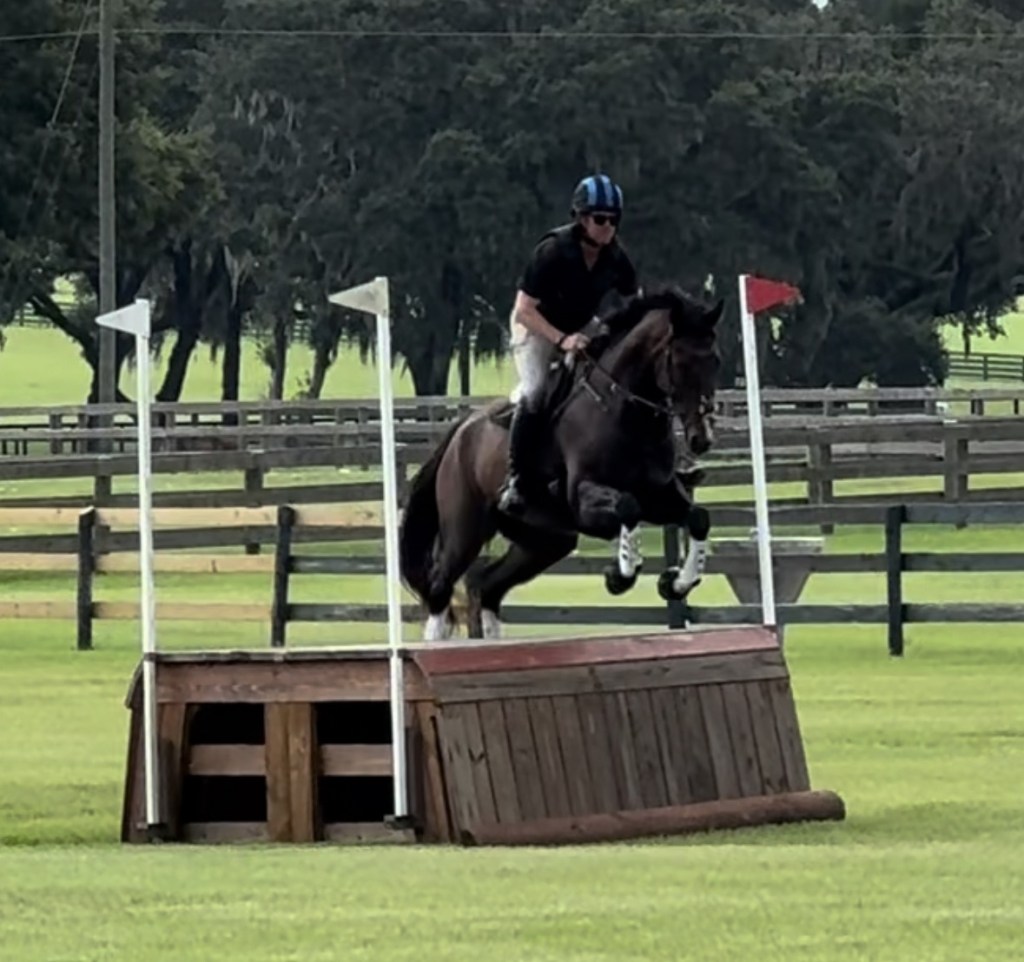
And then on Friday we went with Emily and Holly over to FHP to pop around some cross country.
the biggest WTW and the smallest WTW
I was hoping to be able to line something up to school with Alex, but his group wanted to go to the open schooling day on Saturday, which is always maximum chaos, and I didn’t feel like that would be the best choice for Presto. So instead we opted for a quieter day with friends, and it was fun! It was nice and quiet and we had the place mostly to ourselves, so it was a low-stress environment.
good kid
Presto did want to be a bit nappy about his new BFF’s a few times, but once I gave him some real work to do he buckled down and got to it. I swear, the harder things are, the better he is. He was definitely a bit spooky when we started, but we ended up hopping through some of the T and M combos later on and he settled.
Saturday Presto just went for a walk hack, and then Sunday we went to the POP show! The schooling shows don’t offer any XC levels above Training, so we entered the MT division and did Modified dressage and SJ and Training XC.
I had no one with me on the ground so I the only media I have is some snippets that my friend (who was scribing) got from setting her phone on the side of the booth. Which is exceptionally better than no media at all, but yeah… nothing from the jumping phases. We’ll see if the photographers got anything.
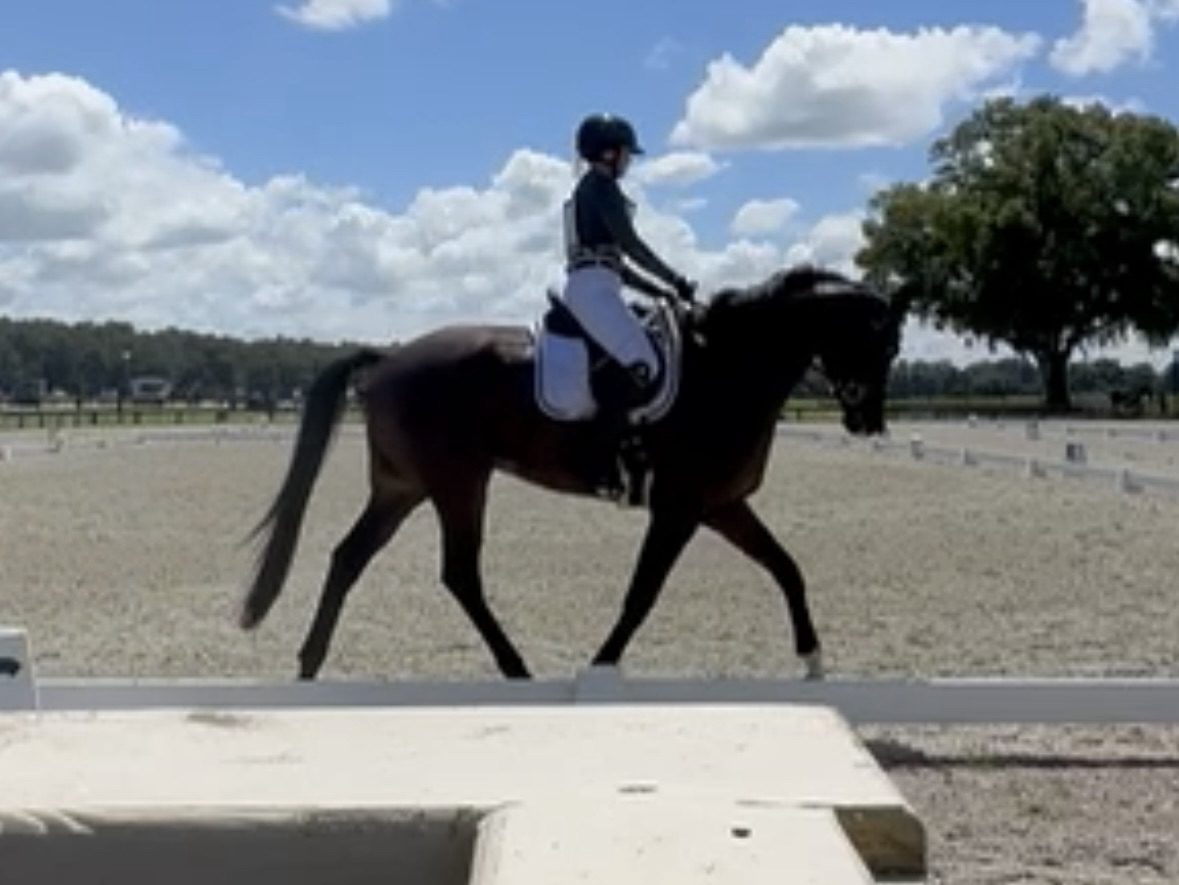
We did dressage at 12:30ish, so I warmed him up for about 15 minutes. Mostly I just get him moving over his back in the walk, move his haunches in and out at the walk and trot, do some up and down transitions, canter both ways and do canter lengthenings both ways, leg yield, and focus on keeping him in front of my leg. He was really well-behaved so even though I started warming up when I was 4 horses out, we still walked for a good bit of that time. It’s a long hot day, no need to wear him out. Make sure the buttons are working, get him loose, and get on with it.
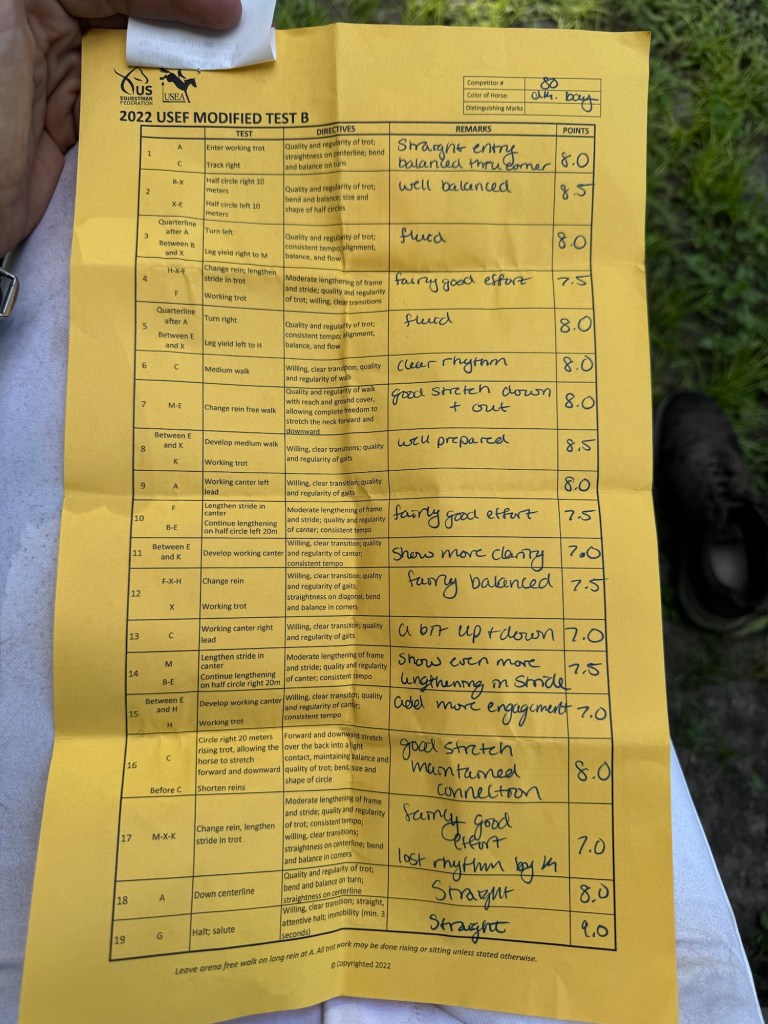
should I frame this?
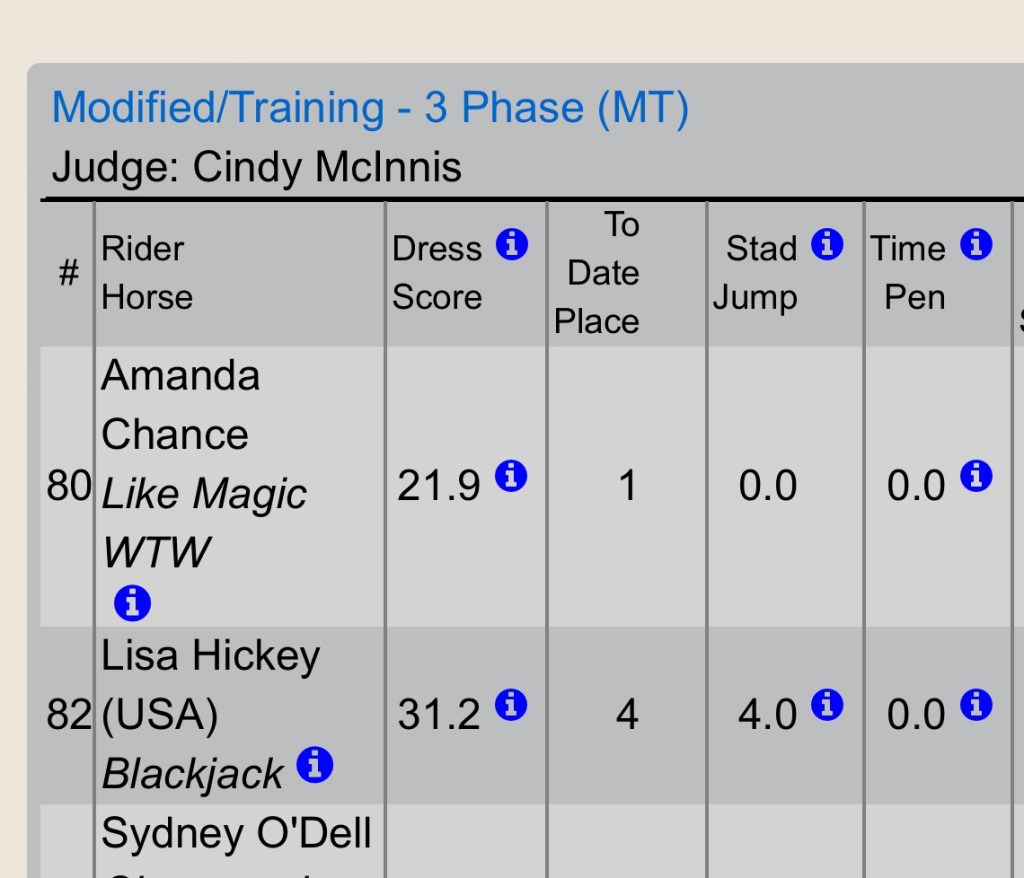
His buttons indeed were working, and he laid down a good test for our personal best score of 21.9. It was probably a bit generous but I’ll take it. Sometimes you get generosity and sometimes you don’t. Either way he was a good boy and it was a very steady test, so I was happy with that.
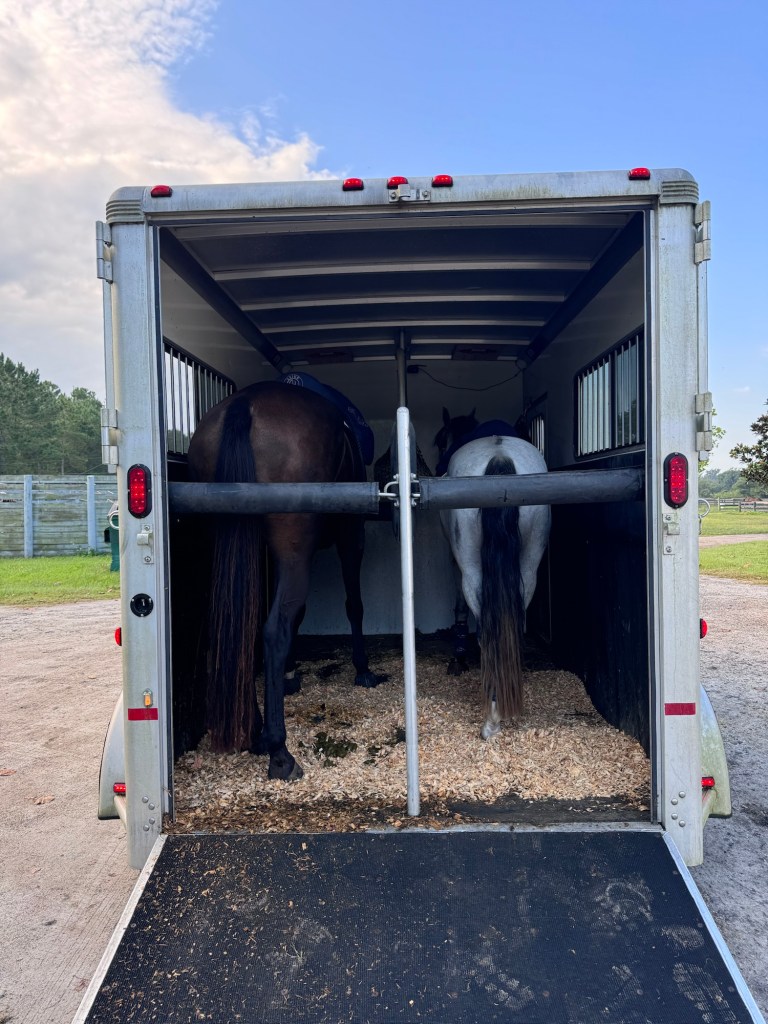
Then we had a few hours to kill before we jumped at 3:30. I hosed him off and set him up at the trailer in the shade with his fancy battery operated Ryobi fan (he’s bougie) while I scoped out SJ. Which was the same course as the show a few weeks ago. At least I didn’t have to learn a new one? I have no media from SJ, so short version: he jumped great, even when I had a swing and a miss at a single oxer because I got just a bit underpowered out of the turn.
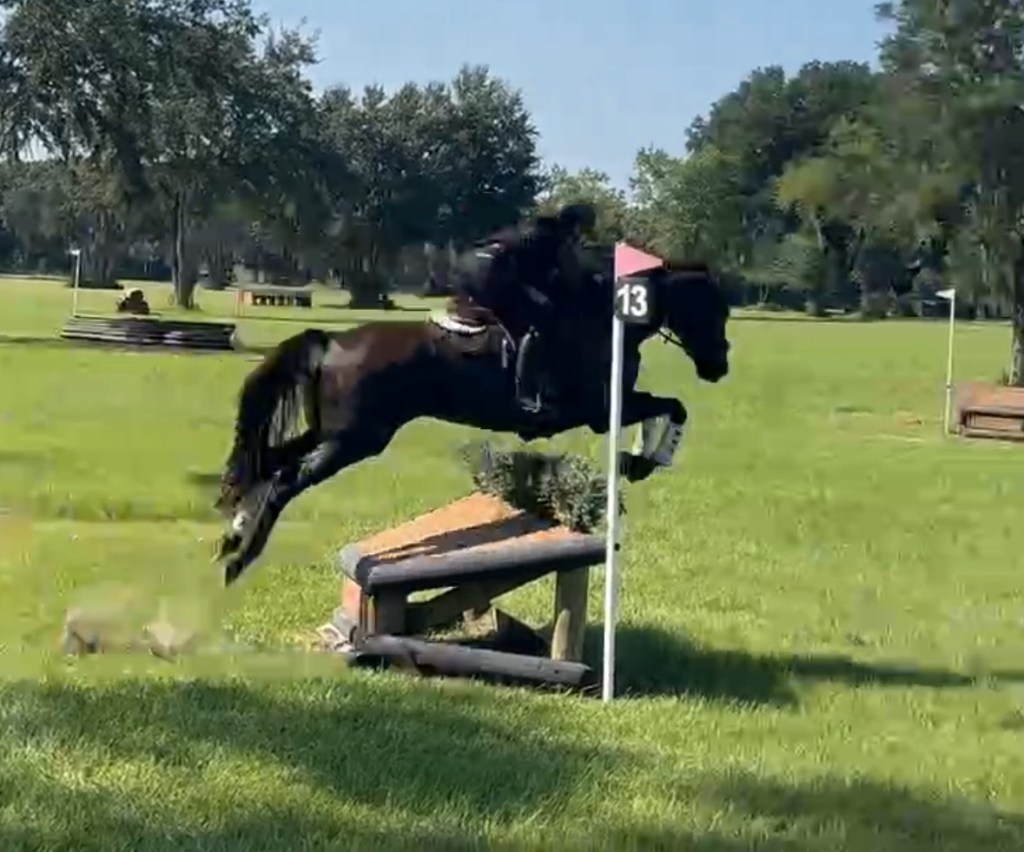
I slapped his xc boots and my xc vest on and then went straight out to XC. We hopped over a brush jump, angled a rolltop, and then headed to the startbox. Mostly I wanted to just have him feel calm and not be spooky out there, I didn’t care much about the rest of it. The course was almost the same as last time (except for the waters) so I didn’t walk it again nor did I have my watch or know what OT was. I truly just wanted to have a nice little lope around where he felt happy and confident and we didn’t go spinning around because of whatever demon he thought he saw in the distance.
And TLDR once again: that’s exactly how it went. He came out and jumped 1 great, was def a bit on edge passing the crater area to 2 (where he spooked last time) but I put him a bit rounder, told him he was fine, and he got on with it. Big pats. After about jump 6 he finally took a deep breath and dug in, feeling more like his normal XC self, and after that he didn’t so much as pick his head up to look around at anything. He finished double clear on his dressage score, winning that one by a mile. Mostly though I was just happy to feel him click back in and be my normal bold brave boy out there again.
Cindy is my new favorite
I did make an appointment to have my vet come scope him for ulcers again, because I still think he’s being spookier than is typical for him. I suspect the ulcers are back, which is exceptionally frustrating given everything I do to mitigate that. Will be talking to the vet about that too, because if they’re back I literally have no idea what else to do to try to manage this horse’s stomach.
Horses are fun (said both truthfully and sarcastically, all at once).
Happy US Equestrian Safety Awareness Week! This seemed like the perfect time to finally publish my ARRO helmet review, which I’ve been promising for a while now. Really this is the story of how I went looking for a new XC helmet and ended up with an Every Ride helmet instead. Before we dive into it, let’s back all the way up to why ARRO snagged my attention in the first place.
First confession: my XC skull cap was actually due for replacement last year. It hadn’t taken any bumps, but it was 5 years old, and I’m generally pretty paranoid about replacing my safety equipment when it’s supposed to be replaced. I’d dragged my feet a little bit on this replacement because 1) it’s not cheap 2) I was still kind of waffling on what to get. I was riding previously in a Champion SNELL skull cap, which I liked a lot, but before I ordered another of the same helmet I really really really wanted to try an ARRO.
hello beautiful
I was first introduced to ARRO at Kentucky in 2023, at which point they were still waiting for their main supply, but they had some at the trade fair and were there talking about them and fitting people. The owner/developer Rhys was one of the people in the booth, and seemed to have some really interesting insight. However, every time we found ourselves by their booth it was absolutely packed. We elbowed our way in there a couple times to get a closer look, but as someone who feels like they’re being suffocated by crowds, I ended up not really staying for long. Still though, I was very very intrigued by what they had shown us, and made a mental note to check them out more the next time I was helmet shopping.
For those who aren’t familiar with them, there are a few things about ARRO helmets that make them unlike anything else on the market. First and foremost, the Kevlar and carbon fiber shell is very strong… like… as in they legit have videos of them driving cars over the helmet. One hell of a marketing technique, you gotta admit. ARRO also has more protection around the back of the skull, and a liner system with a ton of shim options to customize the fit. And, probably the biggest selling point to me personally: they’re currently the only helmet with MIPS technology that is also SNELL certified.
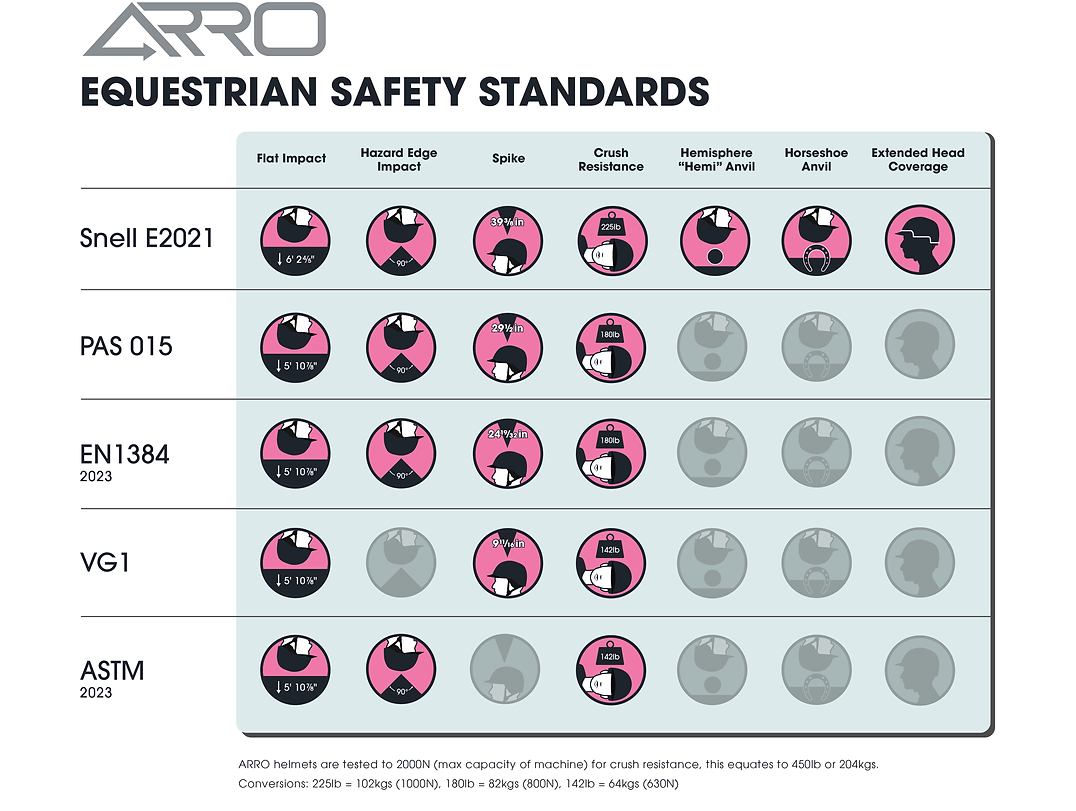
SNELL certification has been an absolute non-negotiable for me when it comes to a XC helmet ever since I first learned what SNELL is. If you’re unfamiliar with the different helmet standards and what they test for, here’s a handy dandy chart with some (but not all) of the differences.
ASTM is LOL
As you can see, the SNELL standard tests for a wider range of impacts than any other standard, and also requires more crush protection. I think this is pretty crucial component for a XC helmet, where a horse landing on your head is a real possibility (ok that’s a possibility for anyone and everyone, but probably more so when you’re galloping over solid fences). We’ve seen that happen several times this year to upper level riders alone, so as much crush protection as possible is important to me, as is a helmet that can take secondary impacts (unlike others we know, like KEP, that are designed to fall apart upon impact).
SNELL certification is a rigorous testing process that very few equestrian helmets meet. In addition to the various impact and crush tests, SNELL helmets are also required to have a steel buckle because plastic can break too easily, causing your helmet to come off of your head during a hard or repeated impact (there is video of a jockey whose helmet popped off upon impact due to a broken plastic buckle and then their bare head was stepped on… you DO NOT want to see this video). The SNELL standard requires more skull coverage, particularly over the occipital bone on the back of your head. Their testing also covers a range of conditions – hot, cold, wet, and ambient.
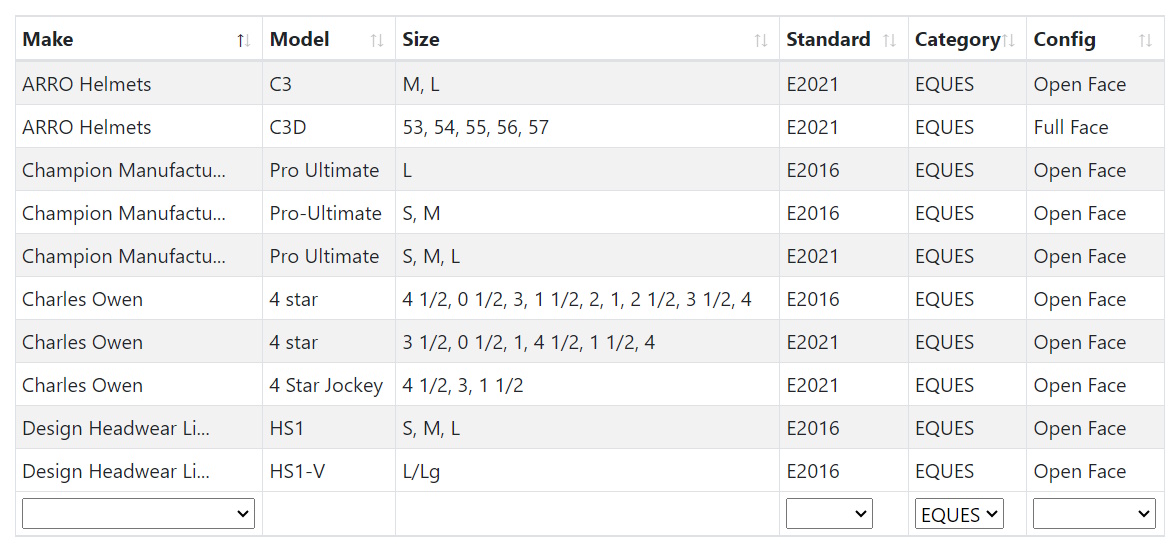
Basically, the TLDR version: the SNELL testing process is far more rigorous than other safety certifications, making SNELL certification the “gold standard” for helmet safety. Currently there are only a handful of equestrian helmets that carry the SNELL certification, and only 3 that meet the latest 2021 standard.
the current list, courtesy of the SNELL website
You can see more details about the SNELL certification on their website, including their testing procedures as well as some handy dandy videos and powerpoint presentations. Best of luck finding specific details on any of the other safety standards. The lack of transparency with most of them is laughable at best. You’d be shocked at how little some of them actually test.
Anyway, It’s important to note that anything with a fixed brim (ie Samshield) will never meet SNELL certification either, due to how a fixed brim can modify the trajectory of impact (it’s really not good). Of the SNELL-approved helmets, though, ARRO is the only one with a brim that can be snapped on or off, giving you the option of wearing it as a skull cap without a brim or as a regular brimmed helmet (where the brim easily pops off in case of impact). The ARRO also has two brim styles: regular or wide brim.
So, all of the above info is really just my very long-winded way to explain why I was looking for a SNELL helmet in particular. Now let’s get into the nitty gritty about why I ultimately ended up picking ARRO.
you can really see the additional occipital bone coverage here
First, before I can get into the features, we have to discuss the price. It’s all well and good to say “safety has no dollar value” and that’s true, but it’s also true that most of us aren’t oozing tons of extra money. Ya girl here majorly included. And let’s just say it: at $650, ARRO is not among the cheapest options on the market. Definitely not the most expensive, either, to be fair, but it’s not cheap. However, it’s also not significantly more than the Champion, which rings in at $520. The Charles Owen 4 Star is among the cheaper SNELL options at around $375, but I used to have one of those before the Champion and my god… it was hot and heavy and not super comfortable, so it was never in the running for me. If I’m going to spend money, I’m going to buy one I don’t hate wearing. Helmets are one of those things I don’t really want to compromise on for the sake of saving a little money.
When I laid it out logically and did a little pros and cons list, ARRO just kept having advantages that the Champion skull cap didn’t. The fact that the ARRO is considerably more attractive than the utilitarian skull cap style of the Champion and can be worn with a brim really changes the whole game entirely. Mostly because it meant that, realistically, I could use it as my all-the-time helmet rather than just for XC. It looks like a “normal” helmet, has sun protection with the wide brim option, a removeable/washable liner, and has more/better ventilation. These features meant that truly I had no excuse to not be riding in a SNELL helmet every single day, and for every phase at a show, rather than just when I’m on XC.
Let’s be real, I’m at the point where I realize that riding is mega dangerous no matter what we’re doing, so the idea of being able to wear a SNELL+MIPS helmet every single day for every single ride and still have it look nice and feel comfortable to wear… to me that was an inarguable selling point. It’s also hard to deny the fact that the materials of the ARRO are just superior. Kevlar and carbon fiber? A quick release magnetized buckle? Yas and yas, please and thank you. The design gives you a lot of options and makes a lot of sense.
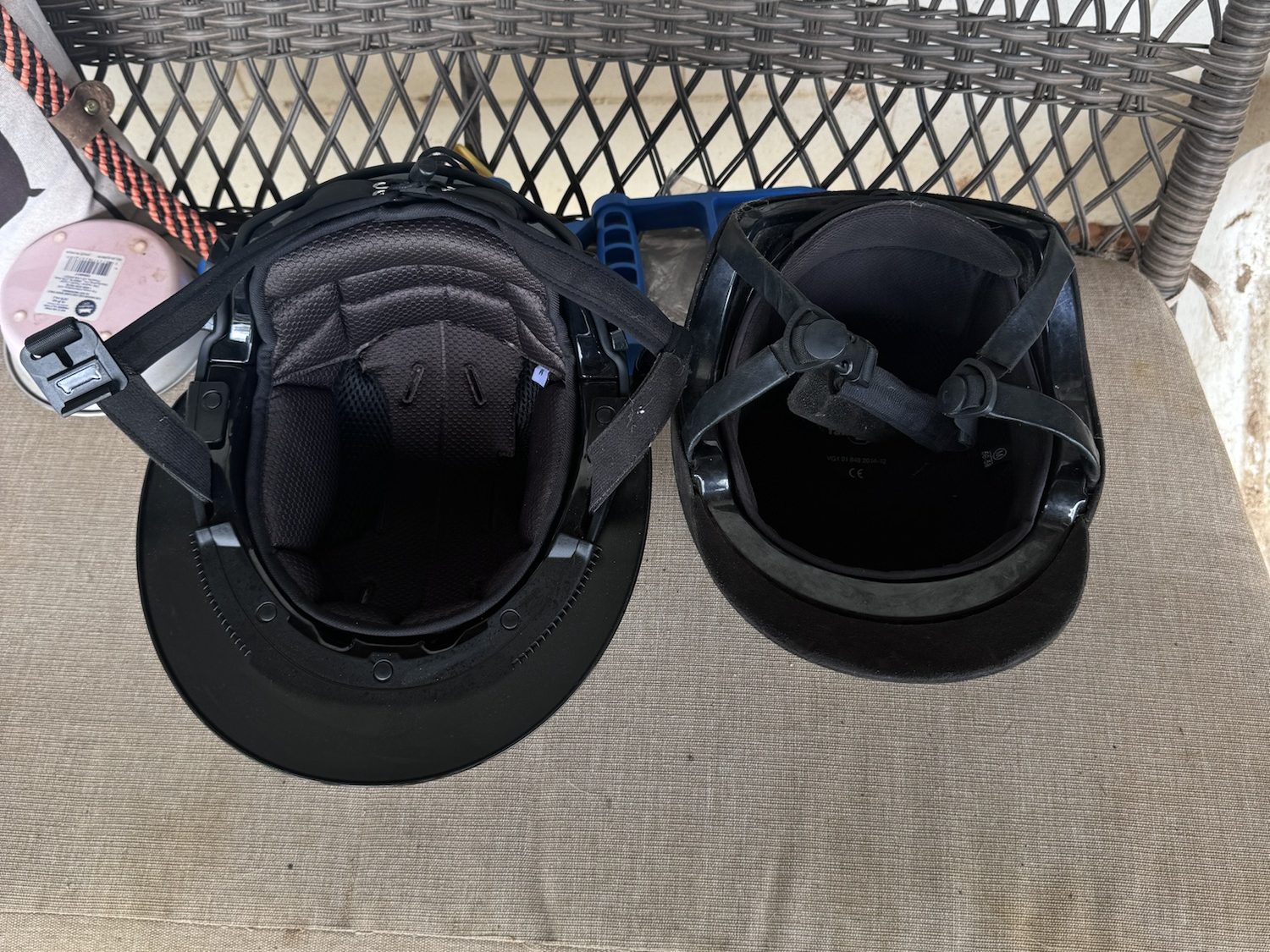
I love my glossy girl
And once I actually tried an ARRO helmet on my head, it was a foregone conclusion anyway. I truly expected it to look and feel like a giant mushroom helmet, which I wouldn’t have loved but could have probably come to accept. In reality, it looks a lot nicer than I would expect, and most importantly it felt like a “normal” helmet. Comfortable, nicely padded, and while I could tell that it covered more of my head, it wasn’t in an uncomfortable way. To be honest, it feels more secure having that coverage. ARRO also has a shim system within their liner to allow you to really tweak the fit to the exact shape of your head, which I love, as someone with an oval head that can be a little harder to fit.
I was fitted by Jeanie (who also does their remote fittings, for those of you who aren’t near a retailer!) and my helmet truly fits very very well, has from day 1, and I love knowing that if I do need to play with the fit a little bit for whatever reason, I have that option thanks to the shims.
I was most skeptical about the ventilation factor, because it’s REAL HARD for a helmet to have decent vents and still pass SNELL, due to the nature of their spike test. I’ve been pleasantly surprised by the ARRO though, even wearing it all summer in Florida. It’s not super breezy, but I can definitely feel air flowing in and I’m not getting crazy sweaty.
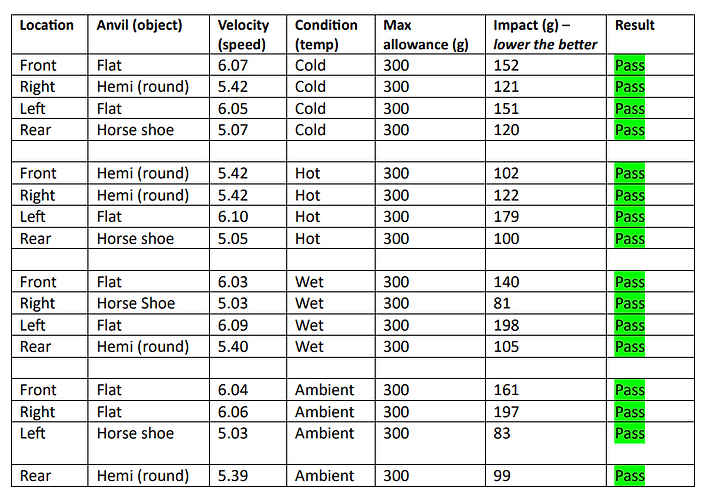
In addition to the high-end materials and superior safety standards, what you’re also getting for your money with ARRO is extensive R&D and continued testing and development. Having gotten a bit of an inside look into the company, I can attest that no one at ARRO is sitting back on their laurels and lining their own pockets. They pay for their own ongoing testing from independent labs and are continually putting funding towards research and an increased range of products. They also publish actual data – REAL NUMBERS – on their website. Transparency, what an incredibly rare treat in this industry.
data, rejoice.
The owner of ARRO, Rhys, is really fascinating to talk to, incredibly smart and innovative and dedicated to thinking outside the box. It’s a breath of fresh air in a sport where we are often lagging way behind, especially when it comes to safety technology (we got MIPS, what, like a decade after cycling helmets?). ARRO is currently in development for a body protector, which I’m really excited to see.
In case you can’t tell, I’m relatively obsessed with my ARRO. This hunt started out as me looking for a new XC helmet, yes, but I feel like it ended with me getting not just that, but a major helmet upgrade in general. Having worn my ARRO for several months now, I’m a huge fan. Like I’m probably annoying the shit out of everyone, but I’m not sorry.
Overall, the ARRO looks nice, it’s comfortable, I can wear it at home or at shows, I can wash the liner, it’s not hot, and most of all – I feel like I’m wearing the safest possible helmet every single time I swing a leg over a horse. I can’t mitigate every risk, but I can try my best to protect my noggin day in and day out, and with this helmet I feel like I’m doing that to the best of my ability. That truly is worth every penny.
it makes a standard run of the mill helmet look like an actual joke, tbh
And if you need me to Horse Girl Math it for you, just divide the purchase price by how many times you’re gonna ride in it. For me, riding 6 days a week, 52 weeks a year, for the helmet’s life span of 5 years… that’s like 41 cents a ride. You’re telling me increased safety isn’t worth that amount? People will spend double the cost of an ARRO for a significantly less safe helmet just because it has Swarovski’s on it or whatever. Safety isn’t sparkly, but neither are brain injuries.
Two additional footnotes because I know people will ask:
First – does ARRO have a replacement policy? Yes they do! “If your ARRO helmet has been involved in an accident, you may be eligible for a 50% discount on a new ARRO replacement helmet depending on the helmets age and nature of the fall.” I can also confirm that they follow through on that, because I know someone that just had a bad fall (whacked her head real good but no concussion) and got the 50% off replacement in her hands within days.
Second – the thing I’ve heard most commonly from our Patreon group is that they need the helmet in larger sizes than are currently being offered. According to the ARRO website they’ll have more stock of larger sizes around October, so if you’ve got a big noggin, don’t give up on ARRO yet. It sounds like they’re coming!
For a quick reminder, my last post ended with this
“So much drama from these horses around here though, my goodness. If we could all just… tone it down for a bit… that would be great.”
Narrator: They indeed did NOT tone it down.
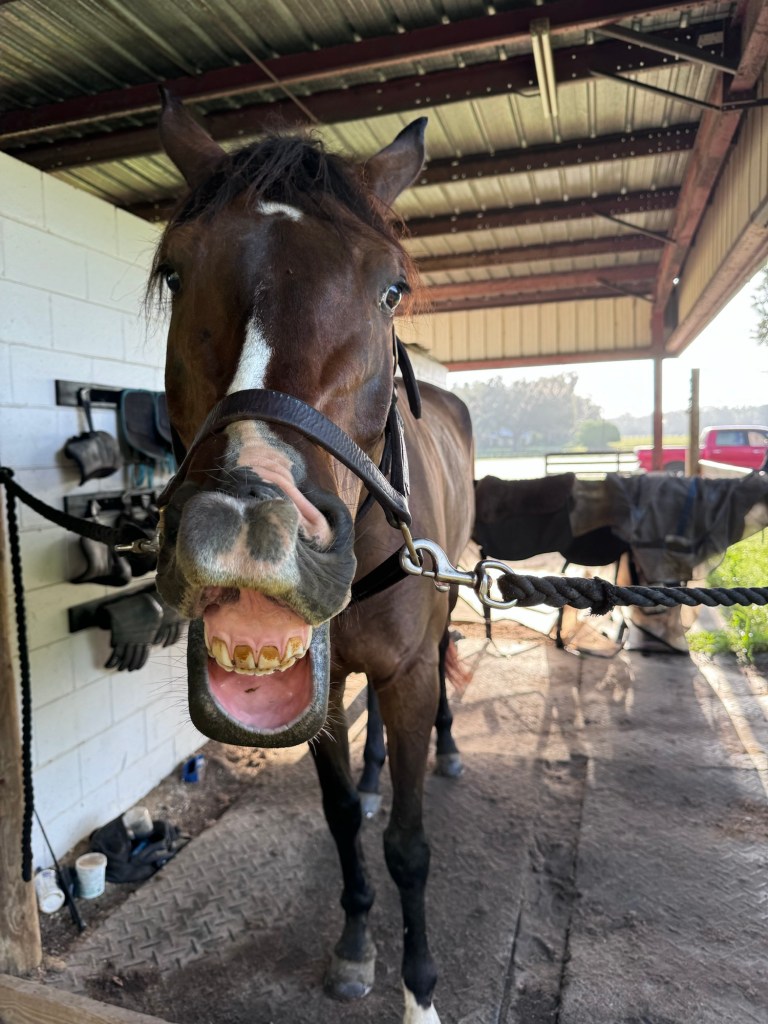
thinks its hilarious
Presto was footsore from his torn-off and put-back-on shoe for a couple days. On Friday Rubes had his follow-up gastroscope to check in on his ulcer situation, and while his stomach looks way way better, there are still a couple grade 1 squamous ulcers. Considering he was on antiobiotics and NSAIDs for his cellulitis in the middle of all the ulcer treatment, and the issues he’s been having with the bugs, I wasn’t particularly surprised by that. But the lack of glandular ulcers this time meant we could discontinue the miso, so that’s good, but he gets another month of 1/4 tube of gastrogard to wrap up the few remaining glandular ones.
By Saturday Presto seemed to be feeling better again, so I texted Ellie and made lesson plans for Sunday. In the meantime, I had PLANNED on going over to a friend’s house on Saturday to watch Burghley XC. Naturally though, because these horses can’t give me one day of peace or let me ever leave the farm, they derailed that entire plan.
First I turned Rubes out and he had a meltdown (first turnout meltdown in several days, to be fair) so I had to deal with that (there were bugs, y’all, and he wasn’t having it). And then Florida decided that actually it was going to rain in the morning instead of the afternoon, which it never does except for the day I need it to NOT do that, so instead of waiting until after XC to clean stalls, I had to go ahead and clean them in the morning like usual, in case I had to bring horses back inside. Which also means stuffing hay nets and scrubbing/filling buckets. And then Tilly lost one of her hoof boots in her turnout and I had to go look for that so I could put it back on, lest she tear up her foot. And then it did start raining.
At that point I gave up. I ended up half watching and half listening to Burghley on my phone while I cleaned stalls and did everything else. It was extra annoying because I had gone and gotten all the stuff to make some dope crepes (Kentucky has trained me to want crepes at 5*’s, what can I say) and that got entirely derailed. I mean I did make myself a banana and nutella and almond and honey crepe for a late breakfast, so it was partly salvaged but still.
Henry’s not sorry either
I love them so much, and I love having them right outside my front door, but if you want to entirely ruin your social life and make it impossible to make plans, just be responsible for a farm full of horses.
On Sunday (after fixing boards that Freya kicked down in her stall) we did make it over to Ellie’s for our lesson and Presto felt good, praise be. Well physically he felt good. He was a bit wild from his very light week of work, and at the beginning he spooked at himself in the mirror, flipped his tail over his back, and tried to passage sideways. Cute. Let’s just say the rideability for this lesson was not as good as it has been.
She had us doing some turning exercises with simple jumps and he was really convinced he knew exactly where he was going and exactly what he was doing, right up until the second he realized he didn’t, which still didn’t faze him in the slightest.
gives zero f’s
That’s fine though, because it IS one of the things about him that comes into play sometimes. He’s cocky and sometimes needs to remember that he doesn’t know everything. (he finds that statement to be super offensive)
We also made plans for Alex to pop Presto around some XC. I really wanted to get his thoughts on kind of where we’re at, what I need to be doing better, and if there’s a way I could/should be riding him that will put me in a better place when he wants to do the spooking and spinning shit. We penciled that in for Tuesday.
Meanwhile on Monday, Sadie scratched her ass on the fence so hard that she snapped a board in half and sliced her ass open on it. Fun times with the vet calls. And it’s been raining buckets for over a week now, so the mosquitoes have returned in full force, which means Rubes’ marbles have been officially lost again. Poor guy, he really really really hates Florida nature. To be fair, I’m starting to understand where he’s coming from, I’m covered in so many damn mosquito bites.
Anyway, on Tuesday we met Alex over at Majestic.
his first male rider
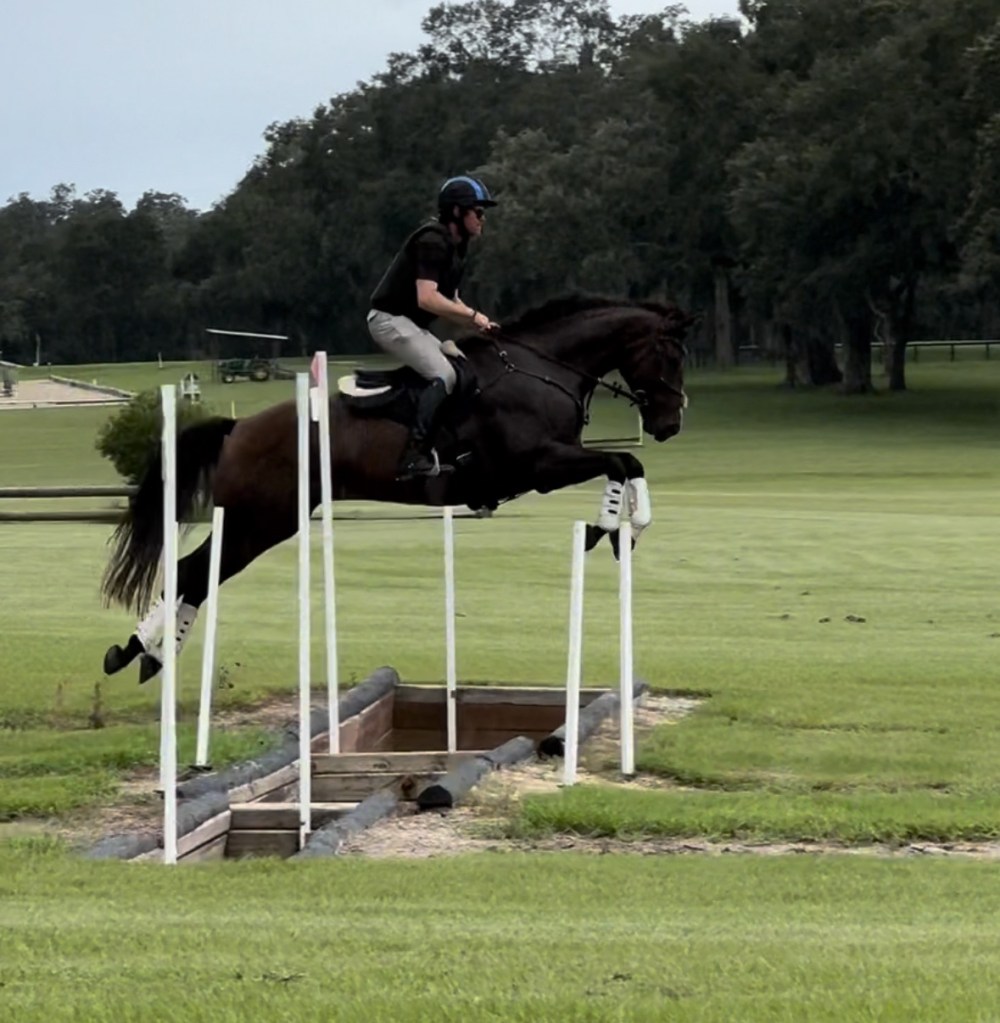
Presto was annoyingly well-behaved. Like come on, not even one little teeny spook? Nothin? Turd. It was fun to see Alex pop him over stuff though, and he got to see some bigger/more technical things again. He really hasn’t jumped much XC since the 1*. He was a little surprised at the first couple bigger fences and had the teeniest wiggle about it, but it definitely woke him up and tuned him in. That’s the thing with him – he’s better when it’s harder.
Alex had a jolly good time though, and had a lot of really nice things to say about him. He gave me some ideas for how I should be approaching the XC rounds at the moment, and changes I can make to my position and Presto’s galloping style that might help. I’ll need a XC lesson to actually put it all into place, but I really appreciated him taking the time to stand there and talk to me about the theory and the physics of it… my brain really really needs the “why” and the “how” in order for everything to click, so it gave me something to take home and think about.
I think he cleared that ditch
It was also fun to just watch my horse go. I haven’t seen anyone else ride him around XC in a really long time and it’s cool to see how he’s matured. He does look terribly unchallenged, which Alex also said “all of this is super easy for him”. Yes yes I KNOW he’s not the one holding this particular duo back.
On Wednesday morning Rubes had an entirely epic come apart when I tried to turn him out in the morning, so I had to really re-evaluate my plan and approach for how to help him deal with the mosquitoes. He was already going out in head to toe fly garb and covered in fly spray, but the fly spray really doesn’t do shit for mosquitoes. I have to be careful using OFF since he already had a reaction to it once, but I went and got some Mosquito Halt. This morning I turned him out in fly sheet, fly boots, fly mask, did a light spray of OFF and heavier spray of Mosquito Halt, and waited to put him out until after 8am when the sun was well and truly up. We had the first entirely no drama morning in days, so hopefully we’re maybe on the right track? He just truly has a menty b about the mosquitos.
To top off yesterday’s drama, Rube pulled a shoe in his stall, the golf cart shorted out and died in the middle of my afternoon chores, and the pressure sensor went out on the well pump last night and we had no water. Fun times on the farm.
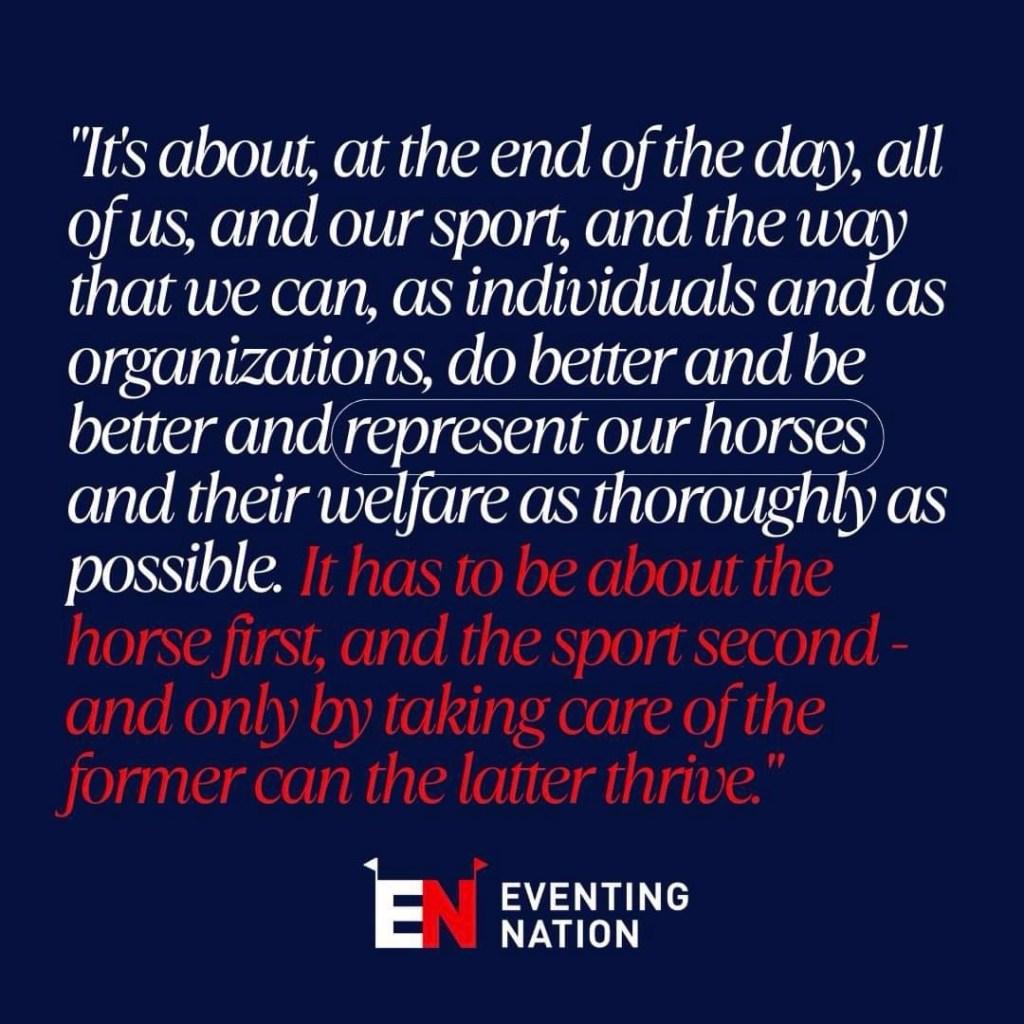
On an entirely different note, a few people had asked if I was going to weigh in on the Andrew McConnon situation, and I would have except for the fact that the EN team was putting together a piece that was totally kick ass and said everything I had to say. If you haven’t read it, you should. It’s so well done and makes me really proud to be part of the EN team.




 breedrideevent.com