“Self-Made”

After Henry and I finished our first Prelim, someone commented that it must feel even sweeter since I was on a self-made horse. At first I was like “Yeah you’re so right” and then I kind of fell down the rabbit hole of overthinking, as one does, and realized it’s not really that simple. What does “self-made” mean, really? And does it matter? Is there really a greater sense of pride to be found in making up your own horse versus buying one that is already going?

sj2

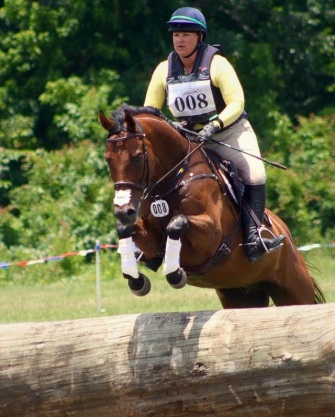
First I would argue that to some people, Henry is not self-made. It depends on what your definition is. By the time I came upon him he was a brain-fried pasture puff, sure, but he had jumped before I bought him. And while yes I have taken him up the levels from BN to Prelim, my Trainer has ridden him some too. She’s probably got a cumulative 20 rides on him over the last 4 years, and she ran him in his first two Training level events because I really wanted him to have positive experiences. Those were the right things for him and I regret none of it. It’s true that I’ve put 99.9% of the work into him myself, but still – I’ve had help. To some people that means he isn’t self-made, and honestly the term kind of makes me feel like it doesn’t give credit to all the support and help that I’ve had. Success doesn’t happen on your own, it takes a village, and I think it’s important to acknowledge that. There is no “self” when it comes to producing a good horse.
xc1
Neither of us would be where we are today without her. Period. Full stop.

Secondly – what is the value in “self-made”, if any? Does that make one person’s accomplishment more or better than someone else’s? To me – hell freaking no! To be totally honest I’m much more comfortable with the idea of buying a green horse and bringing it up through the levels than I am with buying a nice upper level horse that someone else has produced. To me that sounds daunting, and seems like a lot of pressure learning to ride a horse like that, trying to do it justice. I think I’d constantly be worried about breaking it, or doing a really crappy job compared to the rider it had before. I would probably be mortified by any mistakes. Many props to the riders that can do that, because it seems incredibly intimidating. For me personally it’s less pressure and more fun to bring up a greener one, where there are no expectations floating around. I enjoy the process, to which there are pros and cons. At the same time I don’t blame someone for wanting to take a different approach. Having a more educated horse to show you the way can be completely invaluable when it comes to learning and bettering ones skills as a rider, and that’s an opportunity that shouldn’t be passed by.

I don’t think that accomplishments on self-made horses are any less than accomplishments on purchased horses. I think they’re two roads, both full of potholes and roundabouts and construction zones, coming from different directions but ultimately ending up in the same place. I know how hard Prelim is for the average amateur, no matter what you’re sitting on, and I would feel like a real asshole if I tried to belittle someone else’s success just because they got there a different way than I did. It’s a lot of work, no matter what road you take to get there.
mcp12
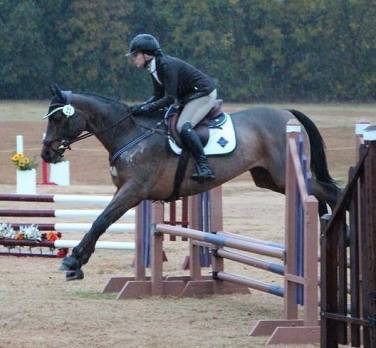
Beginner Novice Henry was cute though.

I think what makes me most uncomfortable with the term “self-made” is that it denotes a sense of pride. Pride is a really dangerous thing when it comes to horses. A healthy amount of pride is fine, I think… like I am insanely proud of Henry and what a good boy he is. But too much pride can quickly bleed over into selfishness and egotism, and IMO that’s where people get into trouble. We’ve all seen it; people that are too protective of their egos to ask for help when they need it, or to do what’s best for the horse. That’s where people get hurt and/or ruin good horses. To me the most valuable quality in an equestrian is the ability to do what they feel is right for their horses, regardless of ego, pride, or the opinions of others. That’s a true horseman, whether it means they’re self-made or not.

How many times have we seen people’s accomplishments belittled because they buy a “made” horse? How many times have we seen people judged because they choose to send their talented young horse to a professional for a while? I’ve been guilty of it at times too. The more I see and experience though, the more I realize that not all of us take the same path, and that’s okay. In fact, I would argue that it takes more selflessness, more courage, and more intelligence to admit when you need/want help, or that someone else could do a better job than you could, or to take on a horse that comes with high expectations.
xcbrush
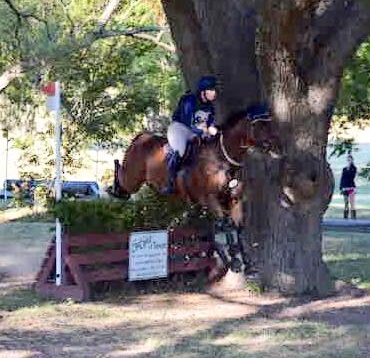
Novice Henry was already pretty pro at saving my ass, let’s be honest

I’m convinced that there is no one right way, or best way. The way I’ve done things doesn’t make me better or my accomplishments more. They are horses, after all, and we are human, and we’re all on the same journey. What matters most in the end is being honest with yourself, doing what’s best for your horse, and what makes the most sense for your current situation as well as for your future. If you’ve done that, in my book you’re successful by default. The rest, as I see it, is just noise.

What do you think?
Pre-Show Routine, or lack thereof.

A few weeks ago someone on Instagram asked me to do a post about my pre-show routine. I had to laugh at that, because clearly y’all don’t understand what a garbage human I am if you think I might actually have a regimented routine that’s worth sharing with anyone. I started to wonder if I’m accurately representing myself in this blog… or if some of you have just forgotten that I’m the idiot who once showed up at an event without either of my saddles. I’m also like 50/50 at best for whether or not I remember my helmet camera at all, and then remember to charge it, and then remember to wear it, and then remember to actually turn it on. Not exactly a shining example of someone you should be trying to emulate here, y’all.

Henry would agree

But hey, if you want to know my typical pre-show routine, I’ll shoot it to you straight.

Usually on Thursday night before the show (assuming we’re leaving on Friday. Push this back a day if we’re not leaving until Saturday, obviously, because why would I ever think more than a day in advance?) I start trying to find all my show clothes. My show coat is either hanging in my closet, if I was feeling particularly fancy about myself after the last show, or it’s still in the coat bag in the back of my truck. My shirts are probably lost in the basket of clean clothes that I sometimes put away but usually don’t. My breeches are definitely still dirty, and probably balled up in the corner of the closet, with my show belt still in the loops. My show saddle pads and XC boots are either still in the trailer or sitting on top of the dryer, still dirty.

Now, because I’ve waited until the last possible second to do any of this, I get to scrub everything with Shout and do a few loads of whites, probably consuming most of a container of Oxyclean in the process. Lord help the laundry room during all this, the Shout and Oxyclean end up all over the place like I was trying to clean up a very intense murder scene or something.

it’s kind of a miracle that I don’t perpetually look like I crawled out of a dumpster

My tack, lord help it, is probably not clean yet either. I always dunk my bit after I ride to get the gunk off, and I wipe down my girths regularly with a rag. That’s about it for daily maintenance. My deep cleaning and conditioning happens the night before the show itself, usually while I’m sitting in front of my horse’s stall going over my dressage test in my head. Unless it’s a teeny tiny jumper show or something, then yeah I’m not cleaning shit.

As for the horses, they are much more well-maintained and don’t require much prep. I keep manes trimmed regularly, I chop off fetlock hair like an obsessive lunatic (okay, confession, I hate feathers or long fetlock hair, it makes me twitchy), and I keep the top of Henry’s tail trimmed up. There is rarely much special prep to do for them aside from touch up the bridle path or re-bang the tail. If it’s a big show I’ll dye Henry’s tail a couple weeks before, but I’m less psycho about that now than I used to be. I do keep a can of black aerosol spray in my trunk though, because sunbleached tails come in really close behind feathers and long manes in my book. Clearly I have hair issues, which is kind of ironic if you look at the terrible disaster that is happening on my own head right now. When was the last time I even had a haircut?

What I don’t do these days is trim whiskers or ear hair. I stopped doing that years ago. Instead my horses have extensive ear bonnet collections (yes, Presto already has 2 bonnets despite not actually having any circumstance in which he would wear one, why are you judging me right now?) that cover the ear fuzz. I had a dressage person tell me that none of the cool people in their world clip noses anymore either, since the Europeans don’t, so who knew I was trendy?

he knows that I am not

The horse area of my trailer is always clean and well-bedded, I’m a stickler about that too. The tack room may or may not look like a tornado ran through it though, depending on what I’ve been doing lately. I keep a lot of my show-specific items in there so I don’t have to remember to pack all that stuff – stud kit, muck cart, buckets, etc. The less I have to pack, the less likely I am to forget things.

I pack all of Henry’s stuff the day before we leave. His food and hay and supplements are usually the first things in the trailer (including extras of all 3, of course), along with his wide collection of clothing (what do you mean it seems a bit ridiculous to have 6 different sheets/blankets/coolers for a 2 day horse show?), etc. My tack and tack trunk go in last. I’m super paranoid these days about compulsively checking to make sure I got both saddles and all 3 bridles, because I will definitely never live it down if I make that mistake again. The people I hang out with are jerks.

don’t trust her face

All my clothes tend to get packed the morning of, maaaaaybe the night before if they’re dry in time. Will I remember to bring non-riding clothes for myself, or pajamas, or my toothbrush? You never know. I will always have extra breeches though, and probably a few shirts, a couple belts, my designated pairs of show socks, a couple stock ties, two pairs of boots, and 2-3 helmets. I’m pretty good about remembering to pack all of my camping stuff too, which may or may not actually still be in the back of my truck from the last show. Does it count as packing if I never actually unpacked it? Let’s go with yes.

I will probably remember to go to the store the night before and grab a few things to eat. It will never be enough, but it will definitely include Pop-Tarts for Henry, one of his special horse show treats. I also NEVER remember to grab water. I’m perpetually dehydrated at horse shows because I can remember to pack 6 items of clothing for my horse but can’t ever remember to pack drinks for myself. I will even stop at a gas station on my way to the barn that morning and get a bag of ice to fill my Yeti so that I can ice Henry’s legs at the show, but I still won’t remember to grab anything to drink. If not for the show moms who are perpetually thrusting water bottles at me when I look like I might pass out, I would probably be dead by now. Let’s be honest.

At least he’s happy?

Did I remember my helmet camera? WHO KNOWS. Did I remember to charge the battery that inflates my air mattress? WHO KNOWS. Did I remember to pack nude-colored underwear so that no one has to see neon through my whites? WHO KNOWS. These are all surprises that we’ll find out when I get there. Living life on the edge.

So basically – if you need to get a horse ready for a show or pack all of their stuff, I’m your gal. But when it comes to being an actual adult human… I’m a hot mess.

Cool like Brother

Throughout the course of my life I’ve been lucky enough to spend time with a variety of different horses. They have represented a wide range of ages, backgrounds, disciplines, and general temperaments. My time working at a breeding farm, and raising my own foal, showed me just how important it can be to get the manners installed early. All the OTTB’s I’ve owned have demonstrated how useful a lot of exposure and handling can be later on down the line. Others have shown me just how much the horse’s natural temperament can come into play, and how much it can be improved upon with proper guidance.

cloconfo
well handled baby stallions grow up into well behaved adult stallions (Cielo B as a yearling)

Henry, while no doubt one of the weirdest and cheekiest horses I have ever met in my entire life, is pretty excellent on the ground. He’s reliable, and he’s smart, and for the most part he can be trusted not to be a moron in a bad situation – if he does anything “naughty” it’s usually completely deliberate on his part (see earlier remark about cheeky). He’s good for the vet, he’s good for the farrier, he comes up to you in the field, he ties like a champ, and he self-loads. He’s an easy horse to own, and I want all of my future horses to be like him.

Most of the horses I’ve had that have been on the track or in race training for any decent amount of time have been similar to Henry. Some more nervous than him just in general, or some with particular issues (generally caused by a person’s stupidity or temper), but overall they’ve been exposed to a lot and been handled extensively.

cruzhead
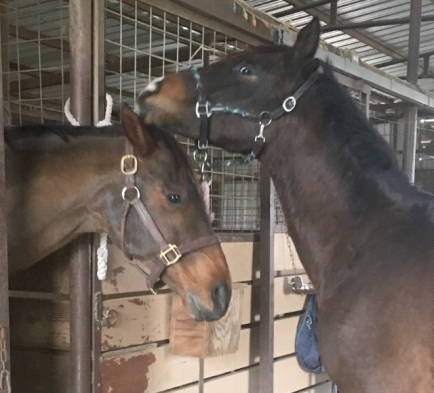
This one was a TB but never made it to the track… he was not as easy.

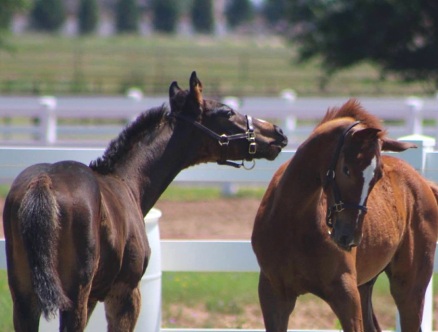
Presto’s dam Sadie was the first foal I raised on my own, from birth all the way up. Working at a breeding farm meant that I was familiar with handling foals, but most of them ended up sold before they were actual adult horses, being ridden and shown. I had never been there every step of the way before. Because of that, a lot of Sadie’s life was a little bit of trial and error on my part. There are the people who say to leave the young horses in a field with other horses and leave them alone until they’re 3 or 4. There are the people who extensively handle and show their horses, going somewhere every weekend and racking up points and miles. I kind of took the in between approach, leaning more toward the “leave her alone” side of things. She wore tack a few times, she knew the basic idea of how to lunge, and she mostly tied, and she kind of loaded (ish). I did something with her somewhere between every 2-4 weeks, although usually it was just grooming. I didn’t take her places or tie her much, or make an effort to expose her to a lot of things. I figured we could do all that stuff later.

What I didn’t take into account with Sadie was her general temperament. She was a busy-minded horse, smart almost to a fault, and with her, inactivity led to bad things. She got herself into trouble a lot, and had the staples, stitches, and scars to prove it. She also didn’t know how to properly respond to pressure, and had a tendency to panic when she felt stuck.

sadie12-9ears
In case you were wondering, donkey ears ARE genetic

I came to realize that I had done her a disservice by not taking her temperament into account. I absolutely should have done more with her, kept her brain engaged, and done a better job of teaching her how to respond in situations where she was unsure or felt trapped. Some baby horses do just fine with the “less is more” approach. She was not one of them. She wasn’t difficult, she just needed more guidance from me than what I gave her.

It’s not a mistake that I’m going to repeat with Presto. Some people think that I do too much with him, mess with him too much, and should leave him alone to just be a horse. I would argue that he has 24 hours a day to be a horse, so spending 30 minutes a few times a week learning to be a good citizen is not exactly infringing on his social development.

3months6
don’t worry, he’s still very good at biting his friends

I’m lucky that Presto’s natural temperament is much like his mother in that he’s naturally pretty easy, he’s smart, and his lessons stick. Since the day he got here I’ve been teaching him how to properly handle pressure and how to think instead of react. It is 100% a quality that you can teach, and I try to always be aware of what he’s thinking and doing so that I’m molding his brain properly. As a result, he’s a much more confident horse at this age than his mother was.

I go out of my way to put him in situations where I think he might be concerned or confused…. not unsafe, but mentally challenging. Each new experience builds his confidence, every time he doesn’t get his way builds his character, and every time he looks to me with a question mark in his mind and I provide him with an answer, it solidifies our relationship more. This doesn’t mean I baby him, because I definitely don’t. His lines for acceptable behavior are very black and white. But training horses is a constant series of praise and corrections, and in order to make said corrections, I have to put him in situations where he doesn’t know the answer. It starts here on the ground, but the same type of thing will continue once he’s under saddle.

img_2089

Henry is a pretty easy horse because he’s confident in himself and he trusts people 100%… I want Presto to be the same. I want him to feel comfortable in his surroundings, no matter what’s happening, I want him to trust that I’m “safe harbor”, and I want him to look to me for guidance if he’s unsure. He only learns those things through experience. Whether it’s something big like standing tied by himself while I ride Henry in the next pasture, or something small like learning how to pick up his feet all from one side, I think that all of these things put together help make him into the horse I want him to be.

Having a big brother like Henry means that Presto has some pretty big shoes to fill. But having both horses together, and being able to directly compare the things Henry does to the things Presto does… it’s a big advantage for me, I think, if I use the opportunity to it’s fullest. Also having made the mistakes I did with Sadie definitely showed me that there is no such thing as one right way – just that I need to do what’s best for me, and take the horse’s temperament into consideration. They’re the ones that should guide my decisions, not anyone else.

Raising Presto in such a public way does leave me open to a lot of opinions, but if anything it’s really just shown me how important it is to go with my gut. He’s my horse, and I know him best, and I also know what’s best for me in my own situation. That’s a big part of blogging and having horses in general, really… considering the opinions and ultimately doing what you feel is best.

Time will tell how all of this works out. Presto already comes up to me in the field, he ties pretty well, he stands for the farrier, he self loads, and he uses his brain pretty admirably for an idiot baby colt. I’m happy with what I have, mostly because I see a horse that is happy in his education and knows what is expected of him. Will he be as good as Henry? Who knows.

img_1795-1

He’ll definitely be as cheeky as Henry is, at least. That’s one quality I seem to be very good at cultivating.

Phillip Dutton Clinic

One of my big goals this year is to seek out as many educational opportunities as possible, in whatever form they may be. Mounted, unmounted, formal, informal, riding-related, breeding-related, horsemanship-related… whatever. I just want to focus on learning. Riding in clinics isn’t really my favorite, mostly because I don’t feel like they have the most return on investment given the limited amount of dollars in my budget, but I do really like auditing. So when I heard about a Phillip Dutton clinic happening up in Dallas, and that auditing was free, I was 100% all in. It didn’t take much convincing (read: none) to convince Hillary to come too.

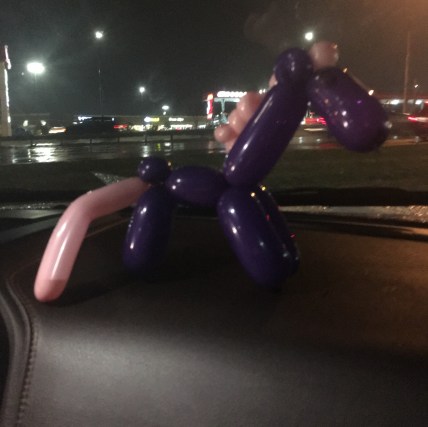
When we stopped for dinner on the way up, there was a girl in the restaurant making balloon animals. This is Mr. Squeakers, the official trip mascot. Later I had to bolt across a La Quinta parking lot to save him when a gust of wind blew him out of the truck.

The weekend was cold as hell, but I did the best I could to take video and notes with my very frozen fingers. Phillip had some really cool exercises, a few that I definitely want to set up at home, but I was glad that I was auditing instead of spending a lot of money riding. I am one of those people that likes things explained to me in detail – I really want to know the WHY behind everything – and Phillip was not particularly verbose. Mostly it seemed like he let the exercises do the talking, which they definitely did. I still got some useful notes though – a few direct quotes and a lot of just general observations.


Some of the exercises set up on showjumping day. The Christmas tree didn’t survive the wind

Saturday was showjumping day. He started off by warming everyone up together in a small space, about the size of a dressage court, and really focused on getting the horse accepting the leg. The did a lot of lateral work at all 3 gaits, and then focusing on getting the horse sharp off the aids by doing a lot of collecting and then lengthening in all 3 gaits. He said several times “prepare for every turn” – which ended up being a common theme for him throughout the weekend. He challenged the riders to see how short they could get the trot, and then how much they could lengthen, and then back again. Eventually he added in small circles in the corners, to increase the balance and get the horses thinking. He wanted them accepting of the aids, in front of the leg, and adjustable.

img_2828

For the jumping, a lot of the exercises involved offset and/or angled fences. There was an offset two stride line of oxers, a skinny with one stride to angled oxer (or the other way, angled oxer to skinny), a corner that got added into the mix, a single oxer on the short side, and a two stride line. They started off cantering single oxers in the middle just one at a time, going straight. Phillip asked them to vary their approach and their distance – first asking them to jump out of an open stride and slightly longer distance, and then asking them to shorten the stride up and jump from a deep distance. He emphasized that it was important to practice different distances and different paces in your training, so that you can produce whichever you want, whenever you want, and the horse knows how to jump out of any of them. He told the riders that if they weren’t sure of the distance, to just sit and squeeze and wait.

When they first added in the skinny, one of the riders tried to walk over to it to let her green horse get a look at it first, and Phillip admonished her for that. He said that our horses have to learn to trust you and that their job is to jump anything we point them at, no questions asked. He said that if we think a horse may be unsure about a question, start small and break down the individual parts of the exercise, then put it together in a way that will educate the horse. But they don’t just get to walk up and get a look at “scary” fences before we ask them to jump. (This is something that I’m a firm believer in, so it was cool to see Phillip saying it too)

img_2855
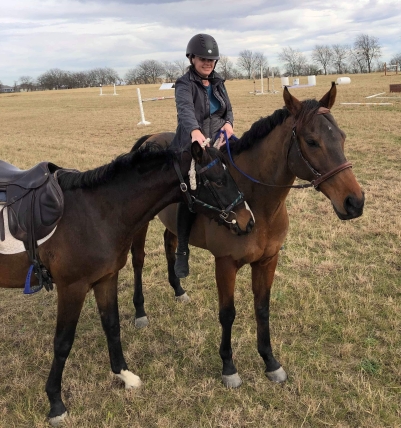
Trainer continues to get Flat nice and trained up and ready for me to steal

Cross country day started off with more, different, exercises in the arena, before venturing out to a little bit of XC. Again he spent some time on the flatwork, especially making sure that the horses were thinking forward and moving sharply off the leg. They practiced lengthening for 6 strides, shortening for 6 strides, turning small circles, lengthening quickly again, shortening quickly, etc. If some of the horses were a bit slow in their responses, Phillip encouraged the riders to put the pressure on their horses now, on the flat, so that it didn’t come back to bite them once they got to the jumping. Quick and clear corrections = good training.

In the arena he had set up an exercise that I’ve seen him use a lot in clinics now, a line of jumps that looks like this:

pdexercise

To start, they rode the first jump and 3rd jump as a 3 stride line, then they rode the first and second jump as an offset line, then he had them come back through and jump all 3. He didn’t explain this exercise beforehand, or offer any kind of guidance on how to ride it. He just kinda… threw everyone in and let them figure it out. The people who went later in the group had the benefit of learning a little bit from the mistakes of the people before them, but still, this exercise was a challenge to every group in the beginning. Eventually everyone figured out that what he was going for here was a) getting the horses sharp and paying attention and looking for whats next, b) getting the riders thinking FORWARD and using an opening guiding rein to move the horse, rather than pulling back on the rein or riding tentatively. Zig-zagging through jumps like this naturally makes you want to slow down and pick your way through, but it NEVER worked out if it was ridden that way. You had to keep the forward, and you had to look for the next jump with your eye, and open your hand in the air to guide the horse’s focus to the next one.

Once everyone got that exercise, he had them really gallop boldly at a triple bar on the other side of the arena, then come through the triple again. On both days he was VERY adamant about making good turns, both before and after the jump. If you landed from a jump and let your horse drift in, or just rode like a sack of potatoes to the corner, you would get a lecture about bad horsemanship. The turns are crucial to the balance, and he did not like even a single bad turn. He was also adamant that if a horse ran out, you must immediately correct them by turning the opposite direction. If your horse ran out to the left and then you immediately turned him back around left, you could go ahead and brace yourself for a megaphone “bad horsemanship” zinger.

After the warmup in the arena, they went out to the small XC field. Again he had exercises involving a lot of narrows or offset jumps. There were a lot of struggles here throughout the different group levels, and some of the greener horses were maybe a little bit “mind-blown” by some of the exercises at first. Phillip’s big thing was that the riders should always be looking to the NEXT jump, planning ahead and getting the pace they needed. His narrow/offset exercises really forced the horses to pay attention, and they forced the riders to make faster and better reactions. He stressed several times that good XC riding isn’t about being right all the time, it’s about having the ability to quickly react. Several of his exercises demanded a conservative ride in, but then a very positive and forward ride out, otherwise it just wouldn’t work. The use of the opening/guiding rein carried over here, too.

He also spent most of the day telling people to lengthen their reins and get their bodies back. He said “When in doubt, stay back and let the horse have his head and neck to balance. You hardly ever see anyone fall off backwards.”. He still wanted the riders to take care not to hang on the horses mouths though, or catch them in the air/on landing. He encouraged grabbing mane or neck strap if necessary.

The biggest takeaways for me were that he made the riders a bit bolder, thinking more forward. He was forgiving of mistakes as long as you dug in, made an effort, and reacted intelligently. Pretty much everyone finished the clinic riding more forward and more determined than they had, and the horses were generally more rideable. For me a lot of what he said was directly applicable to where I’m at right now, so it was a weekend well-spent just to get these reminders and get a few ideas for new exercises that I can set up at home.

Back to the Solid Jumps

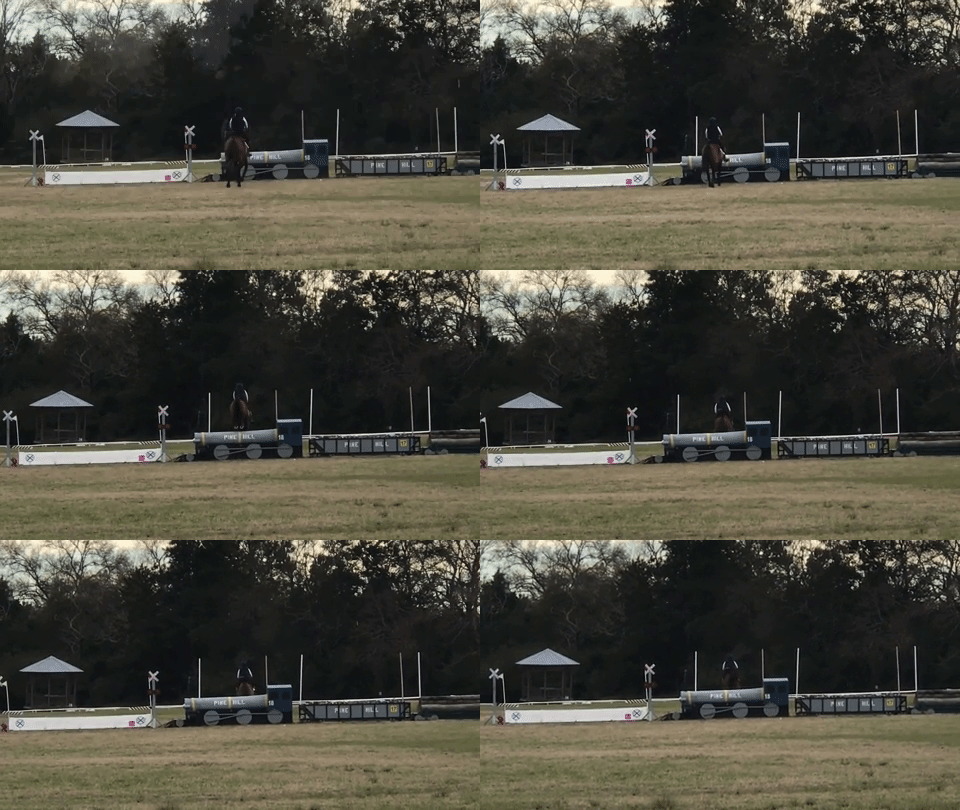
Yesterday afternoon we loaded the kids up for a quick little jaunt down to Pine Hill to cross country school. After what has shaped up to be one of my busiest and most stressful weeks at work ever, I really needed a little reprieve. It’s also supposed to start raining again today so we figured this might be our last chance at a decent school for a while.

Two butts.

We haven’t jumped any XC fences since the last show here at the beginning of December. And we’ve jumped at all a grand total of twice. So… figured it was probably a good idea to get out and gallop a few things before the next show coming up on the 20th. We weren’t planning on doing much, just getting the ride dialed back in. I tend to always take the first few fences to slip back into the bolder XC ride, and the longer I go in between, the longer it generally takes me to remember. This seems especially true as we’ve gone up the levels. Bigger fences and more speed are harder to just snap right back into, when you aren’t practicing those things on a regular basis.

Mum, the XC is that way

I also wanted to take the opportunity to try out a couple of new acquisitions to my equipment line up – a Champion skull cap and a Dainese XC vest. I need to do actual reviews of these soon but preliminarily I’m happy with both things. The helmet is AWESOME, like it’s definitely up there with being one of the nicest helmets I own, if not the nicest. Which is saying a lot, because… um… I own a lot of helmets. The vest is just downright fascinating. I like it, but it’s definitely different from anything I’ve had before. I have many thoughts about it. We’ll save them for another day.

new vest new helmet who dis

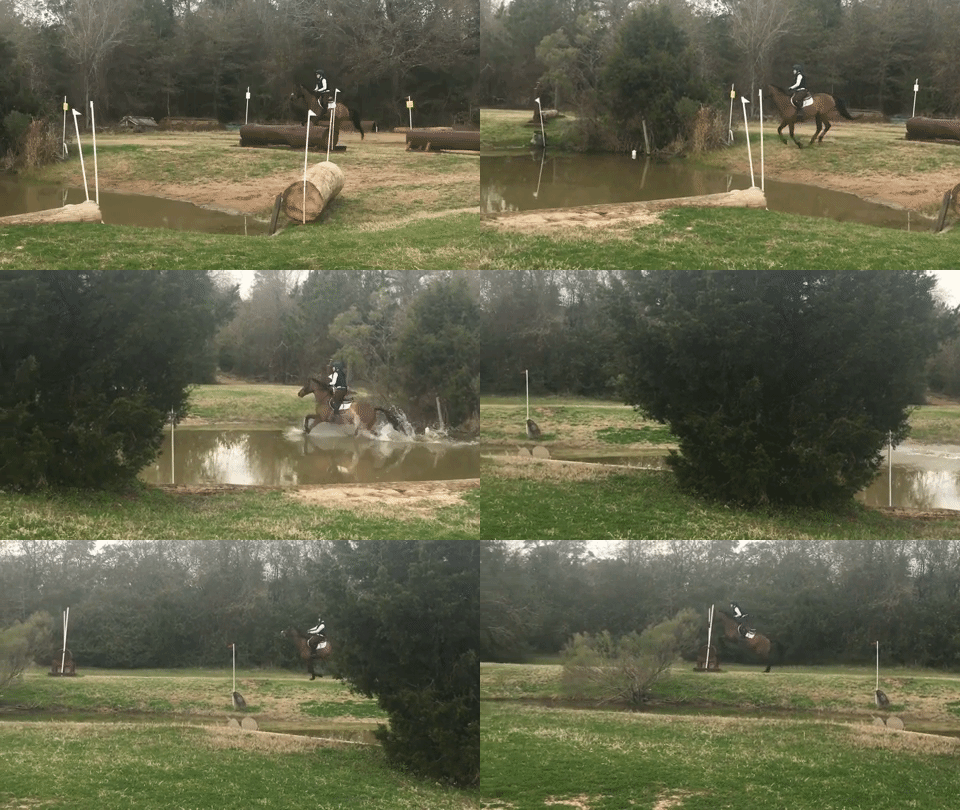
We mounted up and set off to warmup, and Henry felt great. The first few fences were the same as my first few fences always are, with me trying to remember the bolder ride and finding more impulsion again. From there we went to the water, which was a bit deep to jump directly down into, so we made a creative route through, taking the novice log in, skimming the edge, and jumping the Prelim skinny out.

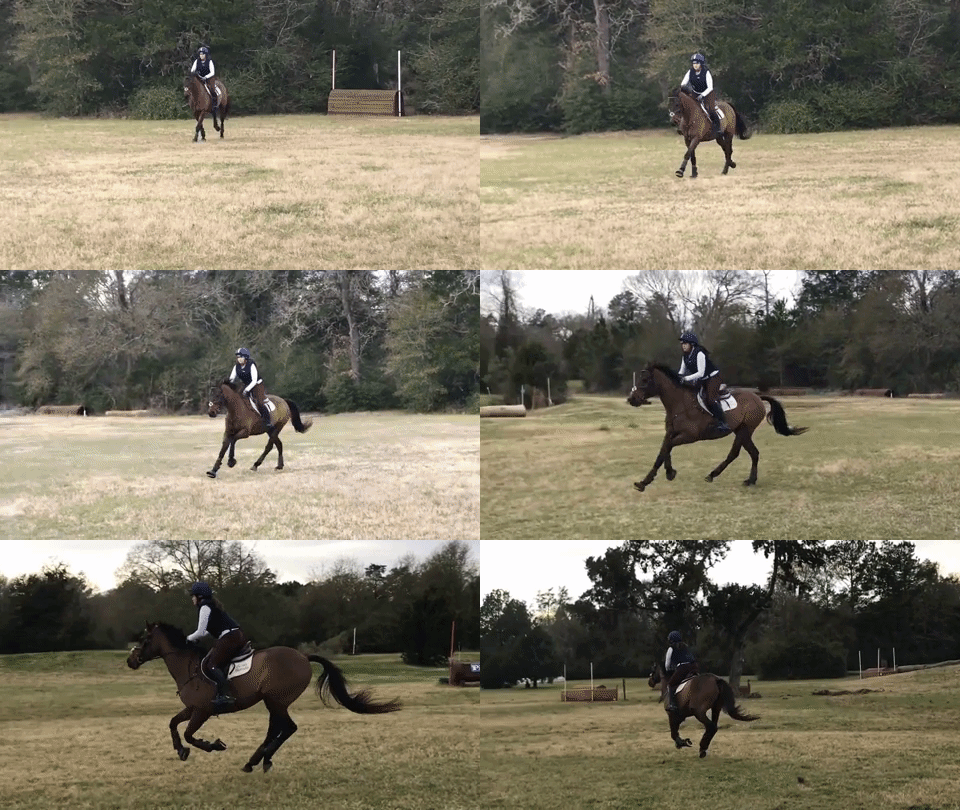
After that we strung a few galloping fences together. I’m trying to up the ante on the speed between the jumps a bit, since things are definitely different in that regard between Training and Prelim, but I’m still kind of learning just when I need to sit up and rebalance, how MUCH I need to rebalance, etc. More speed always changes things. This is my big learning curve at the moment, really. Timing of the half-halt to change the balance, and also still allowing him to carry more impulsion and cover more ground. Everything at Prelim is designed to be ridden like you’re attacking it, but you still have to attack it with a lot of balance and respect – if that makes any sense? I need to set something up so I can practice this at home more and get used to the different feel.

Moar zoomies between the jompies
and then you put the jompies in between the zoomies

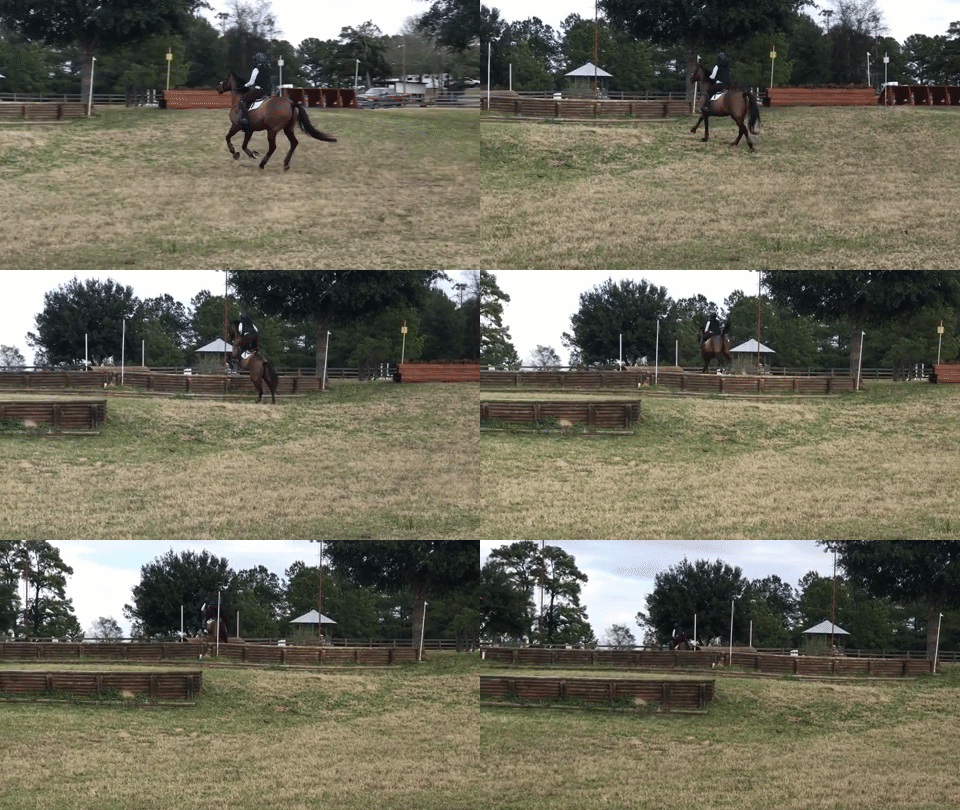
The ground back in the woods was still quite wet, so we just stuck to what we could do in the front field. Luckily there’s still plenty up there to keep you busy, including some of the bank complexes. Prelim has a bigger Irish bank back in the woods (the one that Henry used to have a serious mental come-apart about, but skipped right over last month like it weren’t-no-thang and made my heart so happy) and a smaller downhill bank combination up front. At first I was struggling to get Henry up in front of my leg, which… newsflash, shit don’t work that well when a horse is behind your leg on XC. He’ll keep going and keep jumping, but it ain’t cute. It was very odd for him. He wasn’t responding the way he normally does when I close my leg. I ended up having to give him a couple taps on the butt to get his impulsion back, and then everything jumped much better.

hopping back up the other way

When I got off I thought he looked like maybe he wasn’t feeling the best, and when he didn’t seem interested in eating a treat, my suspicions were confirmed. I dosed him with some omeprazole and coaxed him into eating some grass, and he started to perk back up. I think his tummy was bothering him towards the end of the schooling, which would explain the lack of his typical impulsion. So – back on ulcer meds he goes for a while. Bye money.

I’m glad we were able to beat the rain and get back out there and school a bit. I have a few things work on over the next week before we head back out for our next Prelim run!