If The Bonnet Fits custom fly bonnets – Review

When I found myself in need of a new bonnet but my regular bonnet maker was on hiatus, I wasn’t really sure where to turn. I’m too cheap (ie poor) for DLC or Talisman but at the same time I’m really picky about materials, fit, and execution. Most of them just miss the mark for me in some way or another. I had a bonnet from If The Bonnet Fits last year and liked the execution and fit, but it wasn’t made from mercerized cotton, which I really prefer. So when I saw on facebook that she was starting to offer mercerized cotton, I jumped at the chance to be one of the first to try it.

ITBFHenry6

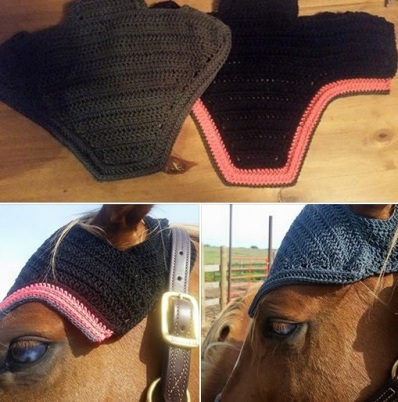
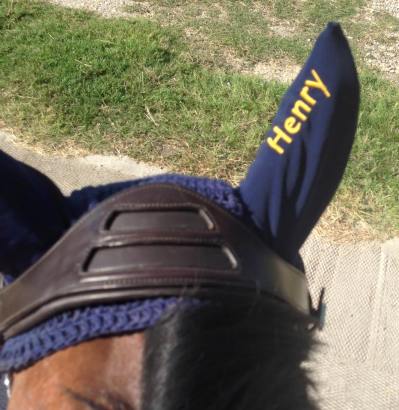
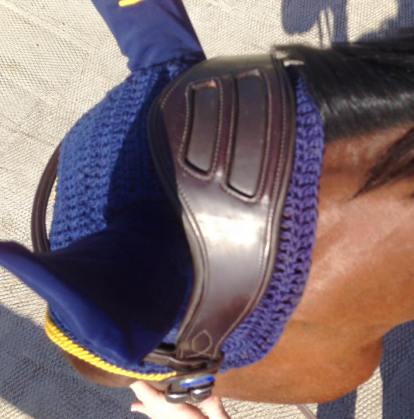
She was also offering a new shape – a more contoured side edge to reduce the amount of extra fabric under the sides of the bridle and around the eye. I decided to try that option too, and because I’m always super difficult (sorry world), I also asked for ear embroidery. Although she isn’t quite set up to do embroidery yet on her own (I hear it’s coming soon!) she moved heaven and earth to get it done for me and make sure it was done well. Excellent customer service.

ITBFtaper
The tapered style (top left, bottom right) compared to the classic style

The price was extremely economical – mercerized cotton bonnets start at only $45, which includes 2 rows of trim (cord, crystals, or pearls). Acrylic bonnets start at $35. Additional embellishments are $5 per row, lined ears for sound sensitive horses are $10, hand made tassels are $10, and custom bead strands start at $10. She can also sew patches on to the front. Her prices are much cheaper than most bonnet makers out there, with almost all the same options. The real question was – how would it look?

ITBFHenry3

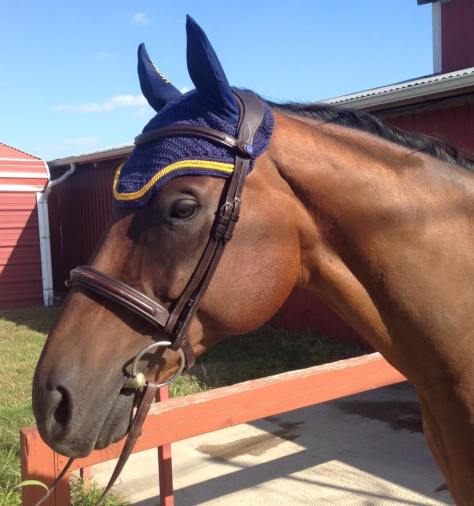
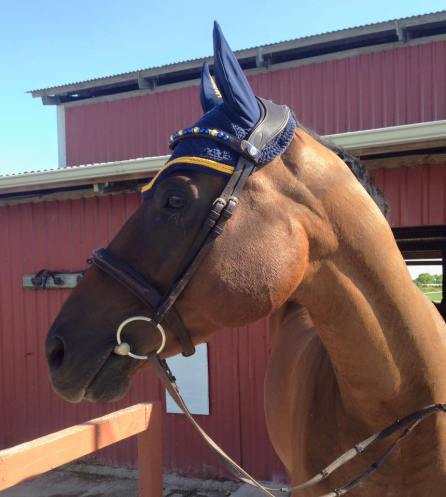
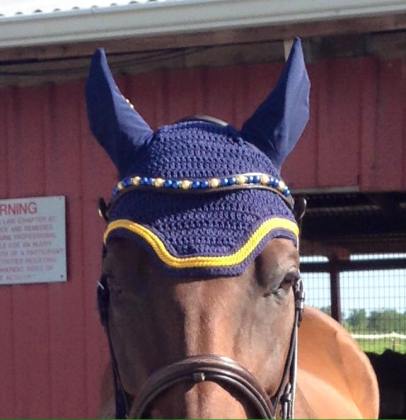
Answer: lovely. Really lovely. The fit is perfect – it comes to just the right spot above his eye, the squared edge is just the right width, the ears fit perfectly, and there’s enough fabric behind the poll to accommodate my wide PS of Sweden crownpiece. I really like the tapered edge, especially since my bridles don’t have throatlatches – the regular more square sides end up with a lot of extra fabric hanging out.

ITBFHenry7

ITBFHenry4

ITBFHenry5

I searched the bonnet from top to bottom and back again, looking for something that I could grumble about and honestly I found nothing. The stitch ITBF uses is tighter than a lot of my other bonnets, which I have come to prefer. It doesn’t stretch out or snag on things so easily, and it lays much flatter to the horse’s head when in motion. No flipped up bonnet edge whipping around the ears, since it’s got a little more structure and weight to it.

ITBFHenry1 ITBFHenry2

Obviously I didn’t opt for crystals or beads or anything like that, just two rows of good old fashioned cord. Everything is securely attached and survived it’s first wash in pristine condition. Overall I would definitely recommend If The Bonnet Fits… the price you pay for the quality you get just can’t be beat.    


Playing by the rules

As someone who started in h/j, then switched to eventing, then switched back to h/j, and now back to eventing – I can attest to how different some of the rules are. Lifelong eventers are often astounded by how much is allowed in h/j, while at the same time h/j-ers are often horrified by some of the seemingly strict rules of eventing. I see some of this come into play amongst bloggers as well, with such a diverse group, that sometimes don’t understand the rules of the other sport. Since I just finished re-reading the Eventing section of the rulebook for the second time (it’s titillating reading material) I thought I would pull out the ones that showed the biggest difference between the two disciplines. For good or for bad, like them are not, it’s fun to compare and contrast and get a better idea of each sport.

Send us your money eons in advance and hope disaster doesn’t strike
rulesopenclose

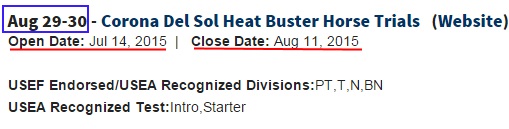
OPENING DATE. The opening date for entries for Horse Trials will be the Tuesday prior to the date that falls six weeks before the first day of the competition.

CLOSING DATE. The closing date for entries will be four weeks after the opening date.

When you go to enter an event, this is the first thing you notice. They officially start accepting entries over 6 weeks prior to the event date, and officially close for entries 4 weeks later. That means you have to enter well in advance of the event itself. Some shows accept late entries with a fee, but not all, and in fact if the event has limited entries and you don’t enter right around opening date, you run the risk of not making it in. That’s a very stark contrast to h/j, where entries are generally due a few days before but are accepted at any time with a late fee. And in that world you can even enter/scratch from classes on the day they’re happening. Much less stressful. Then again, this is how eventing is able to have start times instead of a lot of hurry up and wait, and start times are amazing.


Put your number on – we’re watching you
DSC_8424

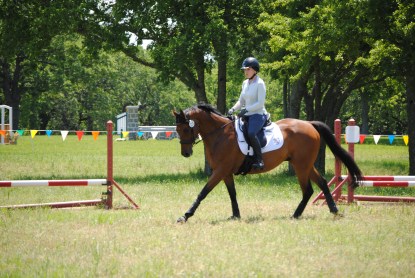
1. IDENTIFICATION NUMBERS – By 3:00 p.m. of the day prior to the start of the entire competition, or upon arrival if later, each horse, including non-competing horses, shall be issued a number. This number must be worn at all times when the horse is being ridden or exercised.

Basically, in eventing, if someone is sitting on the horse or the horse is being lunged, it must have it’s number on. This is because, as you’ll see below, there are fairly specific rules about who can ride or work the horse and HOW that horse can be ridden or worked, so it’s important that the officials be able to easily identify each horse by it’s number at any time. In h/j you just have to remember to put your number on by the time you go in the ring, and you certainly don’t need it for lunging, hacking, or schooling.


You can’t ride that horse
DSC_8445

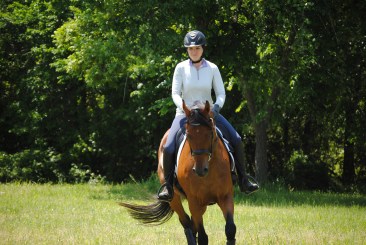
RESTRICTIONS ON SCHOOLING HORSES. It is forbidden, under penalty of disqualification, for anyone other than the competitor who will ride the horse in the competition to school the horse during the competition

In h/j, anyone can ride any horse at any time on the showgrounds. Your Grandma Maxine could hop up there and warm your horse up for you before your class if you wanted her to. Not so in eventing. Only the person who is showing the horse is allowed to ride it at the competition. The only exception is a groom being allowed to walk or trot the horse just to get it from one place to another. That means no trainer rides or trainer warm-ups (unless the trainer is the one showing the horse), which is fairly standard practice in h/j.


Let’s help everyone not kill each other in the warm-up 

The only practice fences that competitors may jump are those flagged fences provided by the Organizer. No part of the fences may ever be held by anyone while a horse is jumping. These fences may not be raised more than 10 cm (4 inches) above the maximum height permitted for the competition in progress (or about to begin), nor may the spread exceed the maximum permitted. Ground lines may be placed directly under, or up to 1.00 meter (3’3”) in front of, the obstacle. These practice fences must be jumped in the correct direction.

In eventing warm-up rings, the warm-up jumps are flagged. You are only permitted to jump those fences, and in the correct direction, with the red flag to your right. In addition to that, you’re only allowed to jump a certain height fence in the warm-up – no more than 4″ higher than the maximum height of the level you’re competing in. The jumps are set to the appropriate height by the show staff in between divisions, and it’s rare that anyone actually changes the height of one. Usually there will be at least an oxer, a vertical, and a crossrail. Sometimes more fences, sometimes not. This is obviously a stark contrast to the h/j warm-up where you can jump the fences whichever way you want and change the height however much you want.


You might die, so secure your medical history to your body

MEDICAL CARDS/MEDICAL BRACELETS. An approved and completed medical card or medical bracelet is required any time while jumping. Medical cards must be enclosed in a transparent, waterproof carrier. Medical cards must be securely attached to the competitor’s upper arm on the outside of the competitor’s clothing. Medical bracelets must be visible on the competitor’s wrist. Medical cards must include any relevant medical history, injury (particularly to the head), drug allergies and current medication.

In eventing you must have a medical armband or medical bracelet for the jumping phases. I wear my medical bracelet 24/7 so I never have to worry about forgetting it, or get into a situation where I need it but don’t have it. You definitely don’t see h/j-ers showing with their medical history affixed to their arm. (I think I just heard a couple dozen h/j-ers say “because our sport isn’t INSANE!” Touche, my friends… touche.)


Gadgetry – NOPE


EXERCISE AREAS. Side reins are permitted only while lunging an unmounted horse, as are running reins and chambons. Other martingales, any form of gadget (such as a bearing, running or balancing reins, etc.) and any form of blinkers, are forbidden, under penalty of disqualification.

Yep, it’s true, you can’t ride your horse in draw reins (or a neck stretcher or a german martingale etc etc) at an event. I’ve seen more than one newbie get in trouble for this one, but it’s very commonplace in the warm-up rings and victory gallops/awards in h/j.


No stuffing things in their ears
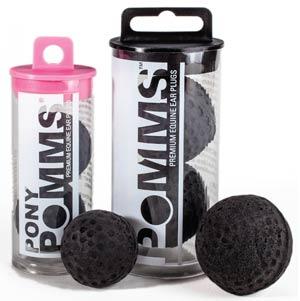
DRESSAGE e. Martingales, bit guards, any kind of gadgets (such as bearing, side, running or balancing reins, etc.), reins with any loops or hand attachments, any kind of boots or leg bandages and any form of blinkers, including earmuffs, earplugs, hoods, nose covers and seat covers are, under penalty of elimination, strictly forbidden. Protective fly hoods made of thin material are permitted. However, these are subject to inspection by the Officials at the end of the test to ensure that nothing prohibited has been added (i.e. special material) or is covered by the fly hoods to protect from sound.

Earplugs or sound-proofed bonnets are not allowed in dressage. Anyone want to fathom a guess at what percentage of hunters go in earplugs?


You can’t ride in there

Disqualification – Ground Jury may disqualify a competitor in the following cases when, in its opinion, the action constitutes unsportsmanlike or abusive conduct: b. Riding in the Dressage arena or in the Jumping arena prior to the actual competition, EV108.2c. c. Riding close to Cross-Country obstacles prior to the actual competition

This is similar to jumper rules, but eventing takes it one step farther. You aren’t allowed to ride in the dressage ring or the jumping ring at all before the competition (exception: some big events have “ring familarization” where you’re allowed to walk around or lead the horse around the ring a little beforehand) whether the course has been set up yet or not. Sometimes warm-up areas will be very near or on the XC course, in which case you’re not allowed to ride close to any of the fences. And yes, the stewards are watching. Of course, for hunters, they are allowed to school in their ring and over their fences before showing.


Calling dressage tests and learning how to shut up

Dressage Rules 2. All tests must be carried out from memory, and all movements must follow in the order laid down in the test. 7. The use of the voice in any way whatsoever or clicking the tongue once or repeatedly is a serious fault involving the deduction of at least two marks from those that would otherwise have been awarded for the movement where this occurred. 

Eventing is different from straight dressage in that no one is allowed to call your test for you. In theory there should be less tests to remember, and therefore no real need for a caller. But as is also true with straight dressage, the use of voice aids is not allowed. Yup h/j-ers, no clucking or audible whoaing allowed in dressage.


“Unauthorized Assistance” aka you’re all alone in the world and no one can help you

UNAUTHORIZED ASSISTANCE. a. Any intervention by a third party, whether solicited or not, with the object of facilitating the task of the competitor or of helping his horse, is considered unauthorized assistance and the competitor is liable to be eliminated. b. In particular, the following are forbidden: 1. Intentionally to join another competitor and to continue the course in company with him; 2. To be followed, preceded or accompanied, on any part of the course by any vehicle, bicycle, pedestrian, or horseman not in the competition; 3. To post friends at certain points to call directions or make signals in passing; 4. To have someone at an obstacle to encourage the horse by any means whatsoever

Hey h/j-ers, do you like having your trainer at the ingate to murmer wisdom to you as you pass by or help you remember what to jump next? At an event, once you enter the ring in dressage or stadium, or leave the start box on XC, you are completely and utterly on your own. No one is allowed to help you in any way – not to point out your next fence, not to cluck at your horse, not to yell even a simple instruction like whoa or sit up. Doing so can get you eliminated. Eventers – make sure your friends and family know this. Slap some duct tape on their mouths if you need to. No one wants to get eliminated because someone else was just trying to help… we’ve all heard the chorus of “SHHH!!” when a well-intended but uninformed spectator starts clucking.


Please god don’t jump from a standstill

CROSS COUNTRY Refusals. 1. At obstacles or elements with height (exceeding 30 cm), a horse is considered to have refused if it stops in front of the obstacle to be jumped. 2. At all other obstacles (i.e., 30 cm or less in height) a stop followed immediately by a standing jump is not penalized, but if the halt is sustained or in any way prolonged, this constitutes a refusal. The horse may step sideways but if it steps back, even with one foot, this is a refusal.

This is one that even some eventers seem confused by, so I threw it in here. On XC when a jump is over 1′ in height, it is considered a refusal once the horse has come to a complete stop, even if he then proceeds to jump from a standstill. The only time a horse is allowed to “jump” from a standstill without penalty would be in the case of a ditch, down bank, water crossing, etc. Some people think that it’s not a refusal until the horse takes a step backward but that’s not the first determining factor – the fence height is. Jumping solid fences from a standstill is unsafe and therefore not allowed without penalty. However, it is allowed to jump a fence in stadium from a standstill without incurring a refusal (same as in the jumpers).


Pace yo’self

6. WILLFUL DELAY. A competitor is considered to have willfully delayed his finish if, between the last fence and the finish line, the horse halts, walks, circles, or serpentines. The competitor will be penalized at the discretion of the Ground Jury.

There is a certain time window allowed on cross country that you must finish in to avoid incurring penalties. Sometimes people end up going too fast, look down at their watch at the end, and then try to eat up some time between the last fence and the finish flags by walking or circling. That’s not allowed and can earn you 20 penalties for willful delay. The only thing really close to this situation is Optimum Time classes in the jumpers, and I have actually seen someone circle before crossing the finish to give themselves a few extra seconds. OT classes still seem pretty rare though, and therefore knowing how to feel your correct speed and keep track of your time isn’t such a priority in that world.


What do y’all think about these rules and the differences between what’s allowed in h/j vs eventing? Are any of them surprising to you? For better or for worse. There are some things I really like, some things I don’t, and some things I accept begrudgingly. H/Jers and dressage folks, what do you think some of the main differences are in the rules between your discipline and eventing?
Doin’ thangs and makin’ plans

I sent off an entry for a dressage show yesterday. Yes, a dressage show. Pretty much the only type of show I’ve never participated in. In a way it’s a little exciting because it’s just two dressage tests and then you’re DONE. Much less crap to take with you, absolutely nothing to stress about, no courses to walk a thousand times. On the other hand you don’t get to do anything fun after dressage, which seems like the whole point of it in the first place, so it’s kinda like:

But since it’s a little schooling show, if you want to do classes outside of the specific ones they offer – which are USDF Intro through Second – you can write in whatever test you want. You have to do them HC, but whatever, I don’t care about ribbons anyway. Novice Eventing Test B and Training Eventing Test A (because I like to confuse the hell out of myself figuring out how to make a semi-symmetrical 15m circle), here we come! I reject your tests, USDF. Who wants to halt twice in one test? Not me. Definitely not Henry.

POOF! Brain explosion.

Aside from that, I also sat down and wrote out my list of shows for the fall. It’s kind of a mirror image of our spring season, except at a different level.

  • Aug 29-30 USEA Corona HT: Novice

I’m a little bummed that it sounds like they’re dumbing their courses way down from the event we did in May. But the May one was also listed as “good for first timers” and that was a huge BN course, so we’ll see what this N course looks like. Hopefully it’s not too basic.

coronaBN
The biggest BN fence ever, from May’s Corona HT
  • Sep 24-27 American Eventing Championships/Adult Team Championships at Texas Rose: Beginner Novice

I’d be lying if I didn’t admit that I’m 2% sad that we qualified at BN for this, but there’s no way we would have had time to qualify at N without a lot of serious last minute hustle. Plus I’m pretty stoked about the ATC with all my friends at BN, so that makes it all worthwhile. It’s gonna be a hell of a fun week. Unicorn paraphernalia is taking over my guest room already.

  • Oct 10-11 USEA Greenwood HT: Novice

Reeeeally excited about this course, it’s legit and I love Greenwood. There’s a little corner, and a bending line down bank to log, trakehner, jump out of a big crater, giant steeplechase brush fence, ditch, etc. All the cool stuff.

dressage3
❤ Greenwood
  • Oct 31 USEA Pine Hill HT: Novice

Pine Hill is always awesome, and hopefully the weather in October will be a bit better than it was in April (so muddy).


There’s an h/j show I’d like to go to in November but we’ll how to see how my schedule and bank account are looking by then. Of course now that I’ve written out a plan, let’s see how much Fate decides to laugh in my face.

KEP Italia: buyer beware?

There’s a thread on British forum Horse & Hound that has been making it’s way around the internet this week about an incident with a KEP helmet and subsequent customer service. If you haven’t seen it, go read it here. Be forewarned, it’s a really long thread. If you aren’t really interested in devoting that much time to being properly horrified, here’s a summary:

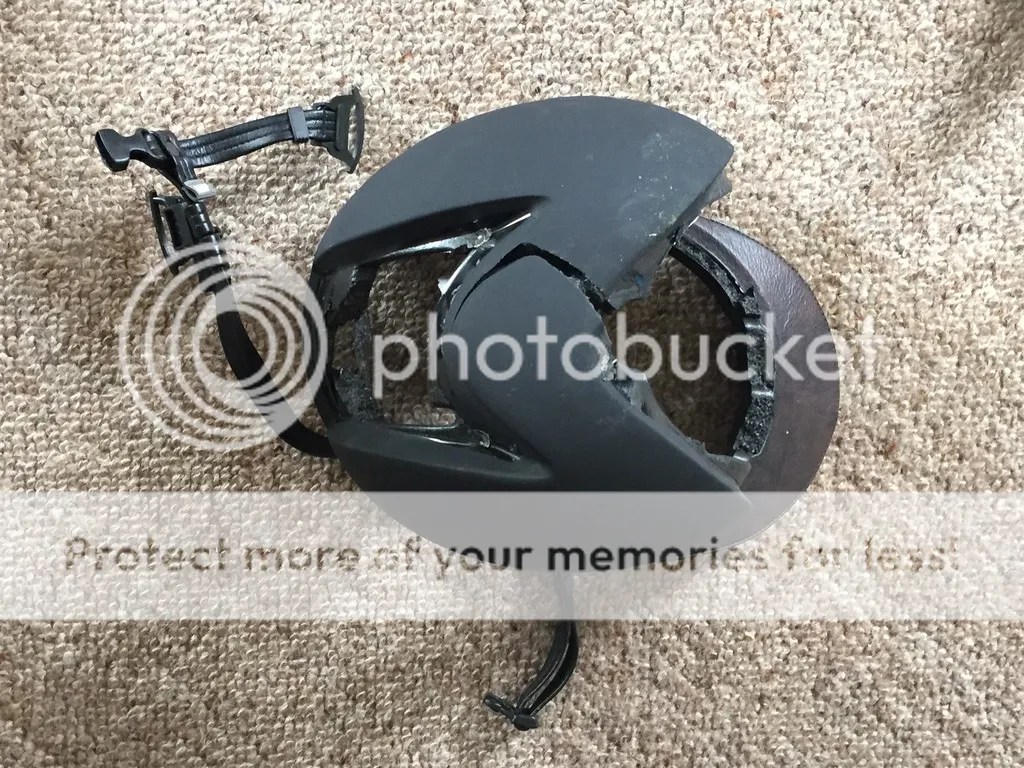
Girl falls off horse when he stumbles while trotting in the grass. She lands on her face/chest, impact somewhere near her temple area. It was not a hard fall. She was able to immediately get up, key in her phone’s PIN code, and call someone to catch her horse (so obviously not too terribly concussed or confused). The helmet looked like this

Her own words: “As you can see the panelled design of the hat cause the hat to fall apart on impact. In fact the hat was no longer on my head after the fall but was hanging in pieces around my neck, held together by the harness!”

Luckily aside from some abrasions and bruising she was uninjured in the fall.

Let’s take a moment to say Holy Crap. A helmet should not crumple apart like a chocolate orange upon impact, especially a fairly light impact. I cannot imagine the damage that could have been done if she’d been stepped on or kicked after the helmet fell apart. Granted, that’s my personal opinion.

So let’s give KEP the benefit of the doubt for a minute and say “Well let’s see what KEP has to say. Maybe this is a weird one-off situation.”

Here’s where KEP really shot themselves in the foot. Brace yourselves.

“I spoke with KEP Italia this morning and informed them of my accident and that their hat had fallen apart on impact. They told me that they do not deal with customers directly and will only deal with the distributor. They told me to follow procedure and to take the hat back to the shop I bought it from, they will return it to the distributor, who will then return it to KEP. KEP will then carry out an investigation and will either offer me a new replacement hat or they will repair the old one

Ok, what???

Repair the old one? WHAT? Never, under any circumstance, should a helmet be repaired after a fall. But maybe she just heard them wrong. Surely they didn’t say that, right? Luckily KEP themselves came onto the thread to speak up for themselves, thus taking away any possible misinterpretation. KEP’s response said

“When she called the person who answered the phone had not been informed about this issue and didn’t know who she was. She thus received the standard answer, including the request to provide photos via the retailer when she had bought the helmet. We usually ask our customers to at least see the photos, so that we can see what the issue is. Of course in Mrs. Smith’s case, the helmet cannot be repaired. ” and “he set some examples and talked about replacing, repairing and refunding, like we always do.”

So in fact, according to KEP, it is their “standard answer” to offer to replace, refund, or repair a helmet. Wow. Even if it’s something as minor as replacing the harness, this seems like a huge liability to me. I can’t imagine the possibility for lawsuits if someone sustained a serious injury in a “repaired” helmet.

Never fear though, it actually gets worse! KEP goes on to say that perhaps this person isn’t being truthful about the nature of her fall

“I’m really sorry to see Mrs. Smith’s reaction against our helmets after her fall. I would like to explain to her that a such a breaking of a helmet during a fall can only be caused by strong impacts received at the moment of the crash, or by the kicking or rolling of a horse on the helmet.”

And

assuming Mrs. Smith is not liar, we suggest one of a few things:
. that Mrs. Smith fell on a harder ground than she thinks, or that she fell in a more powerful way than she recalls;

that Mrs. Smith’s hat was not properly fastened (this is a very common situation unfortunately) and that she lost the helmet after she fell. In this case the horse might have stepped on the helmet in its effort to stand up after falling, or that it stood on the helmet in any other way;
Another, and worse, thought came into our mind: that someone might intentionally be mounting up this case with the precise purpose of damaging KEP Italia’s image. KEP Italia is a growing company and we know for sure that some of our competitors are reacting in a bad way to this, some of them even scaring off kids at shows by telling them stupid and false stories. “

So they went from calling her a liar to saying that perhaps she was making all of this up on purpose just to sully KEP’s image. Unprofessional doesn’t even begin to cover an accusation like this. Neither does astounding. There are really no words.

KEP also posted this text from their helmet’s instructions, which indicate that this helmet is in fact DESIGNED to destruct upon impact.

“Although this helmet reduces the chance of injury, in some circumstances injuries cannot be prevented. This helmet was not designed to protect your head if crushed by a horse. The degree of protection provided by this helmet depends on the circumstances of a particular accident. Using a protective helmet does not always prevent death or long-term disability. This helmet is designed to absorb the energy of a blow through partial destruction of the shell or protective padding material or both. This damage may not be visible and therefore any helmet, which suffers an impact, should be discarded and replaced by a new one as it may have exhausted its ability to absorb further shocks.”

I don’t know about you but that seems really concerning in a sport where there are often secondary blows beyond the initial impact. I’ve fallen a lot, I’ve seen helmets take a lot of impacts, and I’ve never once seen one completely split apart like that. If the helmet falls apart when you hit the ground, what happens when you then get stepped on, or fallen on, or if you end up bouncing or being dragged?

But yet again, let’s pretend we can move beyond that…

Someone else on the thread spoke out about a similar thing happening to their helmet and didn’t have many nice things to say about their opinion of KEP. The KEP representitive sent that person this private message:

“We are aware of your defamatory words against our products and our company in various posts on this Forum.
Please stop saying lies about our company. We ask you to take your responsibility for what you say and reserve the right to take any legal action against you if you do not cease to defame our company in the continuation of these posts.”

So basically… if you don’t like our helmets, you better shut up about it or we’ll threaten to sue you. What in the world is going on here, KEP? It was bad enough that the helmet split apart, but the ensuing words and actions from your company have turned this into nothing short of a complete and utter fiasco.

After reading this thread on H&H I took to Tumblr to see what all had been said about these photos there. Again I figured let’s play devils advocate and see if this really was in fact a one-off type situation. Several people on Tumblr came forward and said they’d had the same experience. I was able to contact 3 of these people and confirm that yes, their helmets also split apart upon minor to medium impact. One of them was told by KEP that this is how they are designed to work. The other two were told by KEP that they had never heard of this happening before. I don’t know if y’all are confused, but I sure am.

So, I encourage everyone to go read that thread on H&H and see how this played out with your own eyes and form your own opinions. Especially if you own or are considering purchasing a KEP helmet. The things posted by KEP are very thought-provoking, to say the least. I have no doubt that when KEP finds this blog post they will threaten me with legal action as well, but at this point this is a huge safety issue AND a huge customer service issue, and IMO it just can’t be swept under the rug and made to “disappear” with threats.

Well, I weekend failed

The weekend itself wasn’t a fail, but my attempts at documenting it via media definitely were. We went XC schooling on Saturday so I had my helmet cam charged up (or so I thought), cleaned within an inch of it’s life (I am determined to de-smudge), and made sure my phone was at 100% so I could get someone to video. I was feeling so prepared. That’s never a good sign.

AutoHenrytrailer
The one picture I took. Go me.

Come to find out later that I must not have charged the GoPro correctly after all, because I got about 5 minutes of helmet cam video that consisted of me putting my bridle on and getting on my horse. Womp womp. I also forgot to ask anyone to take video of me. Womp womp again. But nevertheless we got to school some fun stuff, including the Training water and the big double banks down. This was my first time actually getting to do a real school with Amanda – I’ve just done course walks and XC warmups at shows with her before – and I had already told her about our past issues at the down banks. She was awesome with helping me fix my position, and Henry was very happy to plop very calmly down them over and over while I got my shit straight. It was a long overdue lesson for me and hopefully the end of any bank issues for either of us.

PHdoublebanks
obviously not Henry, but those are the big double banks he plopped down

In general it wasn’t really our best schooling ever… him having two weeks off for his heel grab has left me with a pretty fresh horse right now, so he was just a bit full of himself. Mainly expressed in tiny dolphin leaps, flipping me the bird when I tried to half-halt, and being kinda spooky. I’m not shitting you, he leaped way up in the air over a patch of dark grass/sorta mud because MONSTERS. I also probably could have used more bit than my fat KK loose ring. That’s just not normal Henry. But despite all of that he was still honest and happy to jump everything so I can’t complain much. Next time hopefully I’ll actually be able to have a normal riding schedule beforehand and be sitting on a more typical Henry for an xc school.

Sorry about the epic blogger media fail. I promise to not try so hard next time and to definitely not prepare so much… success will be infinitely more likely.