Last week on my post about the Dover tent sale, someone commented about how they preferred to shop at Dover because of their open-ended return policy. The main example the commenter used was returning a 10 year old pair of $400 boots that had been outgrown and using that money to “upgrade” to Parlantis. This person noted that they hadn’t minded paying full price for the Parlantis because they knew that when the boots inevitably wore out they could be returned for a full refund and new boots could be obtained in their place, on and on down the line. They also mentioned doing the same thing when breeches get stained–return the old ones, buy a new pair. In their mind, since they are a loyal Dover customer for the majority of their purchases (namely non-returnable items such as fly spray and the like) the company is still profiting from them in the long run.

I’ve heard of people using Dover’s generous return policy this way, but I’ve never really known anyone that came out and said it so candidly. For that, props to the commenter for their honesty. It definitely provided a good talking point amongst friends and brought to light some things I hadn’t considered, which is why I’m bringing it up in it’s own post. But I have to admit, I personally had a hard time with it–moreso than I would have expected, especially considering I really don’t like Dover and have zero interest in their overall success. I know that their return policy technically does allow things like this: “At Dover Saddlery, we stand behind the quality of our products. If you find you are not satisfied with your purchase, simply return it at any time and we will refund, replace or exchange it for you. We guarantee your satisfaction.” so it’s within the scope of their policy.
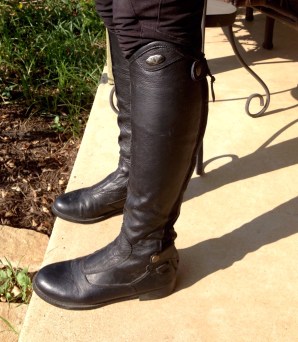
But I guess to me personally, the difference is in the ethics. It’s not really about Dover, it’s about the principle of the thing. I think if I had a pair of boots for 10 years, obviously they were a satisfactory purchase. I would feel like I got my money’s worth, probably sell them for cheap on ETT or give them to a friend, and buy some new boots. To be honest it would never even occur to me to try to return something like that. Same thing if I bought a pair of boots that I knew were well-known for wearing out within a year or two, or stained a pair of my breeches. I’d have a hard time going back to the shop at that point and asking for my money back so I could buy another pair–at least not without feeling like a huge jerk. Then again, maybe I’m being overly sensitive about it.
On the flip side of the coin, there are definitely other things that would fall within a long-term return policy that I do understand. A blanket that gets totally destroyed in the first season. A show shirt that comes un-stitched after just a few washes. A tall boot zipper that breaks within one show season. Those, I totally agree with, and it could easily be many months before any of them come to light. In those situations a longer term, satisfaction guaranteed return policy like Dover’s is really fantastic.

I have a few friends that work at different Dover stores around the country, so I asked them for their input on this issue. All of them agreed that they definitely see people who take the return policy to an extreme, and that these people end up being well-known (not in a good way) in their stores. One of them also pointed at that Dover counter-acts the money lost through the generous return policy by having higher prices, offering fewer sales, and having more expensive shipping rates. After all, the impact on the bottom line of the company has to be balanced somehow. They end up losing money on the people who use the return policy to it’s extreme, and the rest of the customers are the ones that make up that gap in the end.
What are your thoughts on open-ended return policies like this? Do you see it as a good opportunity to stay loyal to one company and keep trading up your equipment as it wears out? Or do you think such actions are abusing what the return policy is really meant for? Do you think that the return policy iteslf is what gets the company so much loyal business in the first place, therefore it’s ok to use it to it’s fullest extent? Where do you draw the line on what is or is not a returnable item?